
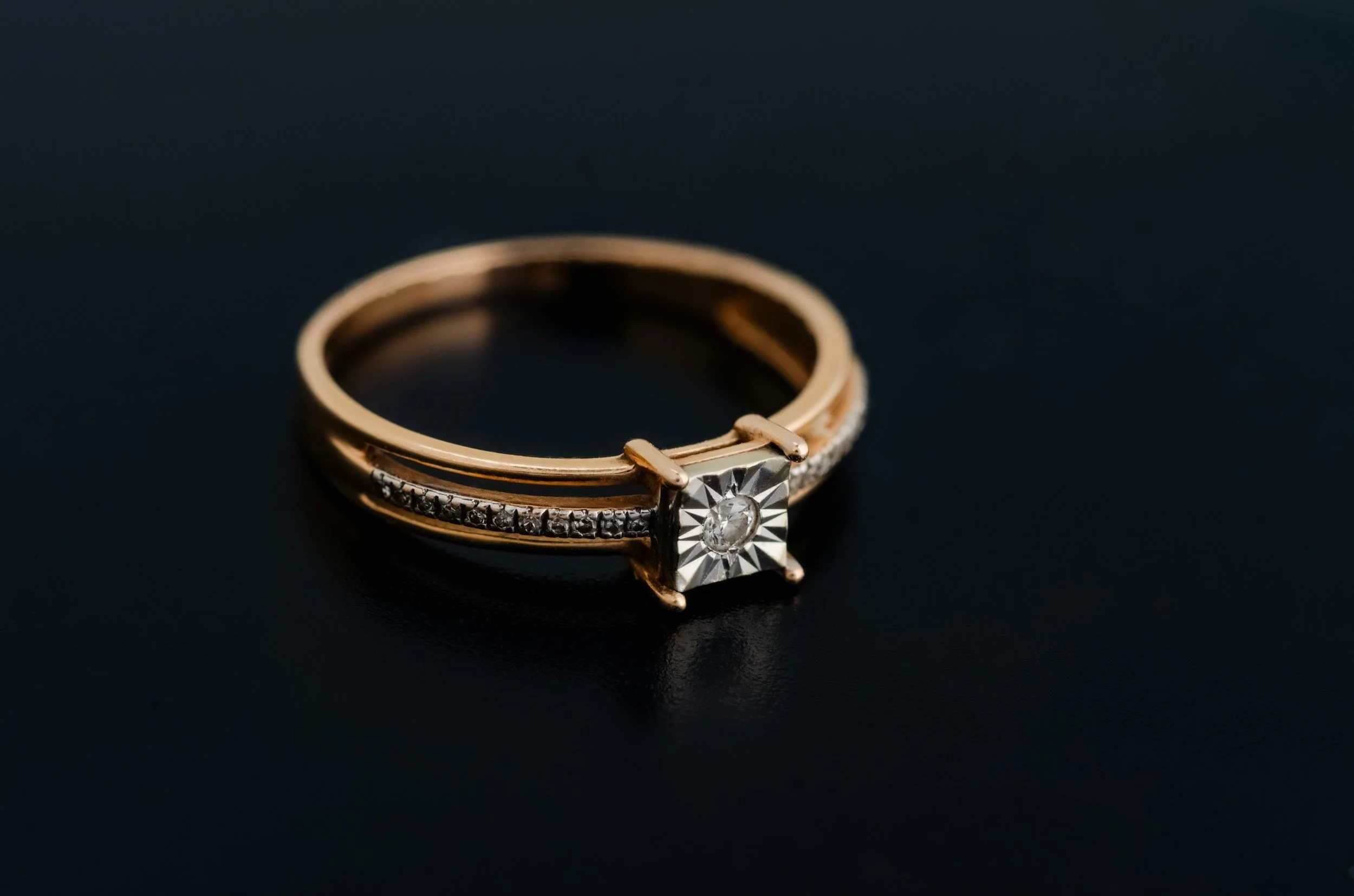
Heirloom Jewelry Restoration NYC: What Restoration Actually Involves
Not every old piece needs to be redesigned. Sometimes what it actually needs is careful, honest restoration — here's the difference, and how to know which one yours needs.
If you're looking for heirloom jewelry restoration in NYC, the first question isn't where to take the piece. It's whether the piece actually needs restoration at all — or whether what you're really looking for is a redesign.
Restoration and redesign get used almost interchangeably online, but they answer two completely different questions. Restoration is about preserving a piece as faithfully as possible — repairing structural damage, addressing wear, and bringing back its original appearance without fundamentally changing the design. Redesign asks something different: what could this piece become next?
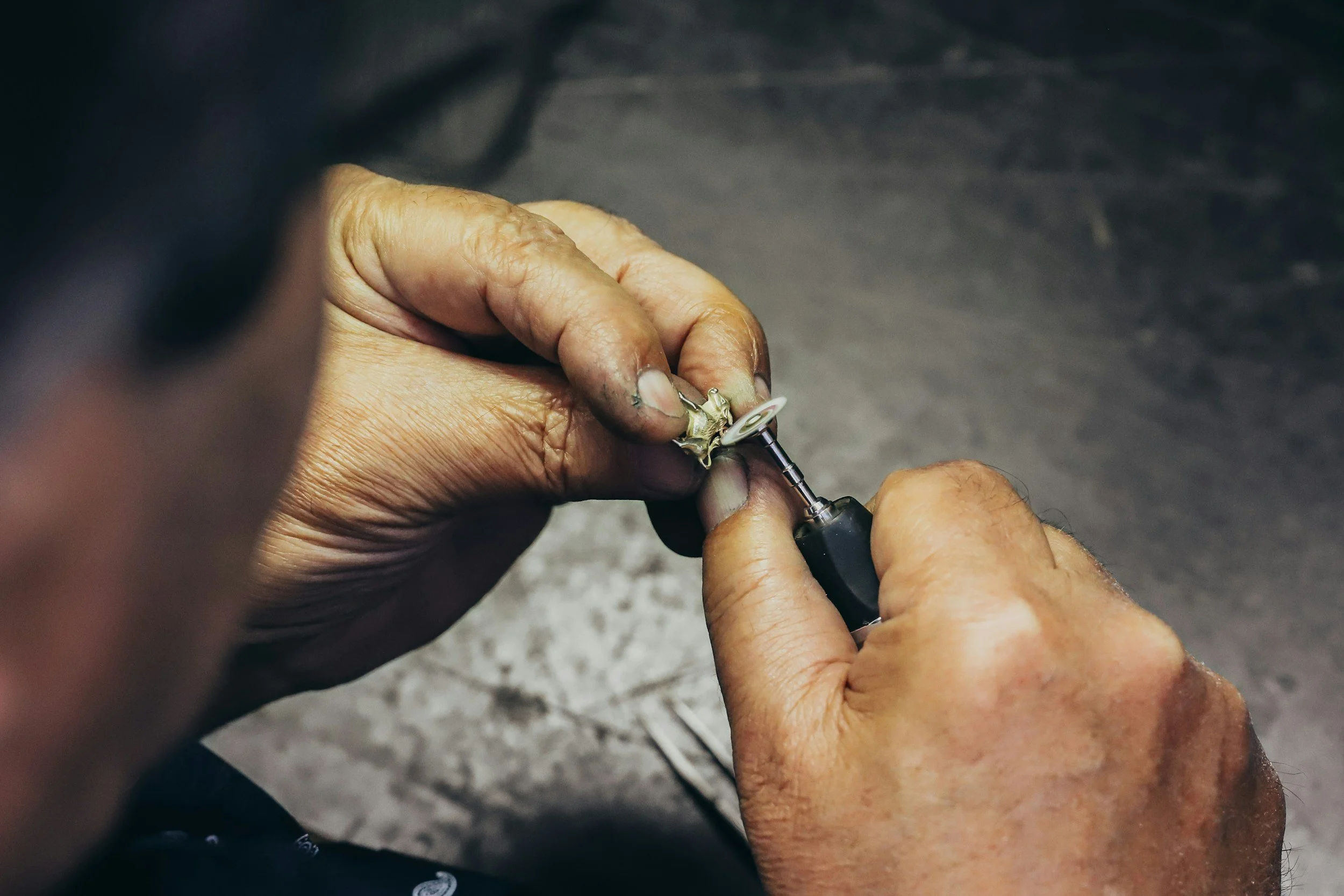
Restoration Preserves. Redesign Transforms.
These are different intents, and they call for different conversations. Restoration is for a piece you already love exactly as it is — one where age, wear, or a past repair has compromised its strength or appearance, and the goal is simply to bring it back, not to reinvent it. Redesign is for a piece whose form no longer fits the life you're living now, where the meaning needs to be carried into something new.
Neither is more valid than the other. But they require different questions at the outset, and a piece that actually needs restoration shouldn't be pushed toward a redesign conversation just because that's the more common inquiry.
What Restoration Actually Involves
At its core, restoring heirloom jewelry means addressing what time and wear have done to the piece while preserving everything that makes it what it is:
Structural repair. Prongs wear thin over decades of daily wear and need to be rebuilt or reinforced before a stone is at real risk of loosening or falling out. Bands that have thinned from years on a finger can be reinforced to restore their original strength.
Re-setting loosened stones. Stones shift and loosen over time, particularly in older, more delicate settings. Restoration means rebuilding or reinforcing the setting so the stone is properly secured while preserving the original construction wherever possible.
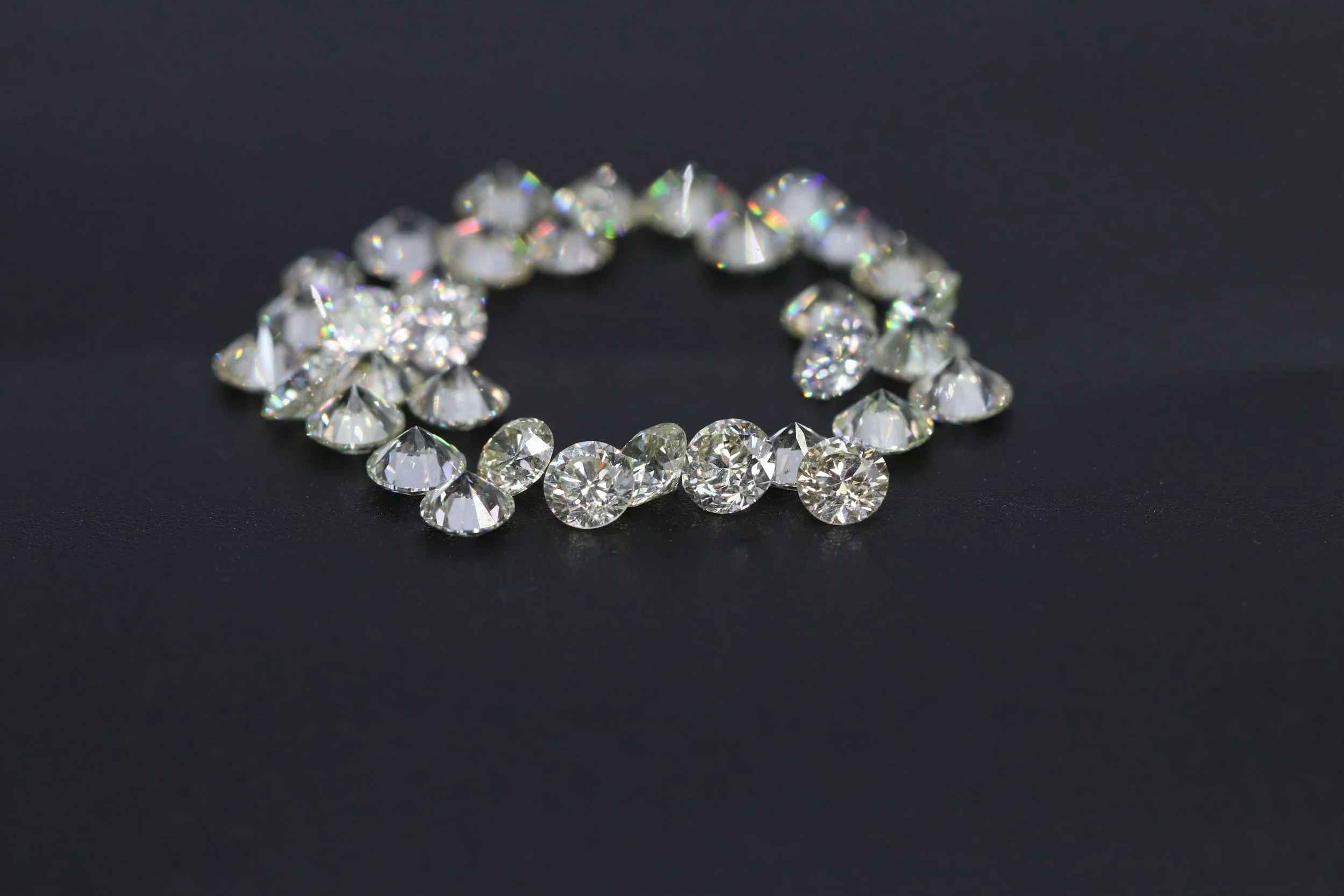
Cleaning and refinishing metal. Decades of wear dulls polish and accumulates grime in detailed engraving or filigree work. Proper refinishing brings the metal's original character back without sanding away the fine detail that gives an antique piece its texture.
Addressing prior repairs. Many heirloom pieces have already been through at least one repair, sometimes done quickly or without much care for the original craftsmanship. Restoration often means correcting that earlier work as much as addressing the original wear.
Evaluating treated or enhanced stones. Older gemstones, particularly emeralds, may have been treated to improve apparent clarity. The type and condition of that treatment can affect how the stone should be handled during restoration, cleaning, and repair. Before heat, chemicals, ultrasonic cleaning, or other procedures are considered, the stone's treatment and durability need to be taken into account.
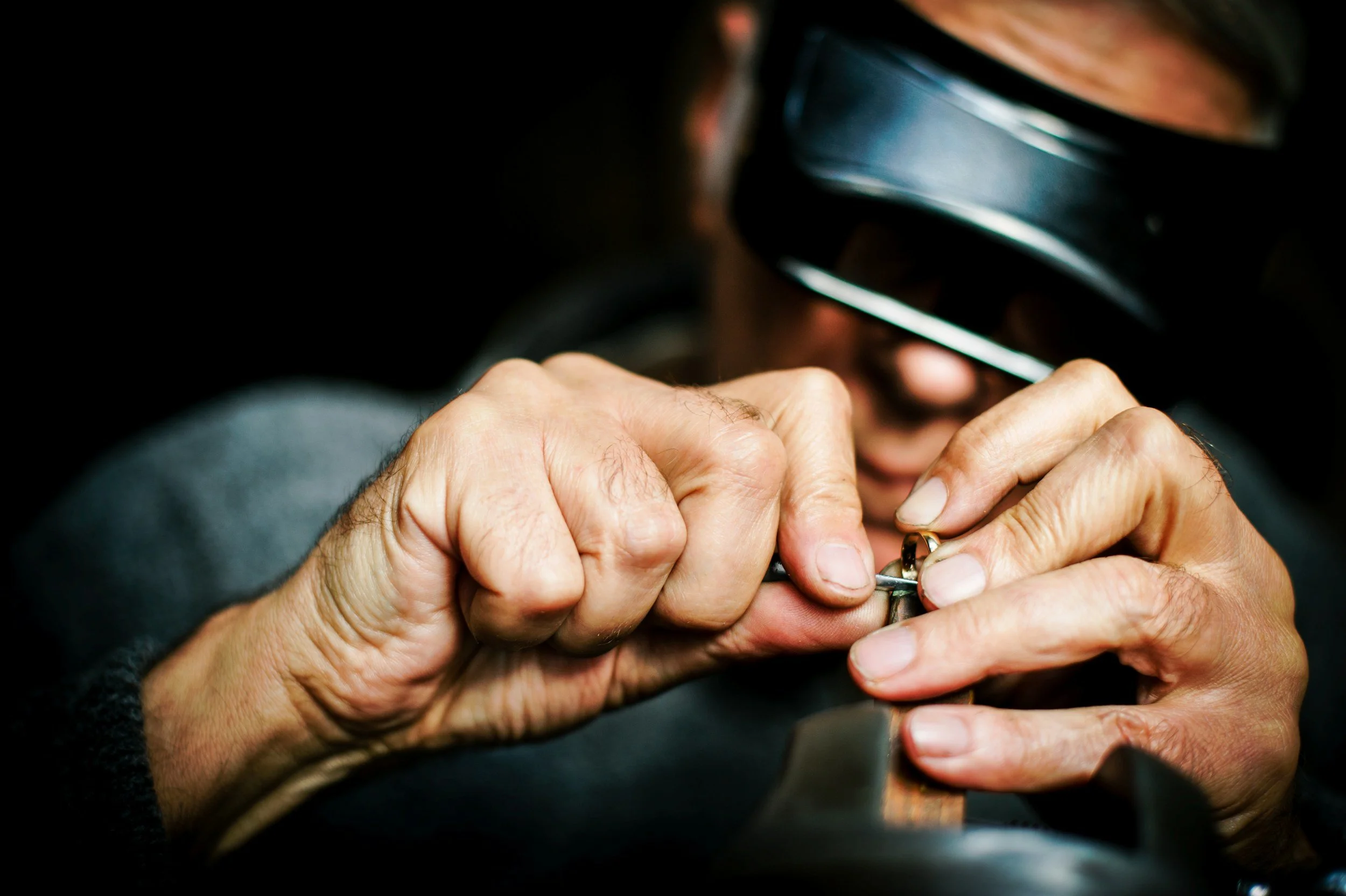
How We Approach an Heirloom Restoration
Restoration begins with evaluation, not a predetermined list of repairs. Before anything is altered, we look at the condition of the metal, the security of the stones, previous repairs, signs of wear, and any details that appear integral to the original construction.
The goal isn't to make an old piece look new. It's to make the piece structurally sound while preserving the characteristics that make it recognizably itself. That distinction matters particularly with older jewelry. A delicate engraving, an unusual setting detail, or evidence of how the piece was originally constructed can be part of its history. Removing those details simply because they show age can leave you with a technically repaired piece that has lost some of what made it worth preserving in the first place.
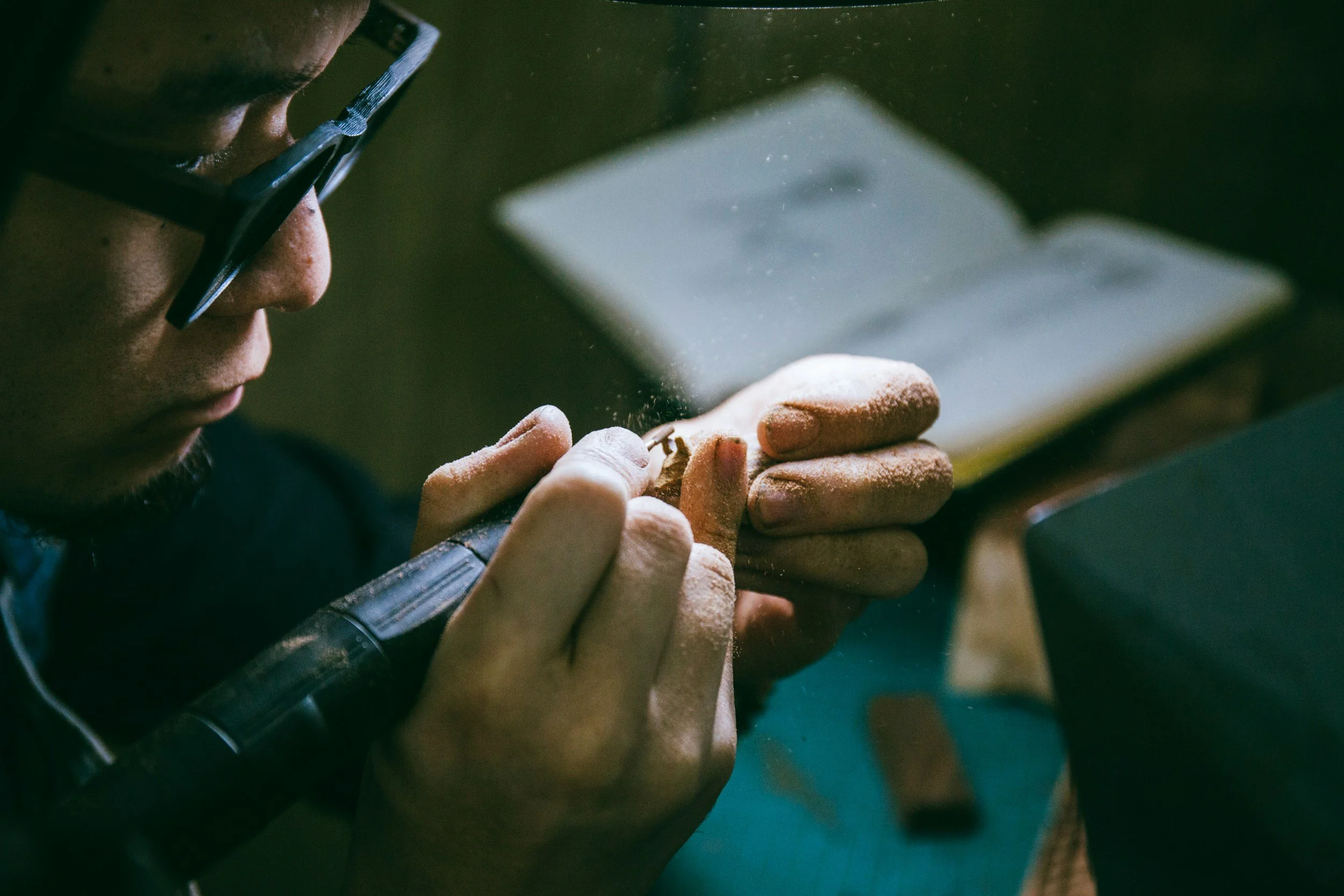
What Happens During a Jewelry Restoration Evaluation?
Examination of the metal and construction
Inspection of prongs, settings, joints, and areas of thinning
Assessment of the gemstones present
Identification of previous repairs
Consideration of any treatments or particularly delicate materials
A conversation about what can realistically be preserved
A determination of whether restoration or redesign is the more appropriate path
The first question isn't always "how do we fix it?" It's "what are we trying to preserve?"
What Restoration Is Not
Restoration is not an opportunity to modernize a piece, resize a center stone, or change the setting to something more current. Replacing an original setting with a contemporary one, changing the proportions of the piece, combining the stone with other inherited materials, or turning a ring into an entirely different form are redesign decisions. They may be exactly the right decision — but they're not restoration. It's worth being honest with yourself about which one you actually want, because they call for different approaches from the outset.
How to Know Which One You Need
Ask yourself a simple question: if this piece could be brought back to full strength and its original appearance, exactly as it was, would that be enough? If yes, you're looking at restoration. If the honest answer is that you'd still want it to look or feel different — a different silhouette, a different way of wearing it, a design that reflects who you are now rather than who wore it originally — that's redesign, and it deserves its own conversation.
Why This Matters More With a One-of-One Piece
Heirloom pieces don't have duplicates. With an older one-of-one piece, there may be no replacement setting, no current manufacturer to consult, and no modern production record showing exactly how the piece was originally constructed. That's why we approach restoration with the same seriousness we bring to a new commission: understanding the piece before altering it, documenting what matters, and making preservation decisions deliberately rather than treating an heirloom as a quick repair job.
Not Sure Whether Your Heirloom Needs Restoration or a New Life?
That distinction is worth establishing before any work begins. At Gerard Rene, an evaluation can start with understanding what you want to preserve, what has been compromised through age or wear, and whether the piece is better served by restoration or redesign.
Begin a private heirloom consultation.
If transformation is what you're considering, you can also read How to Redesign an Inherited Ring Without Losing Its Meaning.
Upgrading Your Engagement Ring
An upgrade isn't an admission that the original ring wasn't enough, it's often proof of how much has changed since you first wore it.
"Upgrade" makes it sound like the original ring wasn't enough. In our experience, that's rarely the real reason someone considers it. Most upgrades aren't about correcting a mistake — they're about marking how much has changed since the ring was first chosen.
Why Couples Actually Upgrade
A change in finances. Early in a relationship, budget often shapes the ring more than taste does. As a couple's financial picture improves — a promotion, a business finding its footing, years of building something together — upgrading the ring can be less about the diamond and more about marking what that stability actually took to build.
A change in personal style. Taste evolves. Someone who chose a simple solitaire in their twenties may find themselves drawn to a completely different design language a decade later — more detail, more color, more presence. An upgrade lets the ring catch up to who you've actually become, rather than staying frozen in an earlier version of your taste.
A milestone anniversary or vow renewal. Some couples upgrade specifically to mark a significant year — ten years, twenty-five — not because the original ring wasn't enough, but because the relationship has become something richer than either of them could have fully imagined on the wedding day.
The birth of a child. A new family member is sometimes marked by incorporating a birthstone, an engraving, or a design element into the ring — a small, permanent acknowledgment of how the family has grown.
Honoring someone who has passed. Sometimes an upgrade becomes a way to fold a family member's memory into the piece — incorporating an inherited stone, or designing in tribute to someone whose loss reshaped how the wearer thinks about love and time.
Should You Upgrade or Redesign Your Engagement Ring?
An upgrade makes sense when there's real continuity between who you were and who you are now — when the original stone or setting represents a starting point you want to carry forward rather than leave behind. If the center stone holds real history — the one from your twenties, or one inherited from a parent — upgrading lets you honor that foundation while giving it a structure that matches your current life.
A completely new ring makes more sense when the milestone you're marking has nothing to do with the original piece, or when altering it would strip away what made it meaningful in the first place. In those cases, it's often better to keep the original ring exactly as it is — worn occasionally, or on the right hand — and commission something new and separate, rather than forcing an old piece into a role it was never built for.
Neither path is more "correct." The question is simply whether the story you're telling now still connects to the one the original ring already tells.
What an Upgrade Can Actually Involve
An upgrade doesn't have to mean starting over. It can mean:
Resetting the original center stone into a more substantial, current setting
Adding a bespoke band or ring jacket designed to sit beneath or around the original ring, framing it in a new context without altering it
Increasing the total carat weight across a redesigned setting to mark a specific milestone — some clients build in a carat for every year of marriage
Introducing color, engraving, or a completely different metal to reflect a shift in taste
The goal in every case is the same: the original piece isn't erased. It's given a new chapter.
When We'd Tell You Not To
Not every upgrade is worth doing. If the only reason for a change is that a design trend has made the original ring feel dated, that's usually not enough reason on its own — trends fade, and a redesign chasing one will feel dated again in a few years. A worthwhile upgrade comes from something real: a milestone, a shift in how you live, a story that's actually changed. If that "why" isn't there, it's often better to wait.
If you're sitting on a ring you love but rarely wear the way you used to, that's usually the right moment to start this conversation — not after you've already decided exactly what the new version should look like.
Begin a private upgrade consultation, or read more about how to redesign an inherited ring without losing its meaning.
How to Redesign an Inherited Ring Without Losing Its Meaning
You don't have to choose between honoring a family piece and actually wearing it. Here's how to know what to preserve — and what's safe to let go.
The meaning in an inherited ring isn't always in the exact arrangement of the gold or the setting someone chose thirty or fifty years ago. More often, it lives in the memory attached to it — the person who wore it, the years it survived, the life it witnessed. Understanding what actually carries that meaning is the key to redesigning an heirloom without losing what makes it one.
You Inherit a Legacy, Not an Obligation
Inheriting a piece of jewelry doesn't come with a requirement to wear it exactly as it was made. If the design no longer fits your hand, your style, or your life, you don't have to choose between honoring the memory and wearing something that feels like you. Redesign can be a way of allowing that memory to remain part of your life, rather than keeping the piece permanently tucked away.
Start With One Question
Before any redesign begins, we ask a single question: what part of this piece actually carries the emotional weight for you? The answer is different for every client. Sometimes it's the exact warmth of the original gold. Sometimes it's the center stone itself — the one that sat on a grandmother's hand through decades of an ordinary, extraordinary life. Sometimes it's a specific design detail: a hand-engraved motif, a particular proportion, or simply the knowledge of who wore it and when.
Whatever that element turns out to be, it becomes untouchable. Everything else is open to reinterpretation. Not everything has to survive physically for the history to survive — that's the intellectual core of what redesign actually means.
Yes, You Can Completely Transform It
You can melt down the original gold and forge it into an entirely new, more substantial band. You can extract the stones and build them into an architectural stack that looks nothing like the original setting. Done with intention, this doesn't destroy the piece's identity — it continues its story. The exact material that carried someone else's history for decades now has the strength and form to carry yours for the next fifty years.
In some commissions, very little of the original silhouette survives. The stones may move into an entirely different configuration, the original setting may disappear completely, and the existing metal may be incorporated into a new structure. What remains isn't the old design — it's the material and history that made the piece worth preserving in the first place.
Where the Line Actually Is
The question isn't whether a redesign looks different from the original. The question is whether there's a real reason for the difference. A successful redesign can be dramatically different from the original while still feeling unmistakably connected to it. What matters is that the changes come from the client's relationship with the piece — not simply from whatever happens to be fashionable this year.
That's also why the preservation decision is never made unilaterally. Whatever the client identifies as meaningful stays; the designer's job is to guide the reimagining of everything else into something that fits who they are now.
Keeping History Without Keeping the Aesthetic Frozen in Time
A common concern clients bring to this process: how do you honor a family memory without preserving an outdated, unwearable design? An engraving might be preserved while the surrounding structure becomes completely contemporary. A historic gemstone might move from an ornate setting into a cleaner architectural design. Original gold might be incorporated into a new band rather than discarded. A distinctive motif might become the starting point for an entirely new silhouette. Jewelry can carry deep history without looking old — it requires knowing which specific detail actually carries that history, and building everything else around it.
A Redesign, In Practice
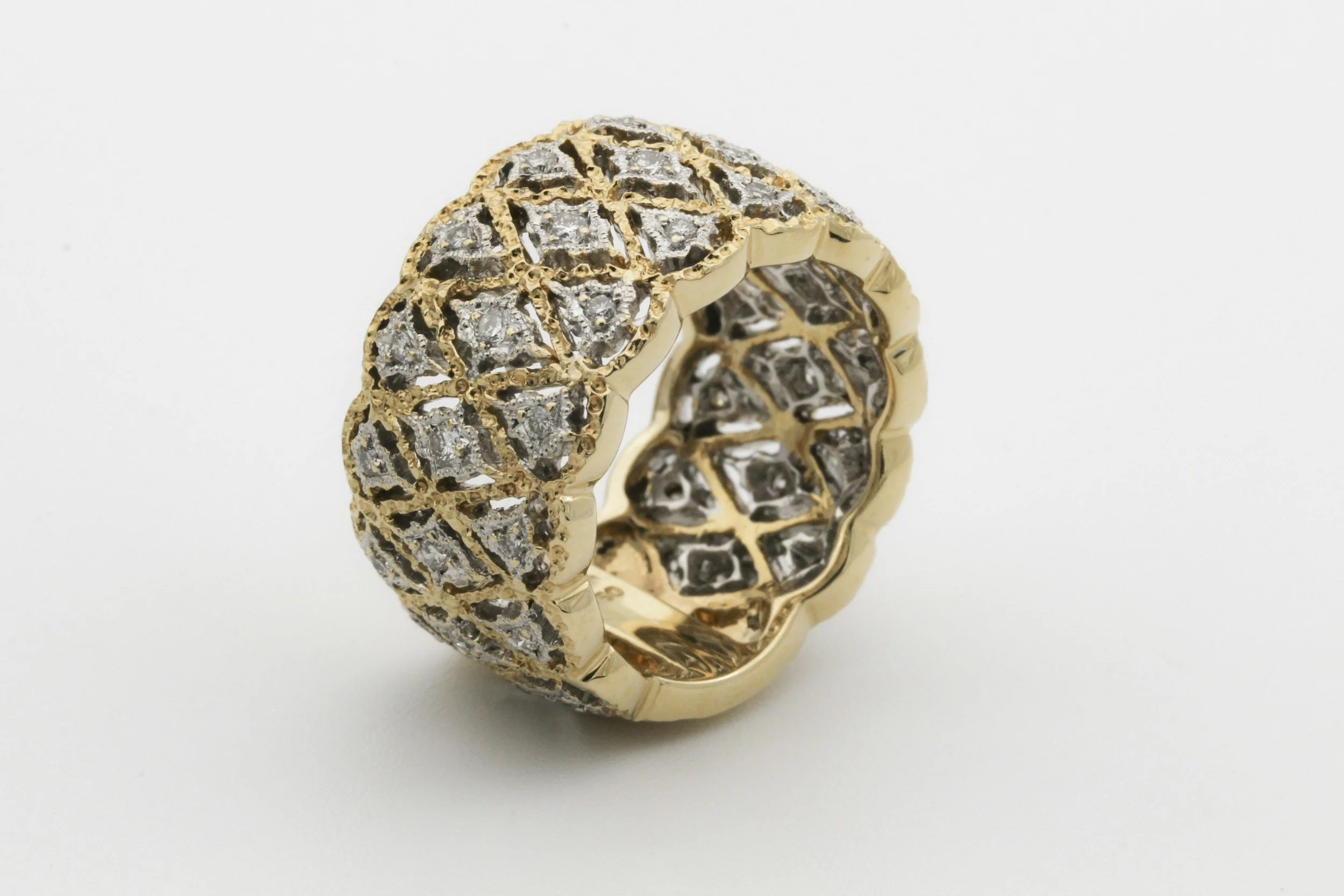
One recent commission began with inherited pieces whose original settings no longer reflected how the client dressed or lived day to day. The goal was never to reproduce the original rings. We preserved the stones and the emotional significance attached to them, then developed new proportions, architecture, and ways of wearing them — built for the client's current life rather than the life of the person who originally owned them. The result was jewelry that belonged to the client, rather than jewelry that simply used to belong to someone else.
Fifty Years From Now
The point of this kind of redesign isn't just to make an old ring wearable again. It's to make sure that when this piece is eventually passed down again, it doesn't just tell the story of who first owned it — it tells the story of how you carried that legacy forward and gave it new life, rather than letting it sit untouched in a box.
If you're holding an inherited piece you're unsure how to wear, preserve, or transform, you don't need to arrive with a finished idea. A private redesign consultation can begin simply by examining the piece, understanding its history, and identifying what you want to carry forward.
Begin a private redesign consultation.
You may also be interested in Heirloom Jewelry Restoration NYC if your goal is preservation rather than transformation.

Diamond District Heirloom Redesign: A Private Atelier Alternative
The Diamond District is the obvious place to take an heirloom for redesign, but redesign is a different kind of conversation than a walk-in reset.
Search "heirloom redesign" alongside "New York," and the Diamond District comes up almost automatically. It's the city's historic center for jewelry — dozens of storefronts on a single block, generations of trade knowledge, and more inventory in one place than almost anywhere else in the country. If you're holding a piece with real family history and wondering where to take it, it's the obvious first instinct.

But redesigning a meaningful heirloom is a different kind of request — and the environment in which that conversation happens can matter as much as the technical work itself.
What the Diamond District Does Well
To be clear: the Diamond District exists for good reason. It's fast, competitive, and enormously efficient if what you need is a repair, a resize, a straightforward reset, or simply the best price on a stone. Decades of trade relationships and sheer density of expertise live on that block. For transactional jewelry needs, it's genuinely hard to beat.
Why Heirloom Redesign Requires a Different Process
A walk-in retail environment is designed to make a transaction possible efficiently. A bespoke redesign requires something different: time to understand what should remain, what can change, and what the client actually wants the finished piece to say. That's not a knock on any individual jeweler — it's simply a different kind of business model, built for a different kind of decision.

A heirloom redesign conversation also tends to go better away from a public storefront. Comparing quotes in real time on a busy block is an efficient way to shop for a diamond. It's a much harder environment in which to hand someone a ring that belonged to your grandmother and explain what it actually means to you.
What Happens During a Private Heirloom Redesign
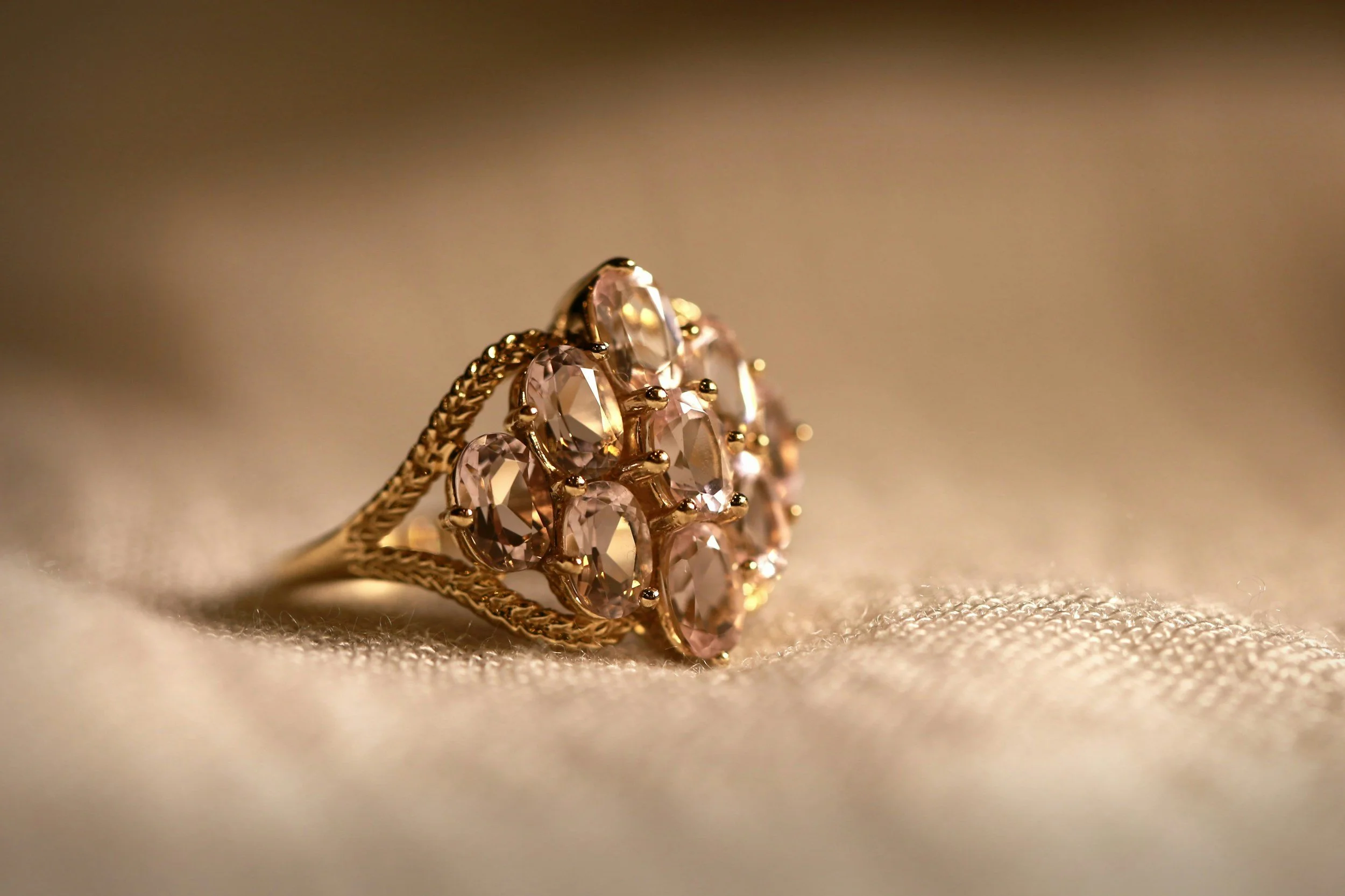
For clients who want the privacy of an independent designer without leaving New York, Gerard Rene approaches heirloom redesign through a private atelier model rather than a traditional retail storefront. In practice, that looks like a specific sequence:
We examine the existing piece. What gemstones are present, what condition the setting is in, which materials can realistically be reused, whether there are structural problems, and whether there are details worth preserving.
We separate sentimental value from physical structure. Sometimes the most meaningful part of an heirloom isn't the original setting at all — it might be the center stone, an engraving, a particular gemstone, or simply the fact that the material belonged to someone specific.
We determine what should survive. Not everything needs to be preserved for the piece's meaning to carry forward. This is usually the most important decision in the entire process, and it's made with the client, not for them.
We design around what the client wants the piece to become. This is where the actual design process begins — informed by everything above, rather than starting from an existing setting on a tray.
A Reset Isn't the Same as a Redesign
A reset means taking an existing stone and placing it into another setting. A redesign asks a bigger question: what should this piece become? That distinction matters, because the answer might be to preserve the center stone, reuse multiple stones, completely change the silhouette, change the metal, incorporate a single original detail, or build an entirely new structure around the existing materials. A reset can be part of a redesign. It's rarely the whole of one.
What Changes When the Question Becomes "What Should This Become?"
Once there's no pressure to move quickly, the questions get better. Rather than "which of these existing settings do you want your stone in," the question becomes: what part of this ring do you actually love, and why? Would you still love it if that same detail existed in a completely different format? Can this piece carry its history forward without looking exactly the way it did fifty years ago? That's the design thinking a redesign actually requires — and it's difficult to get to on a public sales floor.
Who a Private Atelier Is For
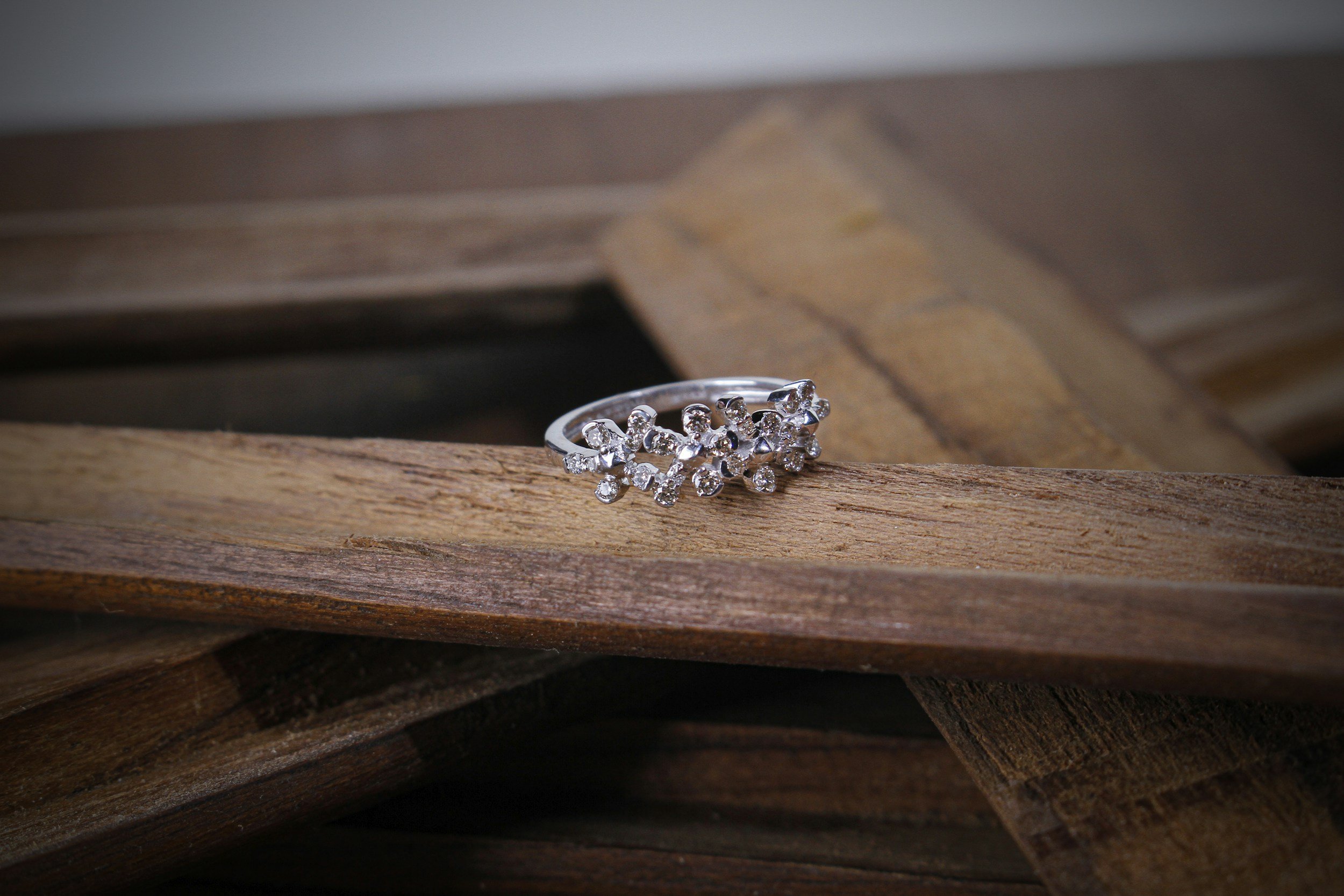
If you need a quick repair or a straightforward reset and price is the deciding factor, the Diamond District remains a perfectly reasonable place to start. But if you're holding a piece with real emotional weight — something you inherited, something tied to a person or a chapter you want to honor rather than erase — a private atelier process is built specifically for that kind of decision, without the noise of a public storefront experience around it.
Schedule a private heirloom consultation, or read more about how to redesign an inherited ring without losing its meaning.
Bespoke Rings for Men: Signet, Wedding Bands & Custom Pieces
Bespoke jewelry doesn't have to default to women's engagement rings. Here's how a men's commission, signet ring, wedding band, or something entirely your own, actually comes together.
Most fine jewelry content — ours included, historically — defaults to women's engagement rings. Search "bespoke jewelry" and you'll find page after page assuming the commission is for a bride. That's a real gap, and it's not because men don't want meaningful jewelry. It's because the market has largely assumed they don't.
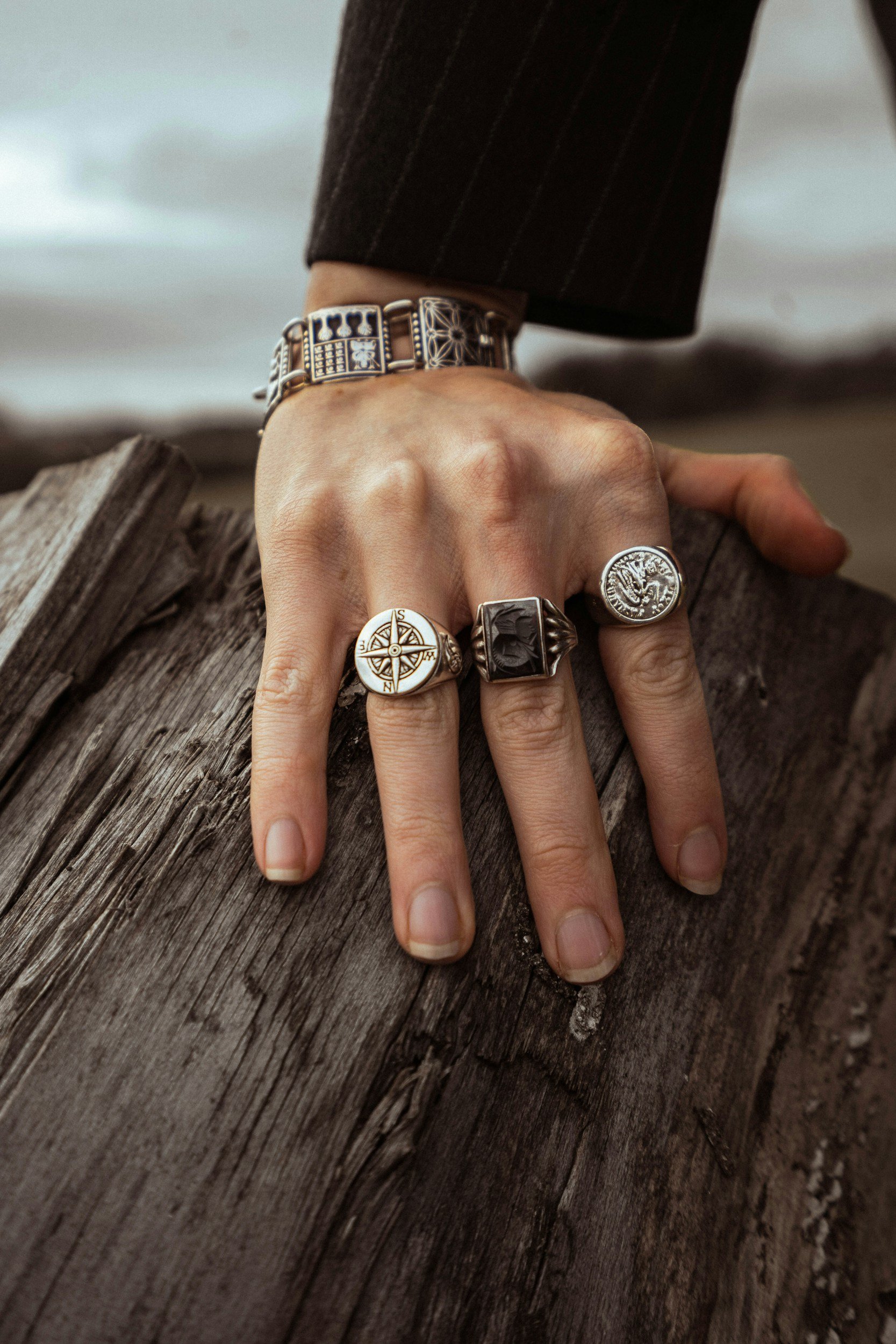
The Assumption Behind the Gap
In our experience, the jewelry industry tends to treat men's pieces as an afterthought — plain bands, minimal detail, nothing that requires much of a conversation. That pattern seems to rest on two assumptions: that men aren't interested in adornment the way women are, and that if a man's piece isn't tied to a wedding, it doesn't need a story behind it. Neither assumption holds up in our own commissions. Some men want jewelry that's genuinely simple, and that's a completely valid preference. But plenty of others want a piece that makes a statement, that carries family history forward, or that marks something they've actually been through.
What a Men's Commission Actually Looks Like
The process is the same as any bespoke commission: a real conversation first, design second. What differs is often the subject matter. A men's piece is less likely to center on a proposal story and more likely to center on identity, legacy, or a personal milestone — a career achievement, a health journey, a family crest passed down through generations.
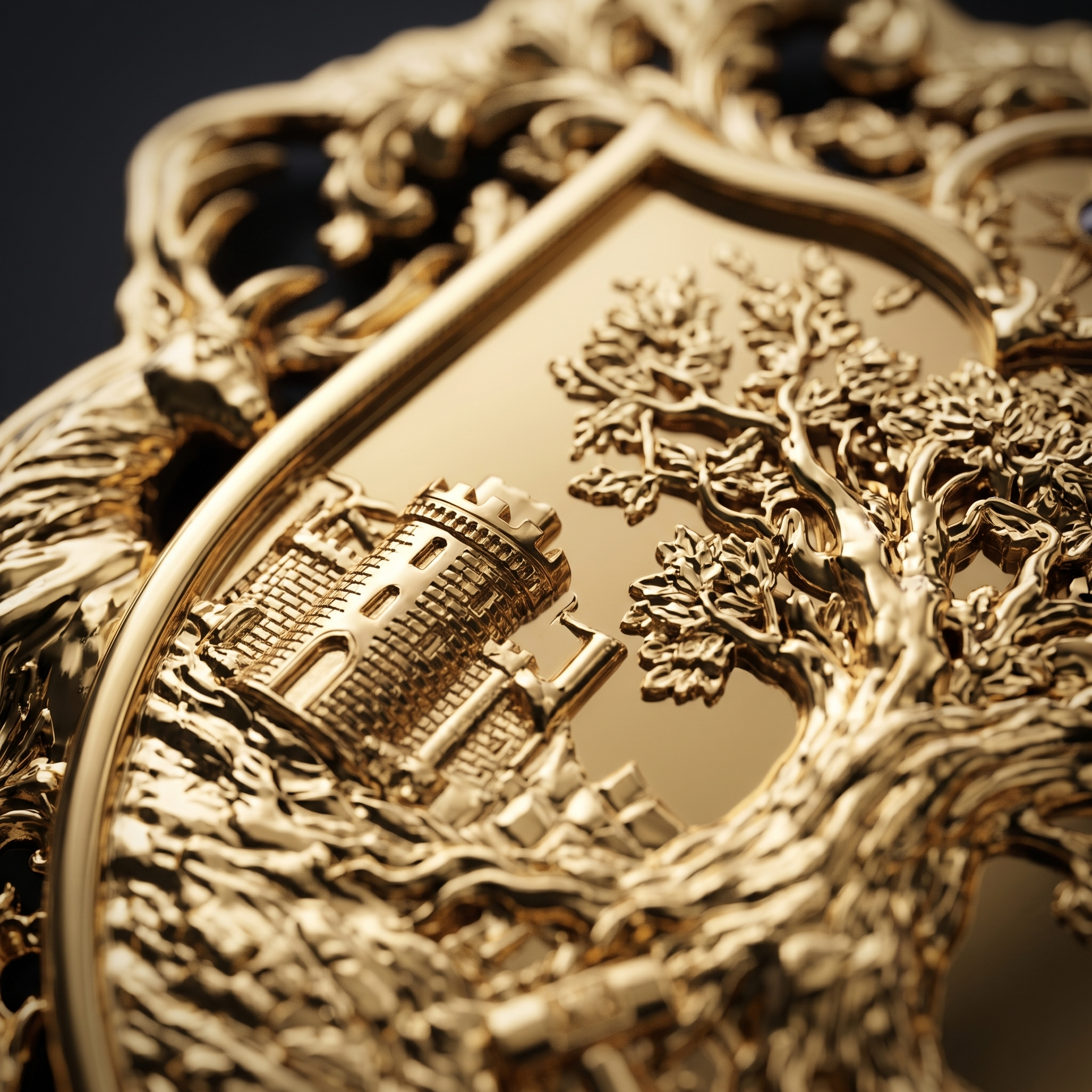
We've built rings that function almost like a class ring, but for something far more significant — a piece designed to mark someone coming out the other side of a serious illness, a physical symbol of having survived something that permanently changed how they understood time. We've also worked on family heirloom crest pendants, designed to carry a specific lineage forward in a way that's deeply meaningful to the family and, frankly, not built for public display at all.
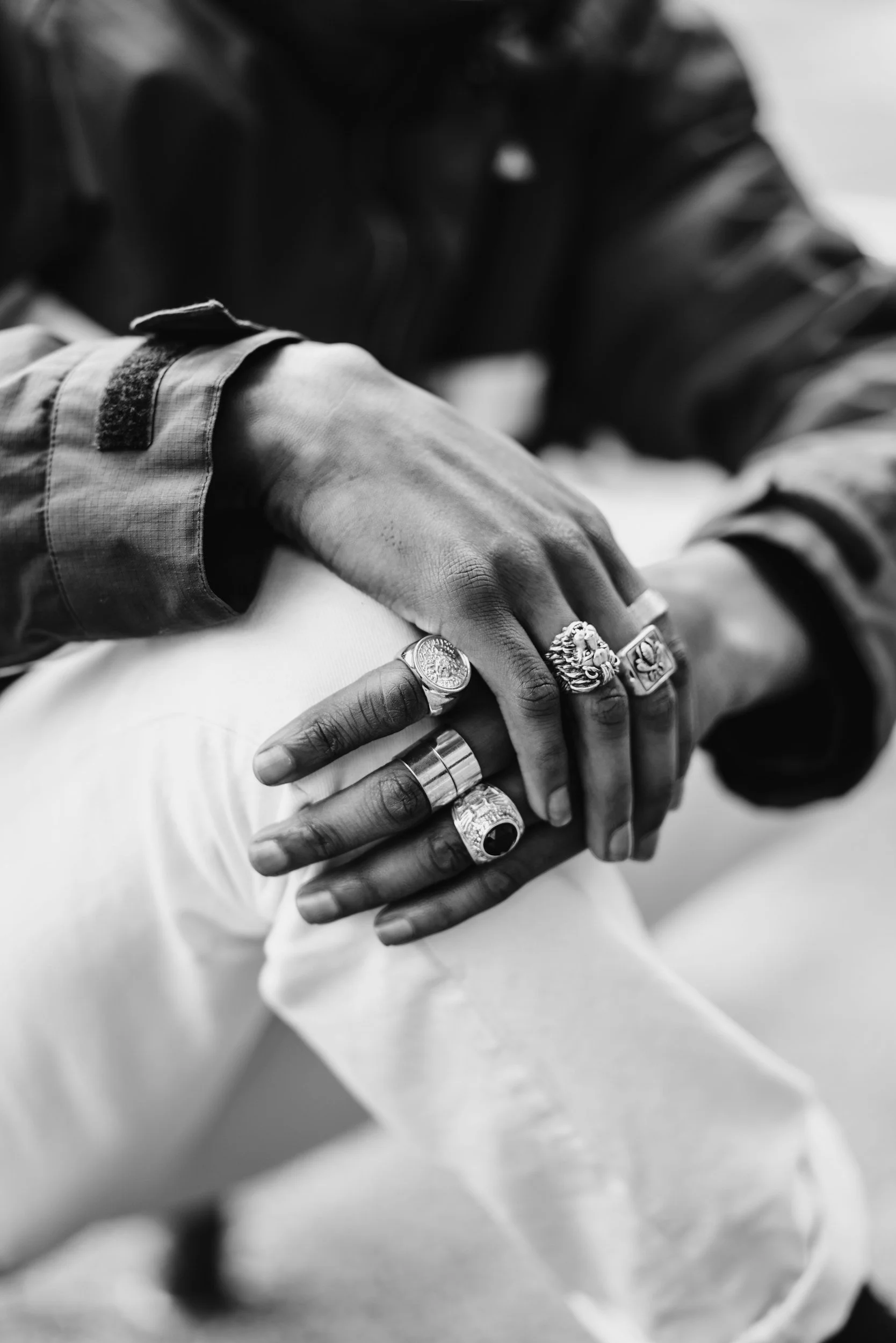
Signet Rings
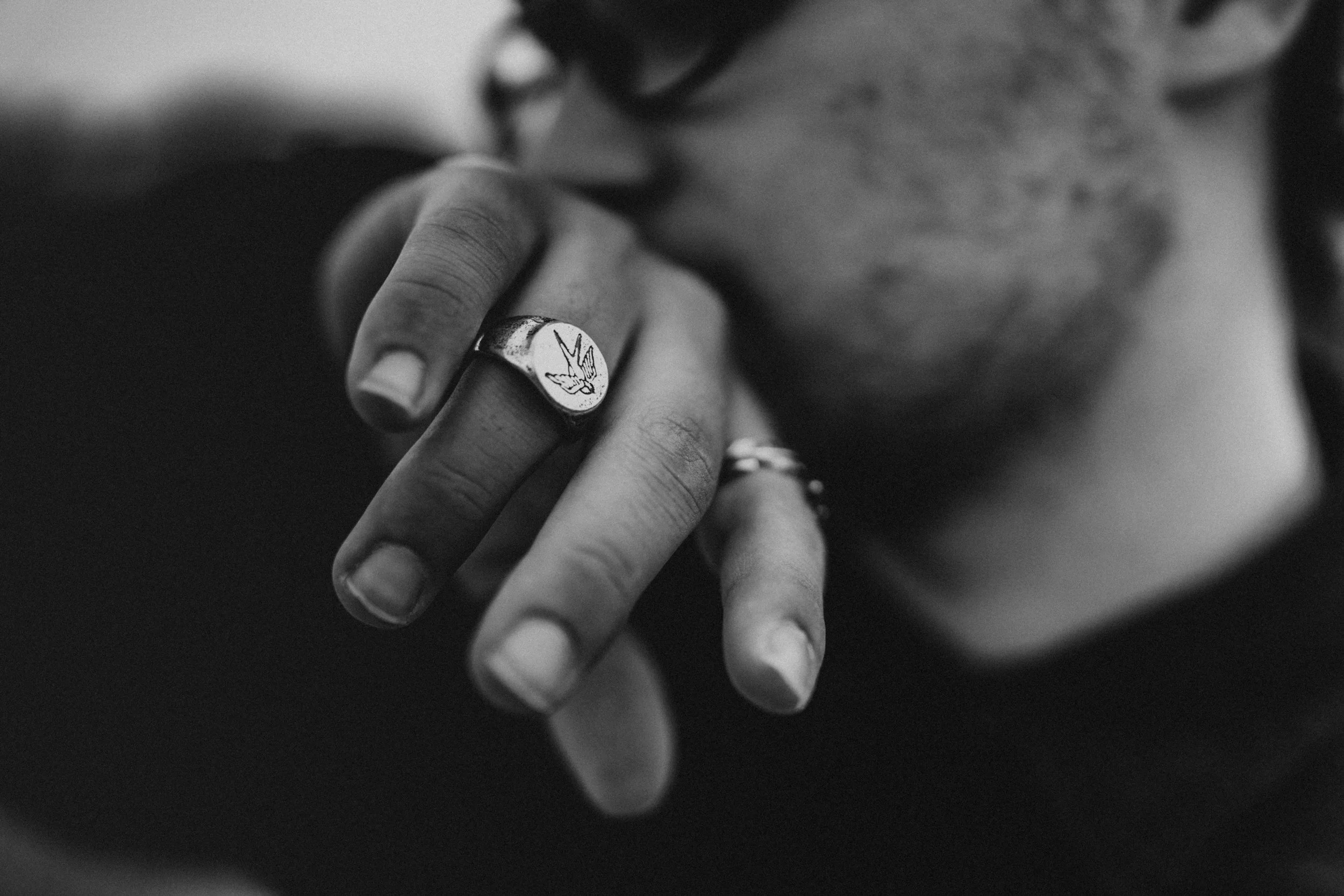
The signet ring remains one of the most natural entry points into men's bespoke jewelry, precisely because it already carries centuries of tradition around personal identity — a crest, a monogram, a family mark, engraved into a piece meant to be worn daily and eventually passed down. A bespoke signet ring isn't about picking a template. It's about deciding what mark actually deserves to represent you, or your family, for the next several generations.
Wedding Bands
A custom wedding band for a man doesn't have to mean a plain, interchangeable ring. It can incorporate texture, engraving, an unconventional finish, or a design language that echoes his partner's ring without matching it exactly. The goal is the same as any bespoke piece: something that reflects the specific relationship and the specific person, rather than something pulled from a case of nearly identical options.
Men's Engagement Rings
Engagement rings aren't automatically a one-sided commission. Plenty of couples want both partners to have a ring to mark the proposal — including same-sex couples, where neither the tradition nor the design language should default to whatever the industry built around a single bride. A men's engagement ring commission goes through the exact same process as any other: understanding the relationship, the story behind the proposal, and the person's actual taste, rather than assuming the design should be scaled down or simplified just because it's for a man.
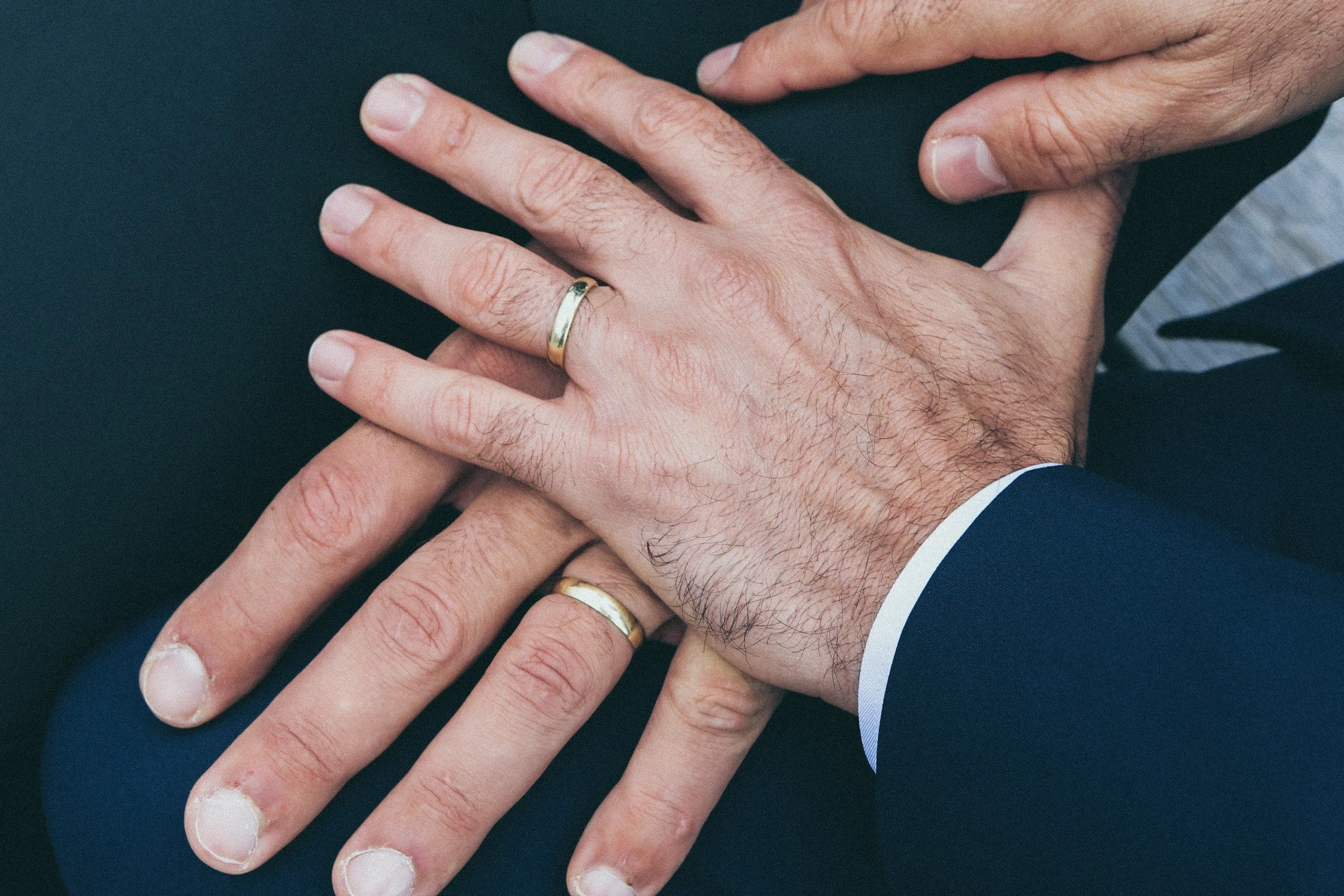
For two grooms, or any couple where both parties want a ring, the design conversation often becomes more interesting, not less — there's no inherited assumption about who wears the diamond and who wears the plain band. Each ring can be built entirely around its own wearer, related to the other by a shared detail or material rather than forced into matching.
Custom Pieces Beyond the Ring
Pendants come up often in men's commissions — sometimes as the primary piece, sometimes alongside a ring. A pendant gives more room to work with symbolism that isn't meant to be worn loudly: a family crest, a personal emblem, something that means everything to the wearer and very little to anyone glancing at it.
Why You Won't See Many Men's Pieces in Our Portfolio
Our published portfolio leans heavily toward women's commissions, and that's intentional rather than accidental. The male clients we work with often commission pieces so specific to their own story that the meaning behind them doesn't come through in a portfolio photo the way the design alone does — not because they're any less beautiful, but because their significance is private in a way that doesn't translate well to a gallery wall. Jewelry has historically been treated as "a woman's thing," which paradoxically makes it easier to show women's commissions openly. Men's pieces tend to stay quieter, even when they're some of the most meaningful work we do.
If You're Considering a Piece for Yourself
You don't need an occasion tied to a wedding to justify commissioning something meaningful. A signet ring marking your own family history, a band that reflects an achievement, or a pendant that quietly carries something important — all of it belongs in the same conversation we'd have with anyone else walking through our door.
Begin a private consultation, or read more about what you're actually paying for when you commission a custom ring.
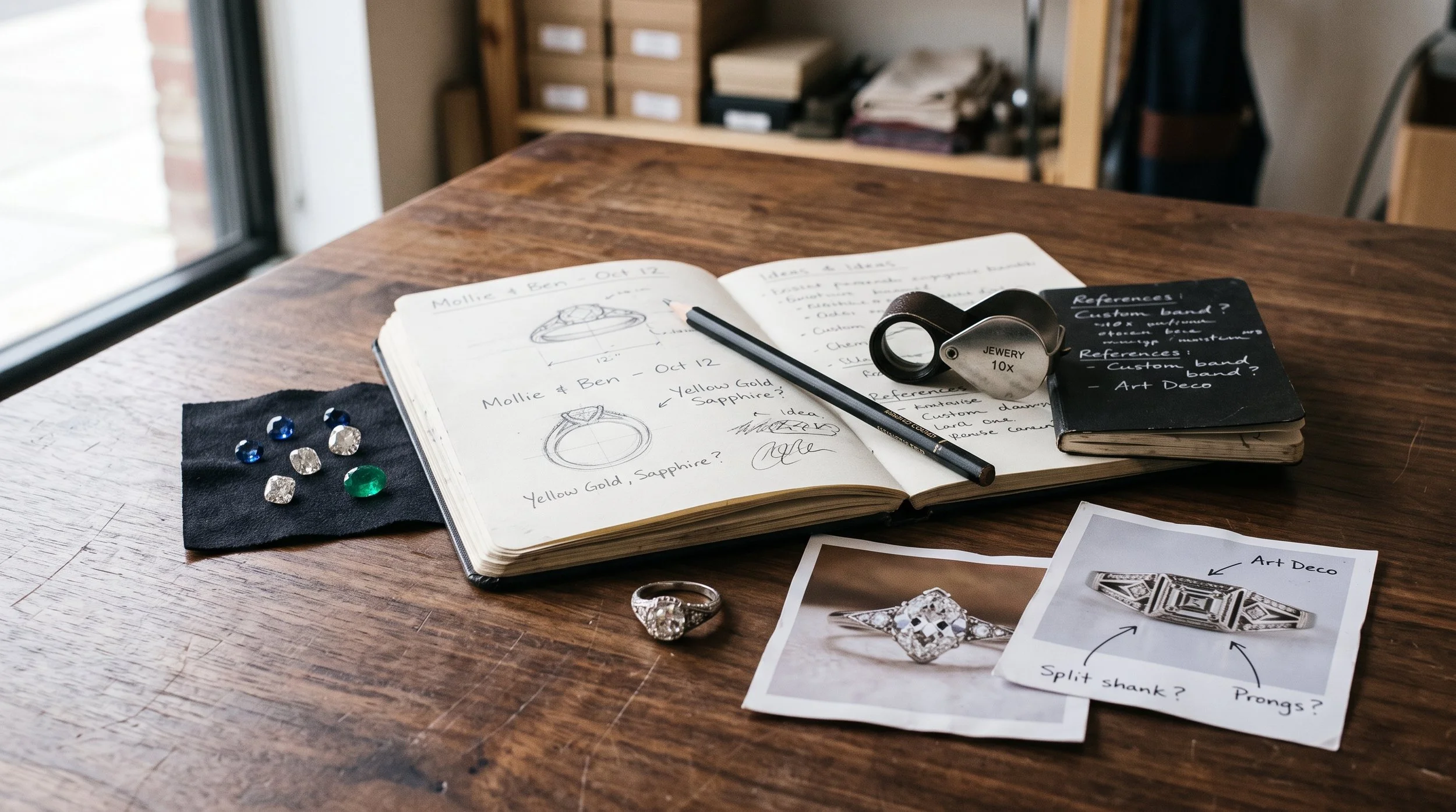
What to Bring to Your First Bespoke Jewelry Consultation
Wondering what to bring to your first bespoke jewelry consultation? Less than you think — here's what's actually useful, and what you don't need to have figured out yet.
The most common question we get before a first consultation isn't about design at all. It's some version of: "What am I actually supposed to bring?" The honest answer is that you need far less than most people assume — clarity helps, but it isn't a requirement.
What's Actually Useful
Reference images, if you have them — but not a finished vision. If you've been saving photos, bring them, even if they feel scattered or contradictory. We're not looking for a single perfect example of what you want. We're looking for what repeats: a stone shape, a proportion, a level of detail you keep gravitating toward. Even just your single favorite element from each image is enough to start building a real picture of your taste.
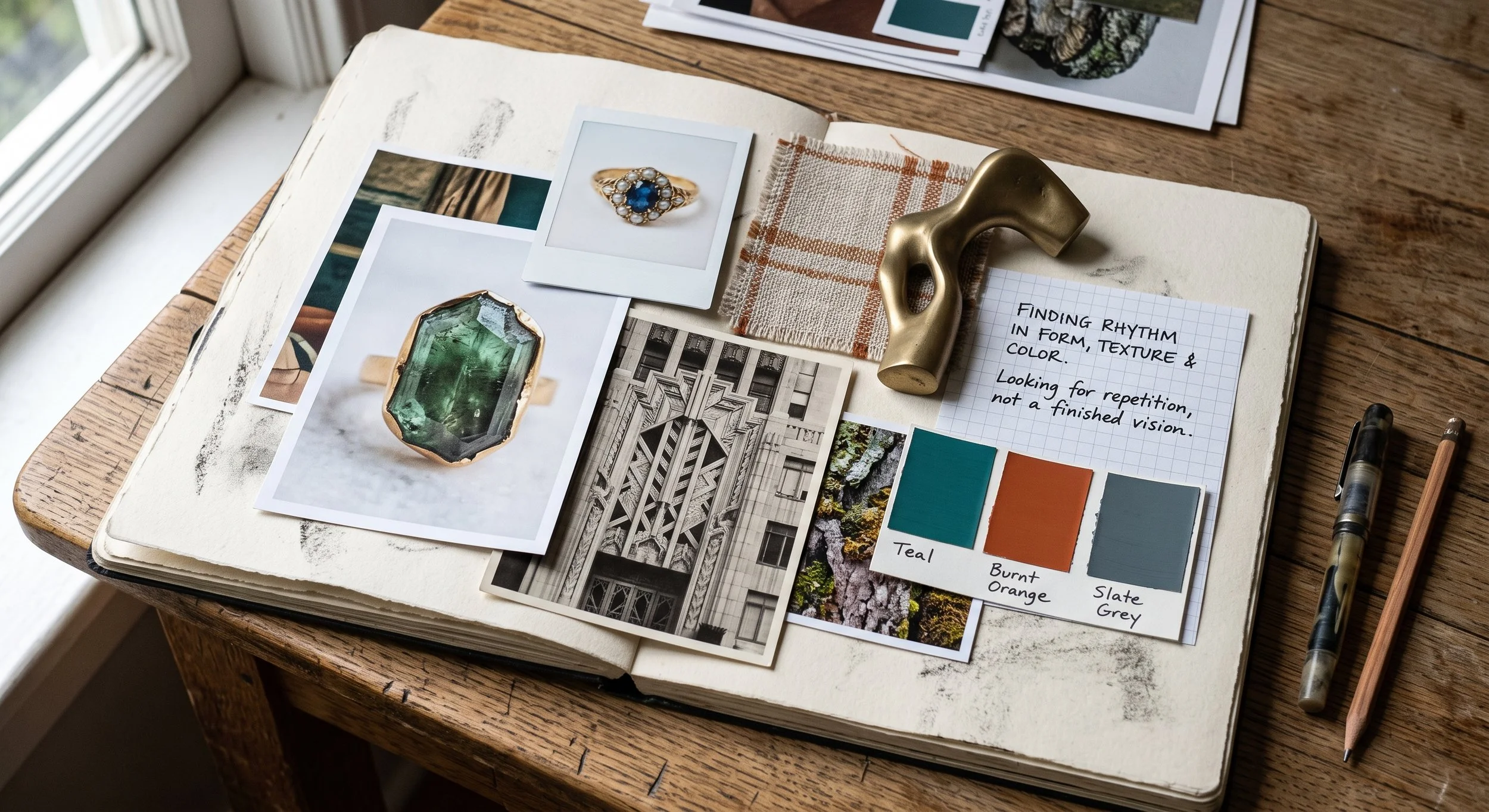
A general sense of your budget range. You don't need an exact number, and you're never going to be pushed toward spending more than you're comfortable with. But a rough range helps shape realistic options from the very first conversation, rather than designing something that has to be scaled back later.
Context about the relationship, if it's an engagement ring. How you met, how long you've been together, what your partner's day-to-day life actually looks like — whether they wear jewelry often or almost never, whether they're active or more likely to be behind a desk. None of this needs to be polished. The more honestly you can describe the person, the more the design can actually reflect them.
Any inherited materials you're considering incorporating. If there's a family stone, an heirloom piece, or inherited gold you might want worked into the new design, bring it — or at least mention it exists. It changes what's possible and often becomes the most meaningful part of the final piece.
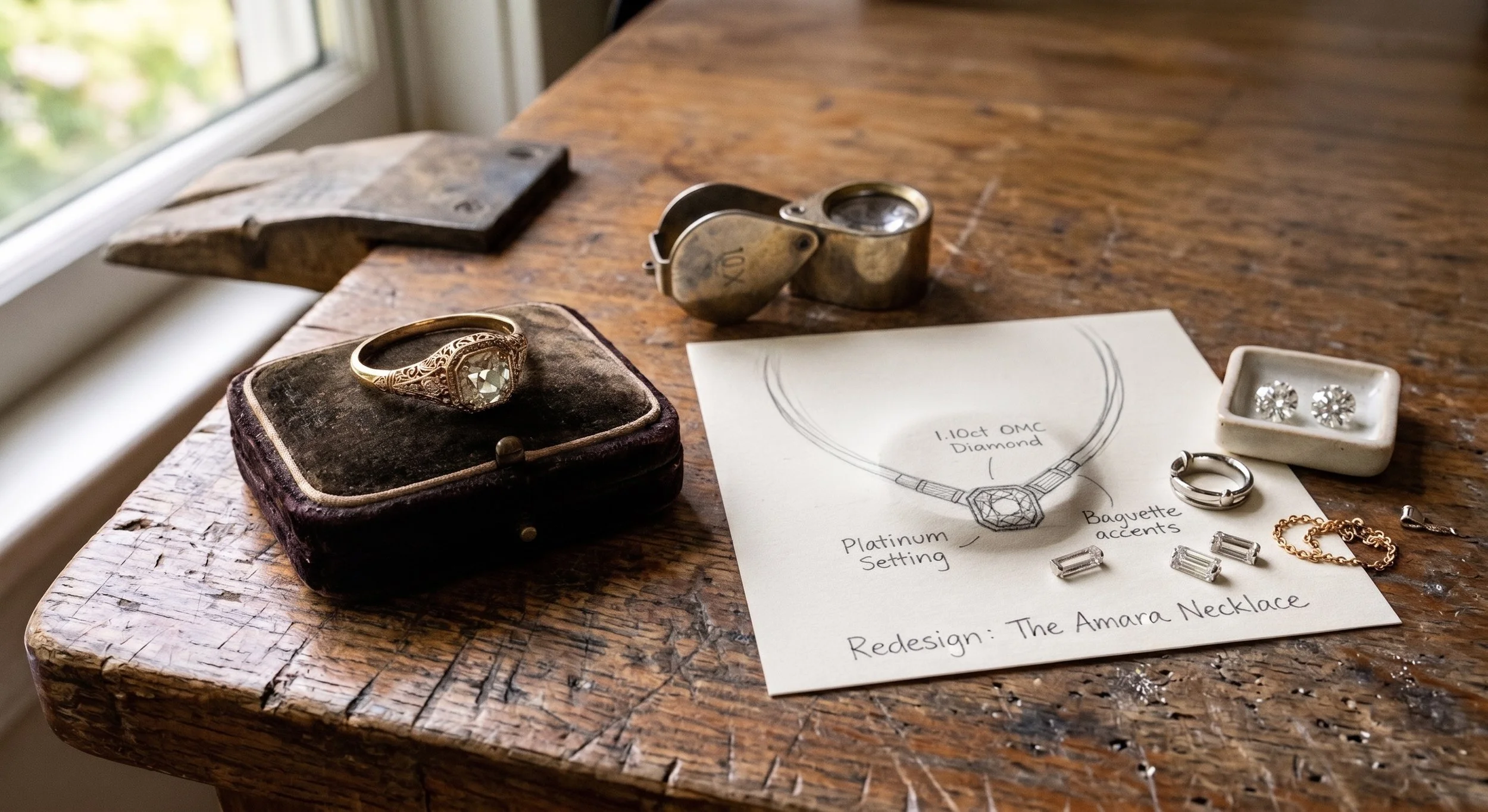
Your actual questions, even the basic ones. Nobody expects you to already understand cut grades, sourcing, or engineering. Ask anything. Understanding the process is part of what a consultation is for.
What You Genuinely Don't Need
A finished design in your head. Plenty of the most successful commissions start with a client who has no clear vision at all — just a feeling, or a handful of scattered references. That's a completely normal starting point, not a disadvantage.
A ring size. Sizing happens later in the process, once a direction is set. It's not something you need before a first conversation.
Certainty about every material decision. Metal, stone type, whether it's a diamond or a colored gemstone — these get worked out together. You don't need to walk in with firm answers.
What the Consultation Itself Actually Involves
Expect a real conversation before any sketching happens — questions about your story, your taste, and what you want the piece to say, not an immediate pitch toward a specific setting or stone. If you already have strong references and a clear point of view, we'll let that lead. If you're starting from almost nothing, we'll build the picture together from what you tell us about your life.
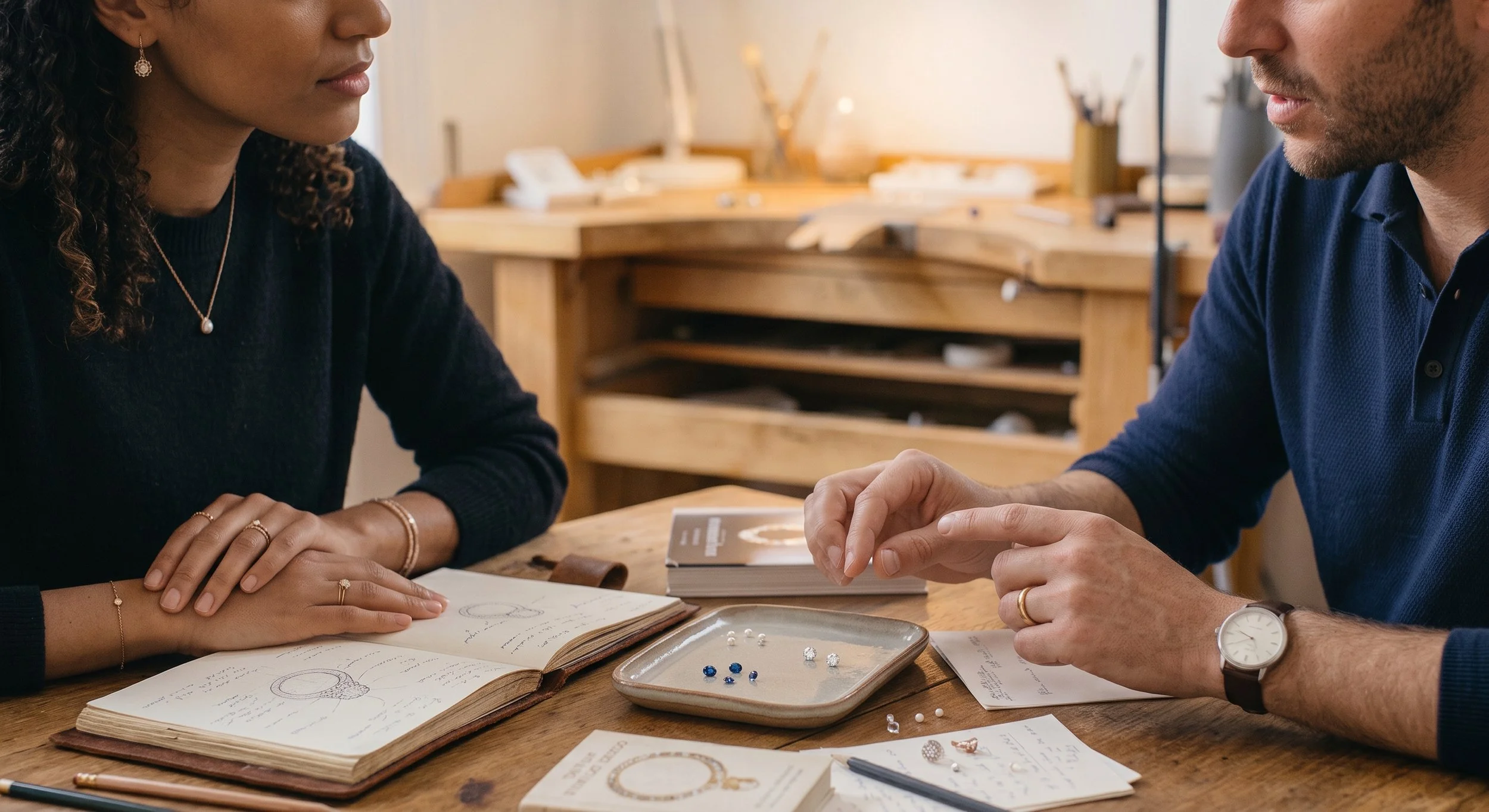
There's no wrong way to arrive at a first consultation. Some clients come in with a folder of saved images and a firm budget. Others come in with nothing but a feeling that they want something different from what they've seen everywhere else. Both are exactly the right starting point.
Schedule your private consultation, or read more about the bespoke engagement ring process, start to finish to know what happens after that first conversation.
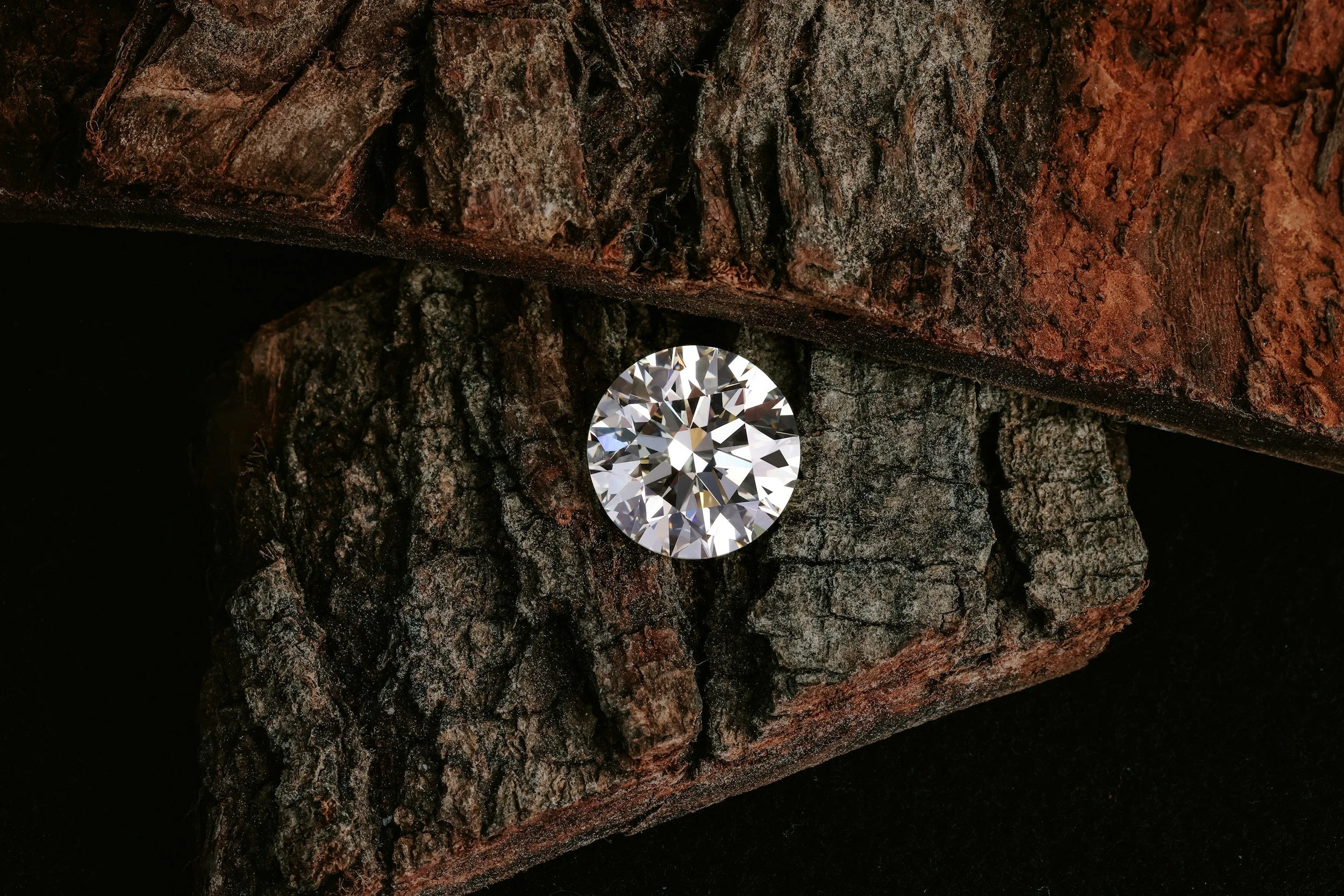
Lab-Grown vs. Mined Diamonds for Custom Jewelry: An Honest Comparison
This isn't a debate about which diamond is "real." It's about knowing what you're actually trying to build before you choose.
This is one of the most misunderstood debates in the industry, mostly because people are asking the wrong question. It isn't really "technology versus tradition." It's alignment — whether the diamond you're choosing actually matches what you're trying to accomplish.
The Question We Ask Before Any Recommendation
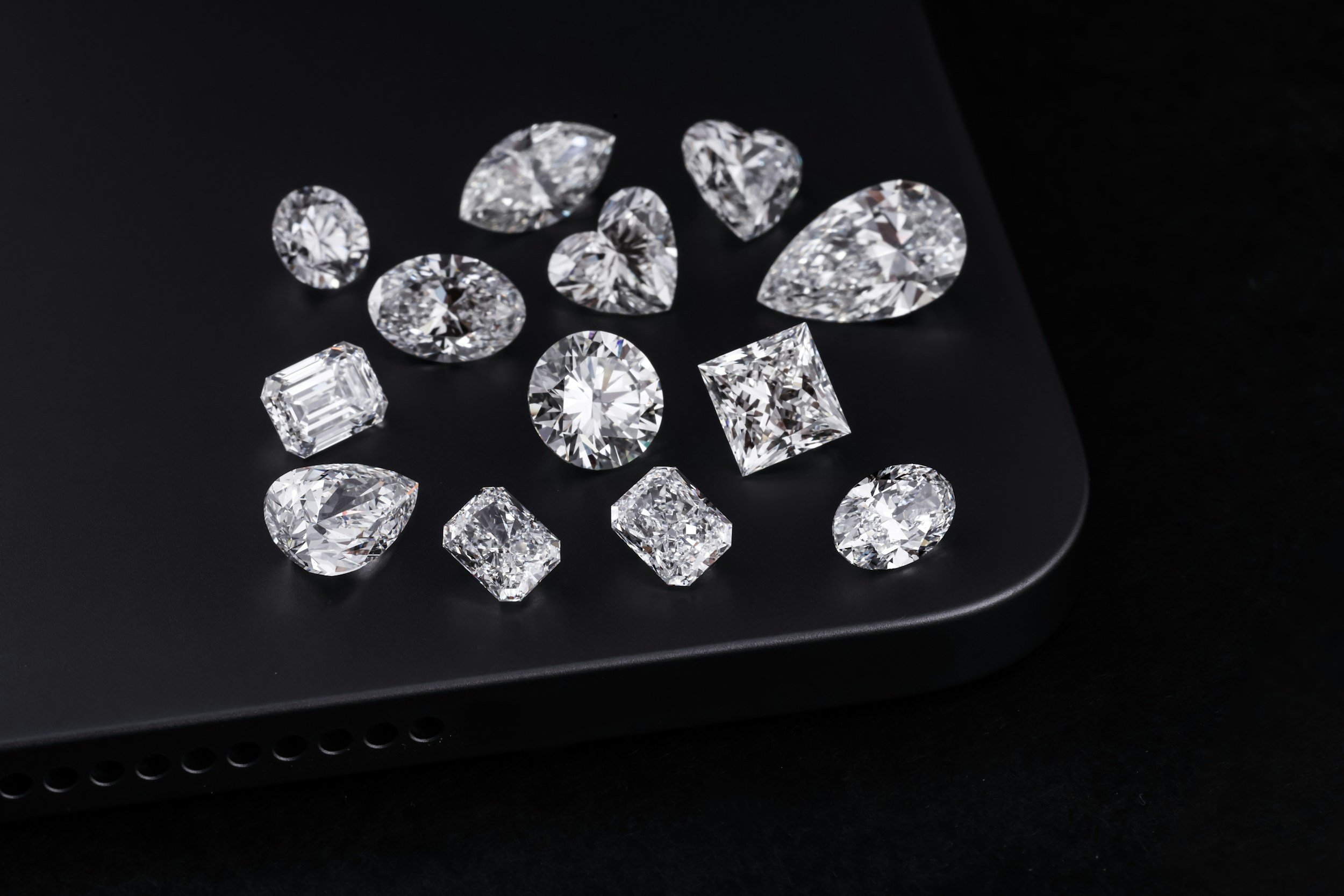
Early in this work, we generally supported clients choosing lab-grown diamonds if it meant getting a larger stone within budget. Looking back, that advice wasn't wrong, exactly — it was incomplete, because it answered a narrower question than the one that actually mattered. Maximizing visual size for a given budget is one conversation. Building a piece meant to carry emotional and material significance across generations is a different one entirely. Both are legitimate goals. They just call for different materials.
So before we talk about diamonds, we talk about intent. What are you actually trying to build? A beautiful ring you'll love wearing? Or a future heirloom, something meant to still mean something to someone who never met you?
Where Lab-Grown Diamonds Make Sense
If the priority is size, sparkle, and value for the budget available today — not the diamond's value forty years from now — lab-grown is a completely reasonable choice. It offers the same optical and chemical properties as a natural diamond at a lower price point, which means more visual presence for the same spend.
Where Natural Diamonds Make Sense
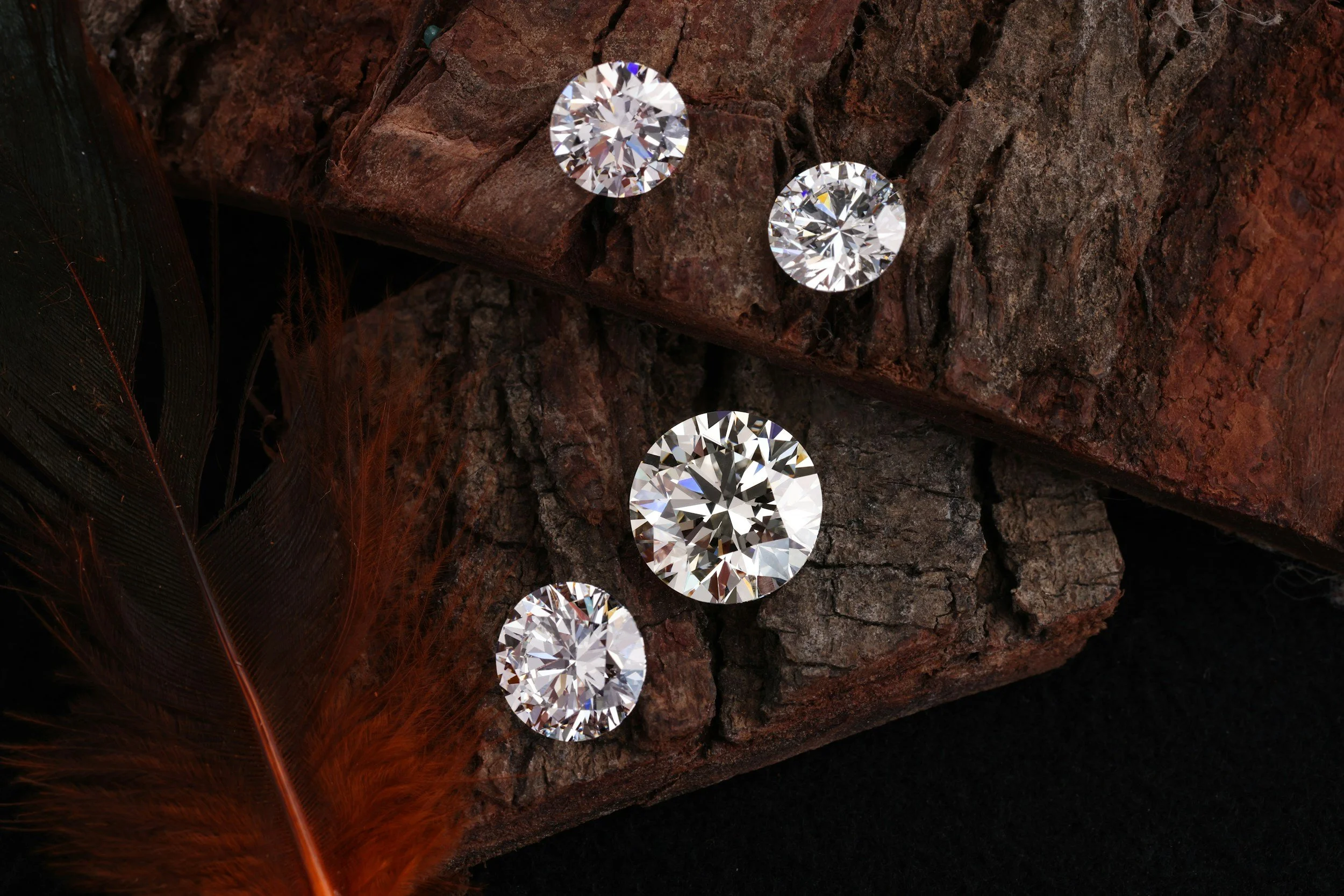
When the goal is building something meant to hold both emotional and material significance across generations, natural stones are typically where we land. A natural diamond carries billions of years of geological history and genuine physical scarcity — qualities tied to provenance, rarity, and heirloom significance, not a guarantee of financial appreciation. Historical scarcity and market value are not the same thing, and we're not going to tell you a natural stone is a financial investment. What it offers is a different kind of permanence: material that existed millions of years before your commission and will still exist long after it.
What People Get Wrong on Both Sides
The debate is full of marketing shortcuts standing in for actual substance.
On the lab-grown side, people often assume "lab-grown" automatically means ethical or low-impact. That's not guaranteed. Lab-grown does not automatically answer every ethical or environmental question — production methods, energy sources, manufacturing practices, and supply-chain transparency can vary significantly between producers, the same categories of concern people assume only apply to mined stones.
On the natural side, people often assume mined diamonds can't be verified or ethically sourced at all. That's also not accurate. With rigorous vendor vetting, sanctions screening, and independent lab documentation, natural sourcing can be entirely clean and transparent — it just requires actually doing the diligence, rather than accepting a supplier's word.
Neither Choice Is Automatically the "Right" One
We don't think there's a universally correct answer here, and we're not interested in selling you toward whichever option is more profitable. Clients deserve an honest answer to what they're actually trying to accomplish, not a sales pitch dressed up as ethics or a sales pitch dressed up as tradition.
If you want a nice design, real sparkle, and don't have an unlimited budget, a lab-grown diamond is a completely legitimate choice — and so is a natural sapphire or a well-cut moissanite, depending on what you're prioritizing. If your goal is a stone with real provenance and heirloom significance — something built to be passed down with its own history intact — that's a different conversation, and it usually leads toward a natural stone with strong documentation behind it.
How We Start This Conversation
Every commission starts by getting clear on what you're actually trying to preserve. Once that's established, the material choice tends to become obvious on its own — not because one option is objectively better, but because it becomes clear which one actually serves the story you're building.
If you're weighing this decision for your own commission, that's exactly the kind of conversation worth having before any stone gets sourced. Begin a private consultation, or read more about how we source gemstones for one-of-one commissions.

What Determines the Price of a Custom Engagement Ring?
The honest breakdown of where your investment actually goes when you commission a custom engagement ring — no sales pitch, no vague hand-waving.
"Why does this cost so much more than a ring I found somewhere else?" is a fair question, and it deserves a real answer rather than a deflection. The short version: a custom commission and a retail ring are two different categories of object, built through two entirely different processes. The price reflects that difference — and these cost drivers hold regardless of which city or atelier you're commissioning from.

You're Not Comparing Two Rings. You're Comparing Two Processes.
A retail ring's price is largely determined by materials, brand markup, and manufacturing at scale. A custom commission's price is determined by something closer to the cost of building a single, unrepeatable object from the ground up — design time, engineering, sourcing, and hand-finishing that all exist for exactly one piece, once.
That's not a justification so much as an explanation of where the investment actually goes.
Where the Money Actually Goes at Gerard Rene
Gemstone sourcing and verification. Every stone that enters a commission is vetted for cut, character, and documentation — not simply purchased off the highest number on a certificate. That vetting process, including verifying a supplier's history and a stone's paper trail, takes real time and real diligence, and it protects the piece long after it leaves the workbench.
Material quality. Solid, substantial gold or platinum, built to hold up under decades of daily wear, costs more than thin, lightweight metal designed to look larger for less.
Design and engineering. Concept sketches, refinement based on client feedback, and CAD engineering to confirm a design is structurally sound before it's ever built — this stage alone can represent weeks of iterative work, especially for a complex or unconventional design.
Hand-fabrication and finishing. Whether a piece is hand-forged, cast, or built through a combination of both, the labor involved in properly securing stones, finishing metal, and quality-checking the final piece under magnification is substantial, and it's labor that scales with complexity, not price point alone.
Irreplaceability. Perhaps most importantly, you're paying for something that exists nowhere else. A retail ring can be replaced or duplicated. A bespoke commission, by definition, can't be.
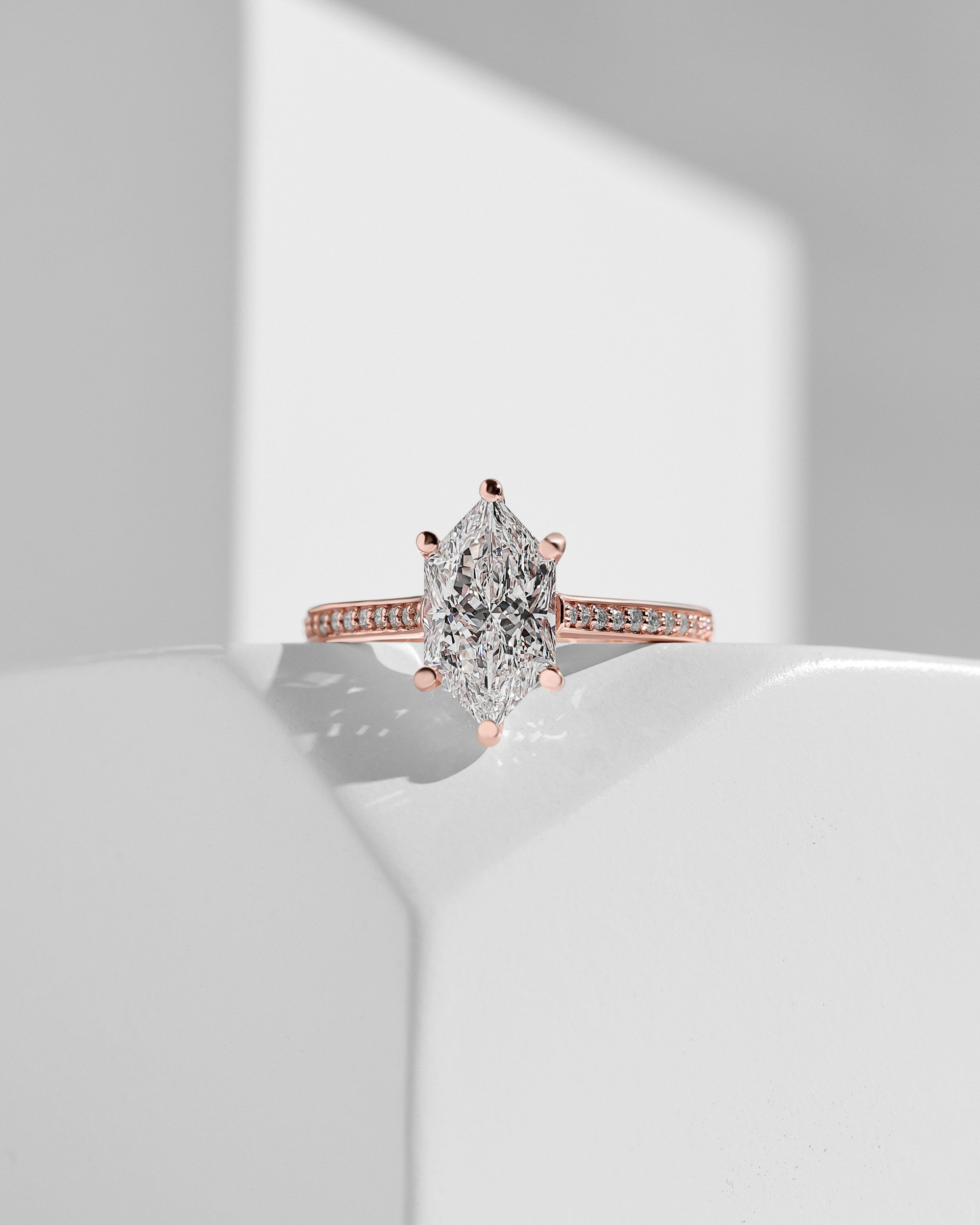
Where the Investment Is Actually Concentrated at Gerard Rene
The investment is concentrated in the design, sourcing, engineering, craftsmanship, and individualized attention required to create one piece — rather than in the overhead of producing and distributing an inventory item at scale. That's a different cost structure than retail jewelry, not an absence of one.
Why Two Commissions Can Cost Very Differently
Complexity is the biggest variable. A clean, architectural solitaire with a well-documented diamond costs less than a heavily engraved, sculptural design built around a rare, hand-sourced gemstone — not because one designer is trying harder than the other, but because the second piece genuinely requires more time, more sourcing effort, and more hand-finishing to execute properly.
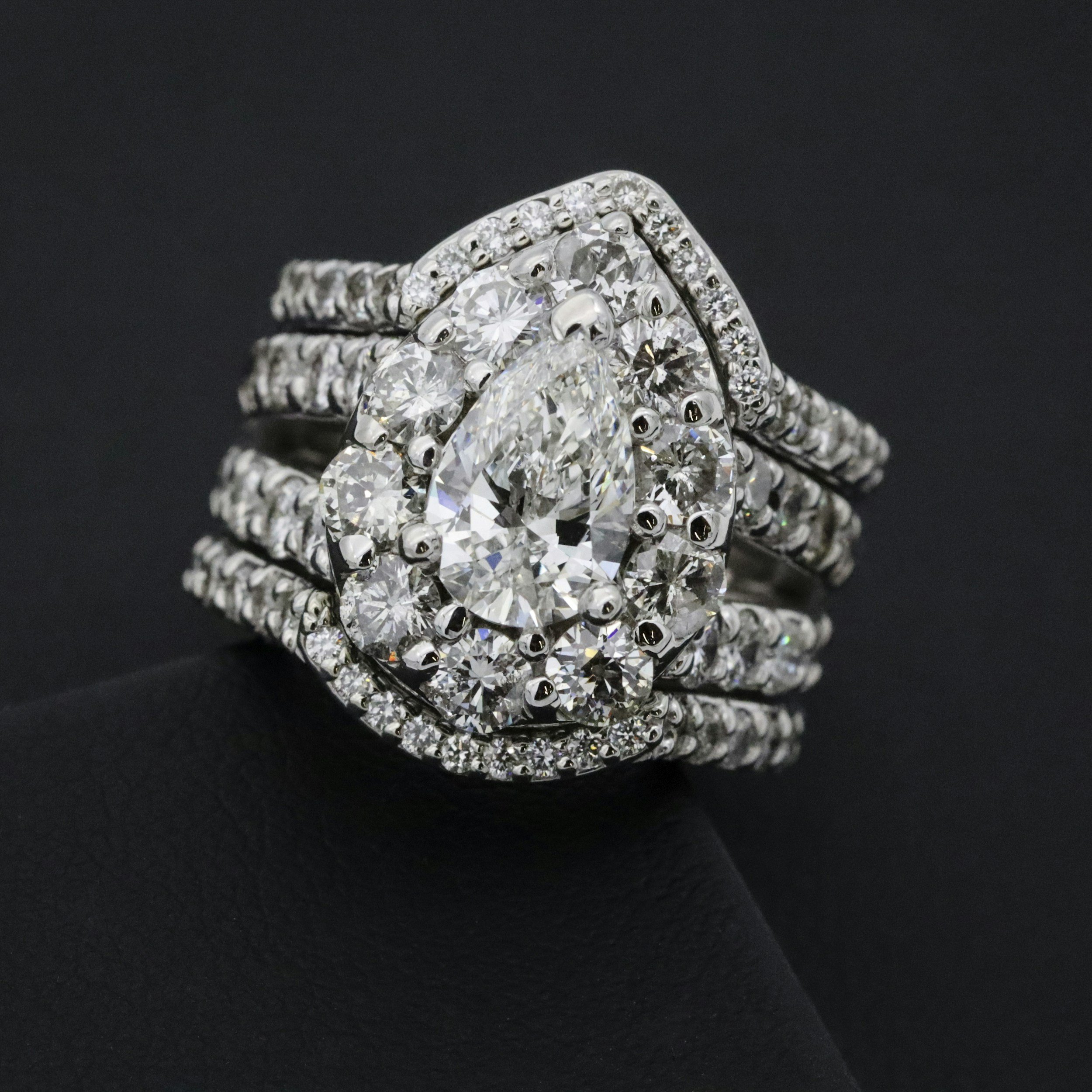
A Note on Comparing Prices
If you're comparing a bespoke commission against a mass-retail ring purely on a price-per-carat basis, you're likely optimizing for a different goal than the one bespoke work is built to serve. That's a completely legitimate priority to have — but it's worth being honest with yourself about which outcome you actually want before the comparison starts, because the two paths lead to genuinely different objects.
If you want a clearer sense of what your specific commission would actually cost, that's a conversation best had directly, with your design and priorities in front of us — not estimated from a general range. Commission Your Ring to begin the process, or explore our custom ring portfolio to see how different design approaches translate into finished pieces.
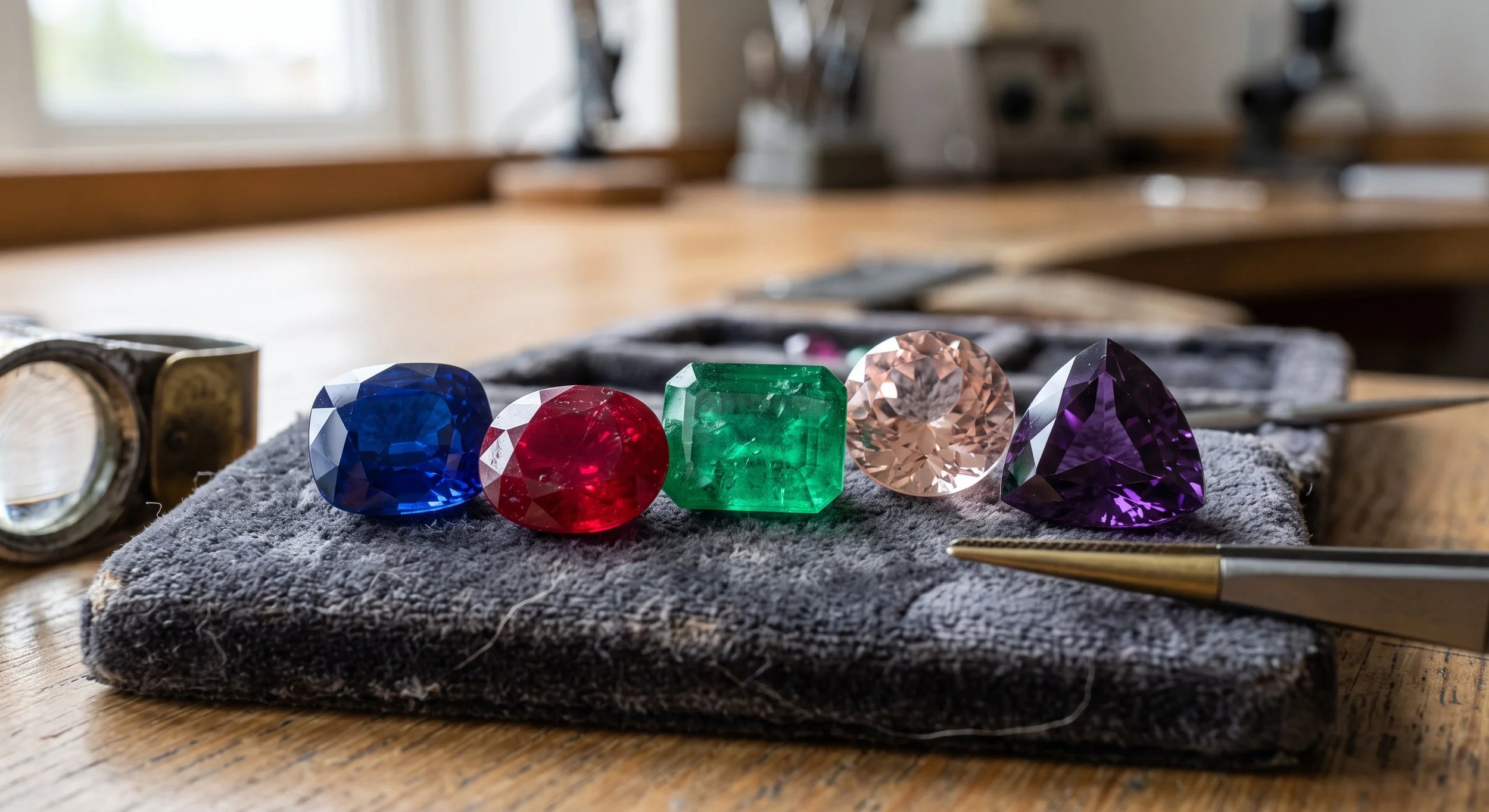
Colored Gemstone Engagement Rings: What to Know Before You Commission One
Choosing a sapphire or emerald over a diamond changes more than the color. Here's what to know about durability, care, and design before you commit.
Choosing a colored gemstone over a diamond isn't just an aesthetic decision — it changes several things about how the ring should be designed, worn, and cared for. Before committing to a center stone, it's worth understanding what actually shifts.
Durability Isn't the Same Across Every Stone
Diamonds rank hardest on the Mohs scale of any natural material, which is part of why they became the default engagement stone in the first place. But hardness alone doesn't determine how well a stone actually holds up — toughness, cleavage planes, how the stone is set, typical treatments, and how the wearer actually lives with the piece all factor in just as much.
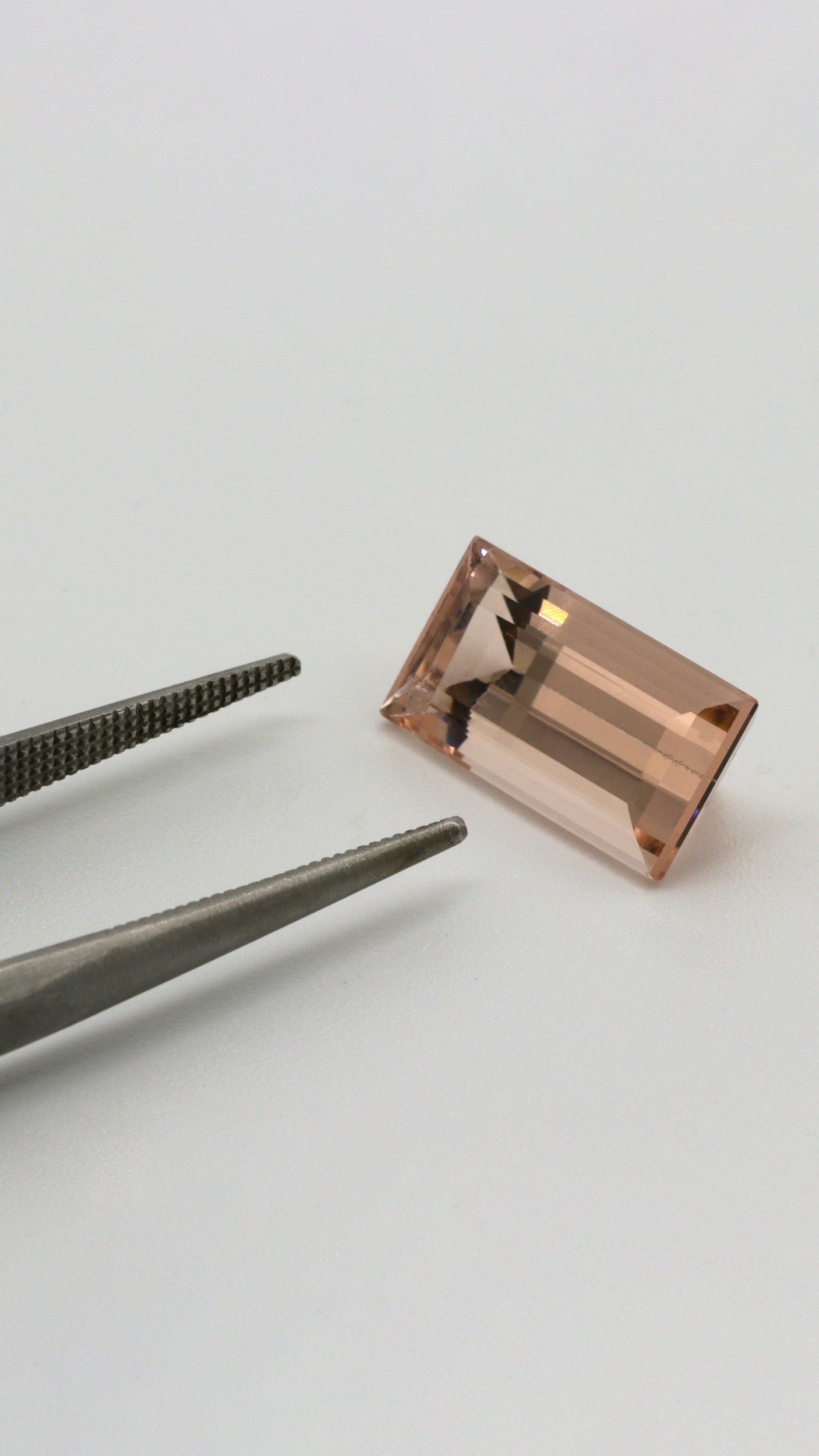
Sapphires and rubies are extremely durable and genuinely well-suited to daily wear, both in hardness and toughness. Emeralds are a more nuanced case: their durability concerns come less from hardness and more from natural inclusions and the clarity treatments most emeralds receive, which can make them more vulnerable to impact than their hardness rating alone would suggest. Morganite isn't automatically unsuitable for daily wear either — with a protective setting and reasonable care, it can hold up well; the real variables are how it's set and how the wearer actually treats it day to day, not a blanket rule about the stone itself.
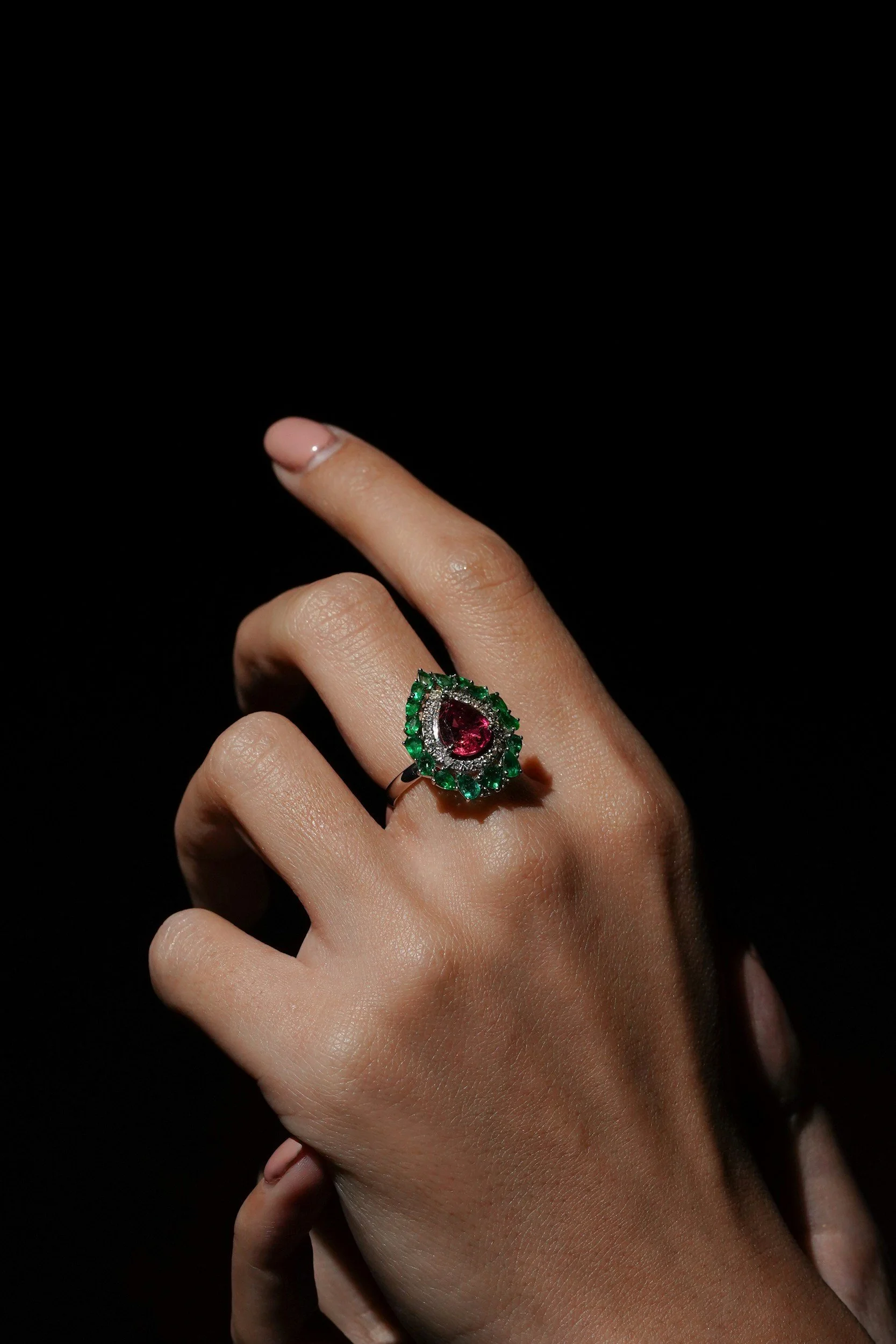
None of this means a softer or more delicate stone is off the table — it just means going in with clear, accurate expectations about how to protect it, rather than a generic durability chart that flattens real differences between stones.
If You Already Know Which Stone You Want
If you're set on a specific colored gemstone — an emerald, a morganite, a particular sapphire — that's exactly what gets built. The design process centers on making sure you understand that stone's physical characteristics and daily care requirements clearly enough that living with it feels effortless rather than anxiety-inducing.
If You Just Know You Want "Something That Isn't a Diamond"
This is a more common starting point than people expect, and it's a perfectly good one. If a client isn't attached to a specific stone but knows they want, say, a pink stone that isn't a diamond, that opens up options like pink sapphire, pink spinel, or a light ruby — stones that deliver a similar color family with significantly more durability for daily wear than some of the softer, more fashionable alternatives.
Color Becomes the Design's Primary Language
With a diamond, the design conversation centers on cut, brilliance, and setting. With a colored center stone, color becomes the organizing principle of the entire piece — which changes how every other decision gets made.
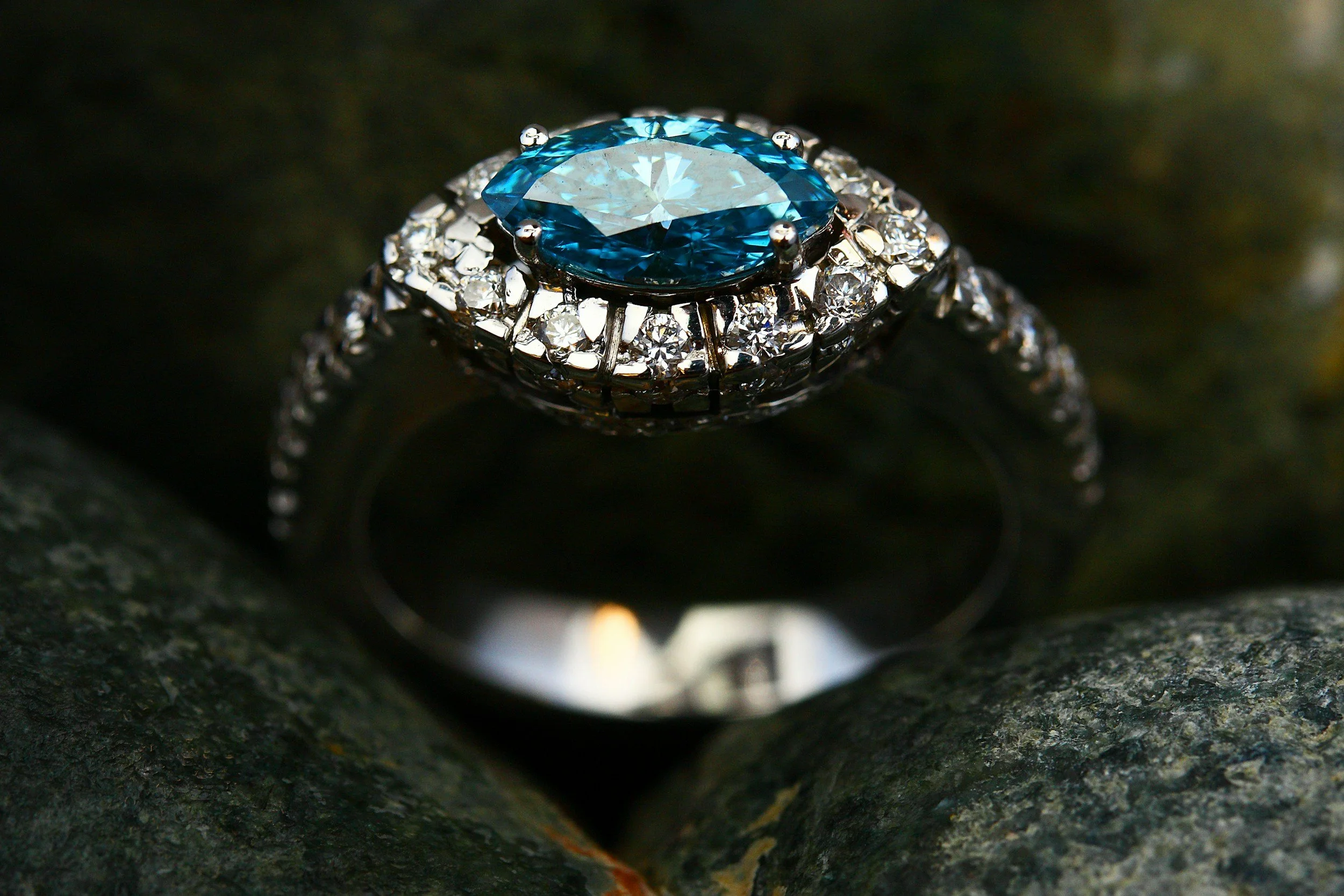
Metal tone matters more. The warmth of 18k yellow gold can deepen the richness of an emerald in a way white metal doesn't. Platinum tends to make a saturated blue sapphire look crisp and architectural, rather than warm. Rose gold can soften an otherwise formal stone into something quieter. None of these pairings are automatic — they're decisions made specifically around the stone you've chosen.
Why a Colored Stone Often Feels More Personal
A colorless diamond, however beautifully cut, tends to read as a conventional choice — recognizable, expected, safe. A colored center stone shifts the piece away from that default entirely. It becomes an intentional, specific statement about mood, heritage, or meaning, rather than a piece that could belong to almost anyone.
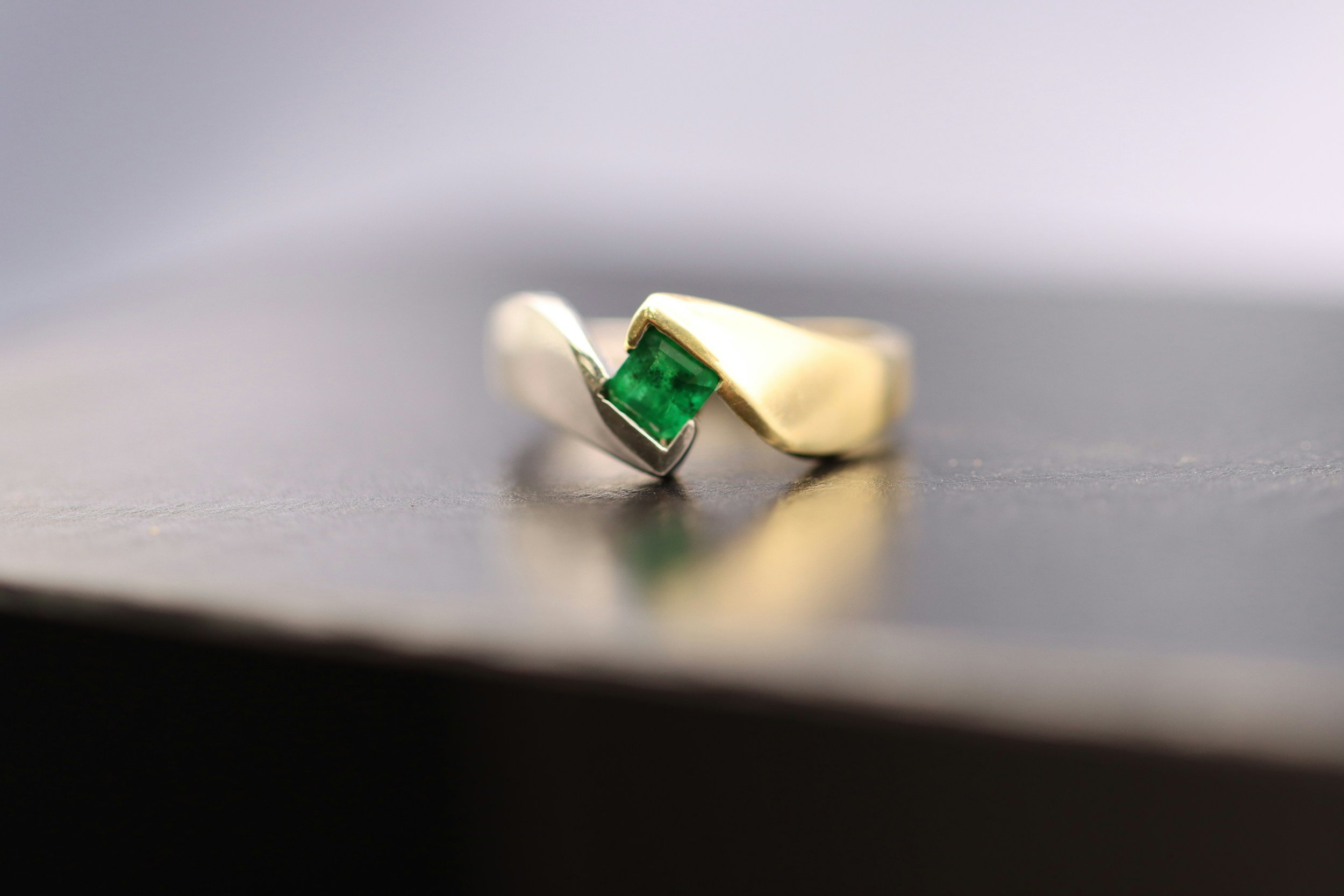
That's often the actual draw for clients who choose color: not that they dislike diamonds, but that they want the ring to say something more specific about who they are.
Treatment Isn't Automatically a Red Flag
Most colored gemstones on the market have been treated in some way — heat treatment for sapphires, clarity enhancement for emeralds, and so on. Treatment by itself isn't a defect. The real question is whether it's disclosed, whether it's stable over time, and whether it's compatible with how you actually intend to wear and care for the stone. An emerald with well-documented, traditional oil enhancement can be a completely sound, long-term choice. The same stone with an undisclosed or unstable treatment is a very different proposition. Knowing the difference — and asking about it directly — matters more than avoiding treated stones altogether.
How the Stone Shapes the Actual Design
A colored gemstone's specific characteristics don't just affect which stone you choose — they shape how the entire piece needs to be engineered around it. This is where a lot of the real design thinking happens, and it's easy to overlook if you're only comparing stones on paper.
Bezel versus prong protection. A more delicate or inclusion-prone stone often benefits from a full or partial bezel, which shields the girdle and edges from daily impact in a way open prongs can't.
Stone orientation. Certain cuts and inclusion patterns hold up better oriented one way over another — this is a judgment call made stone by stone, not a fixed rule.
Exposed corners. Pointed shapes like pear, marquise, or emerald-cut stones are more vulnerable at their corners, which often calls for reinforced prongs or protective metalwork specifically at those points.
Setting height. A lower-set stone sits closer to the finger and is naturally less exposed to catching or impact than a high-set stone, which matters more for someone with an active day-to-day life.
Cleaning restrictions. Certain treatments can't tolerate ultrasonic cleaners or certain chemicals, which affects not just how the stone is maintained after the ring is finished, but sometimes how it can be safely cleaned during fabrication itself.
We'll sometimes recommend against a particular stone for a specific client's lifestyle — not because the stone isn't beautiful, but because the honest answer is that it won't hold up the way they'd want it to. That judgment call is part of what a real consultation is for.
What to Ask Before You Commit
Is this stone durable enough for how I actually live day to day?
What treatments, if any, does this stone commonly have, and are they stable, disclosed, and compatible with how I'll wear and care for it?
How will the metal tone I'm considering interact with this stone's color?
Does the design protect this specific stone's vulnerable points — corners, girdle, inclusions — or is it purely decorative?
Am I choosing this stone because I love it, or because it's currently trending — and does that distinction matter to me?
If you're weighing a colored gemstone for your own commission, that decision is worth working through with someone who can walk you through the specific stone's character, not a generic durability chart. Begin a private consultation, or read more about how we source gemstones for one-of-one commissions.
The Bespoke Engagement Ring Process, Start to Finish
From the first conversation to the final polish, here's exactly what happens when you commission a bespoke engagement ring — and why none of it looks like picking from a catalog.
Most explanations of the "custom ring process" are really explanations of a product configurator: pick a setting, pick a stone, pick a size, check out. That's customization. It's not what happens at Gerard Rene, and it's not what the word bespoke actually means.
This is the general process behind a Gerard Rene bespoke engagement ring commission — from the first conversation through final quality control. The sequence can vary depending on the piece, particularly when gemstone sourcing, design development, and engineering overlap, but the underlying process remains the same.
Step One: We Learn Who the Ring Is For
The first thing we want to know isn't your budget or your metal preference. It's how you two met, how long you've been together, what her day-to-day life actually looks like. Does she wear jewelry often, or almost never? Is she active, or does she work a desk job? Does she care how her ring compares to what her friends and family wear, or is that irrelevant to her? Where someone lives even factors in — a large center stone reads differently in New York than it does somewhere it would make the wearer feel conspicuous rather than confident.
If a client already has strong references — a folder of saved images, a clear point of view — we let that lead. If they arrive with nothing but a feeling, we build the design from everything they've told us about their life, their values, and what they want the ring to say. Either way, the goal of this stage is the same: understanding the person well enough that the ring could only have been made for them.
Step Two: Reading the References
When a client sends twenty saved photos, we're not just looking at what's pretty. We're looking for what repeats — stone shapes, proportions, metal tones, whether the eye is drawn to architectural lines or organic movement, negative space, symmetry, engraving, pavé. If there's no obvious throughline, we ask a simpler question: out of everything you've shown me, what's your single favorite detail from each one? That's usually enough to reverse-engineer a taste the client hasn't fully articulated yet.
Step Three: Concept Sketches
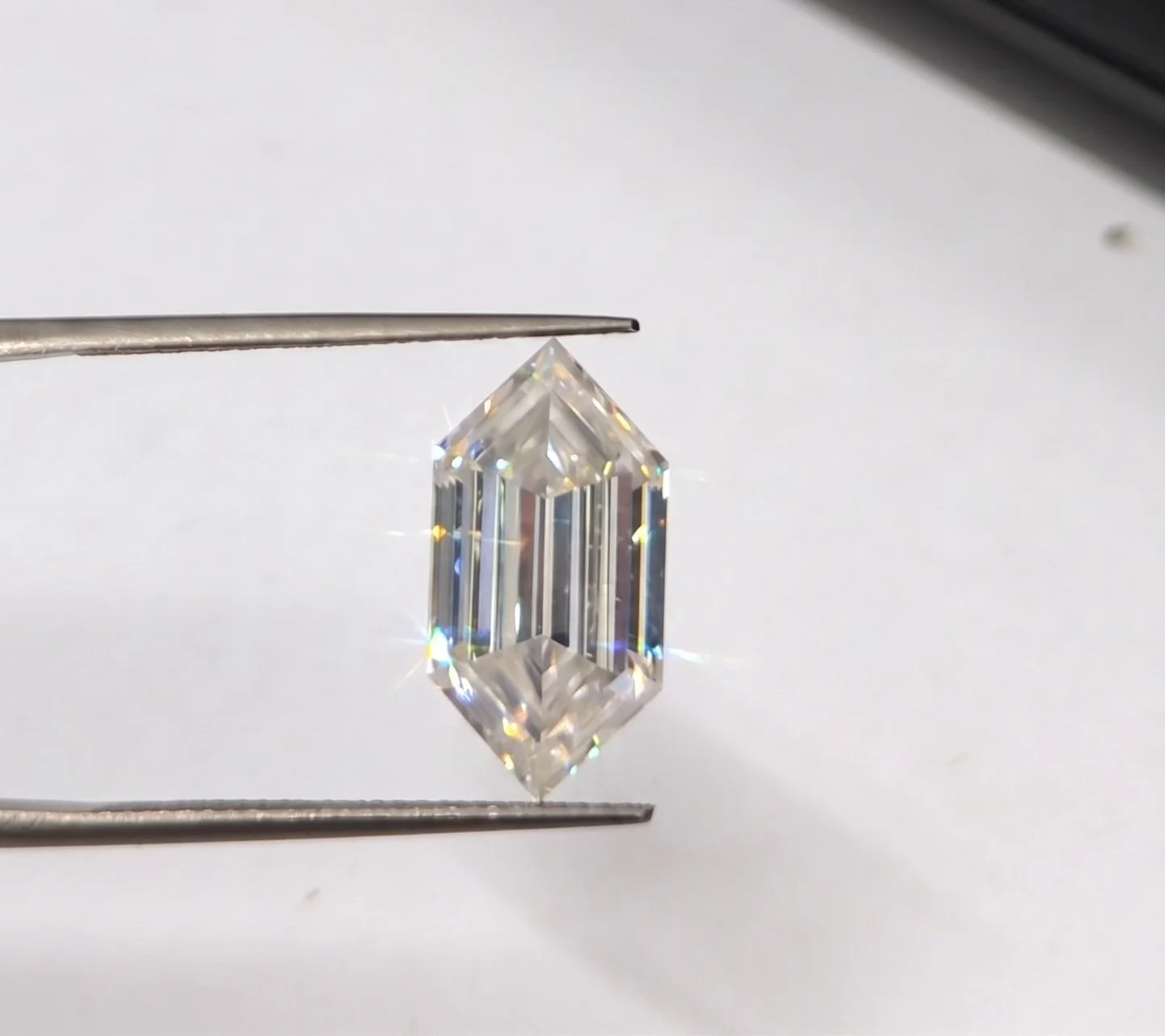
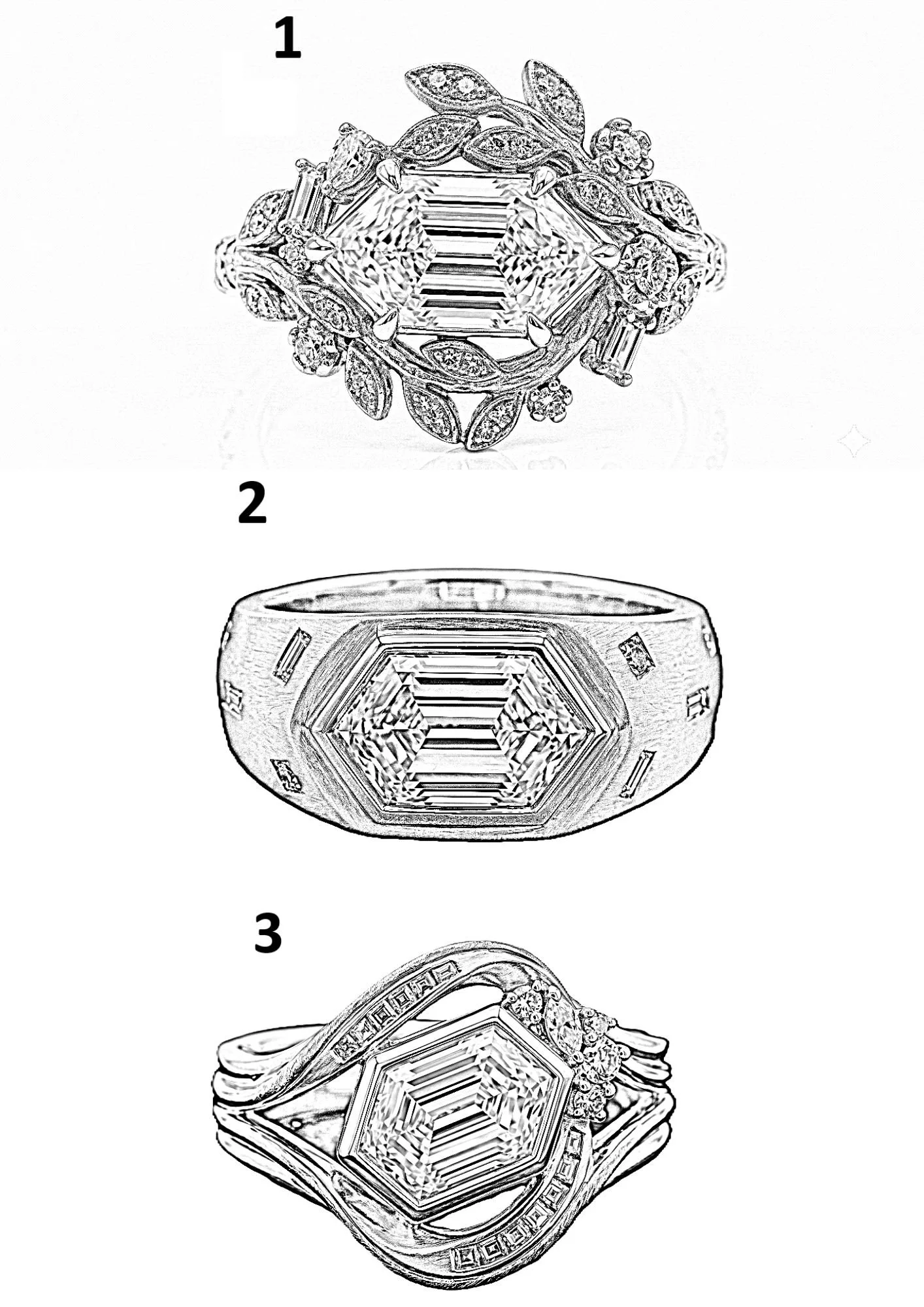
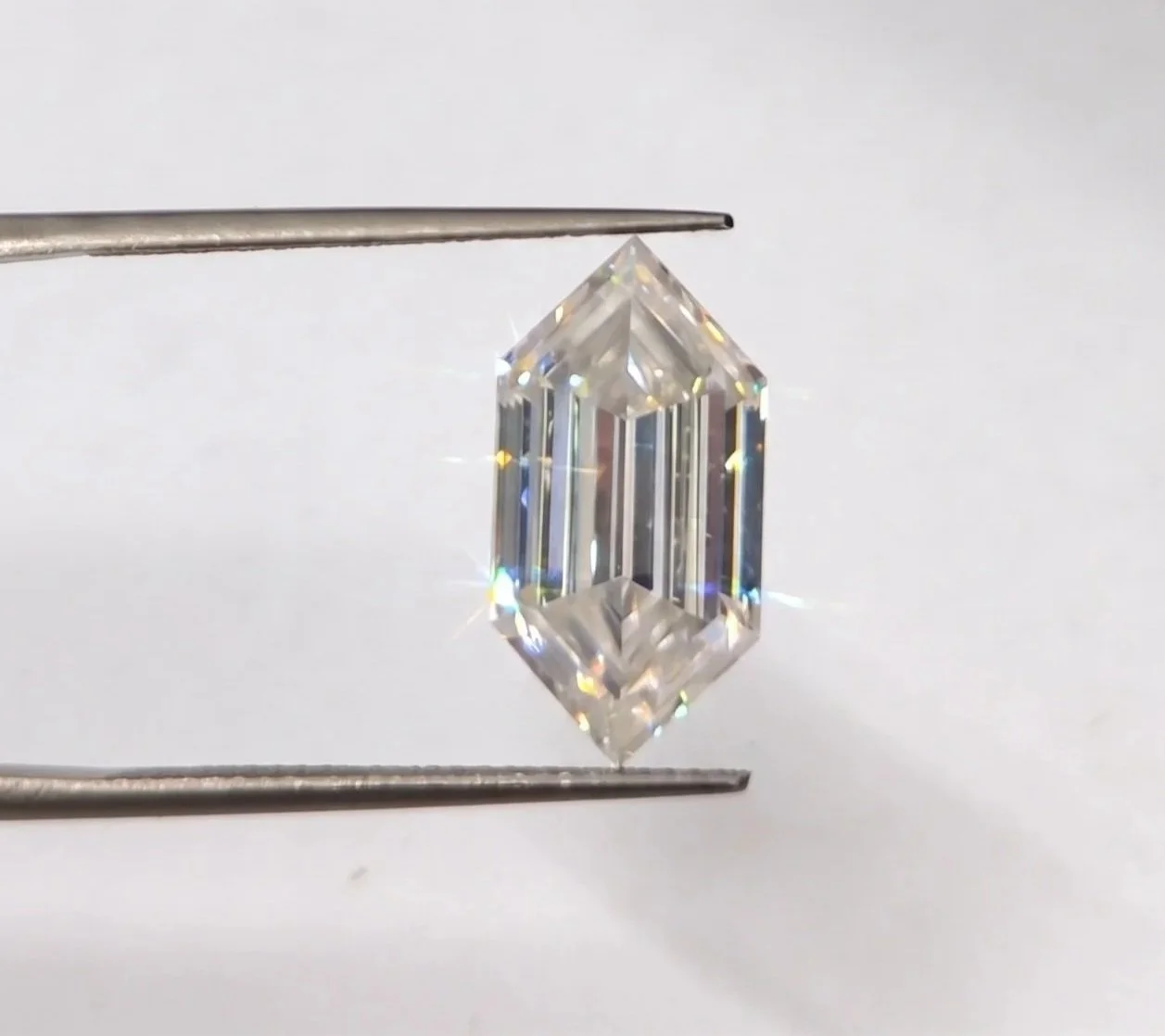
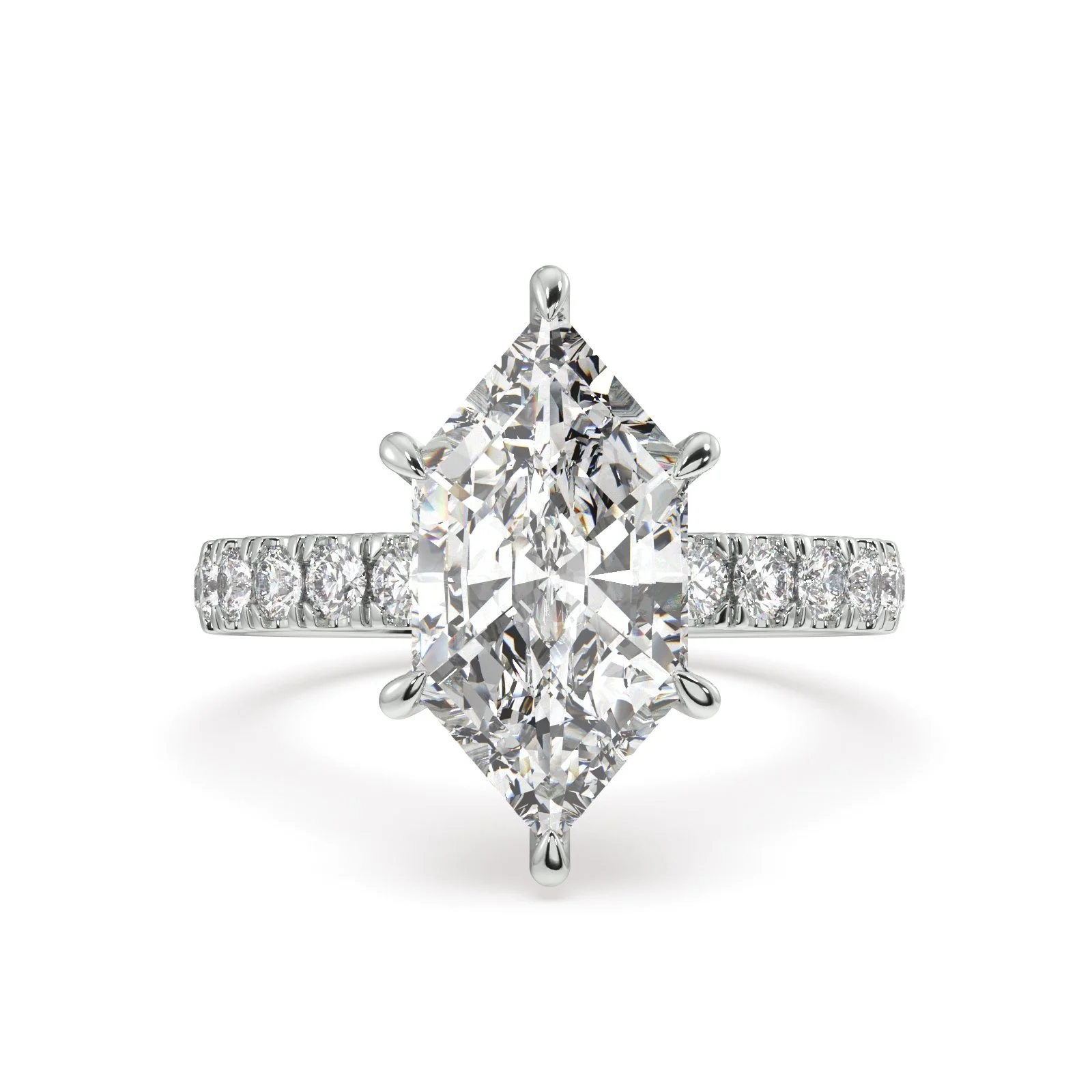
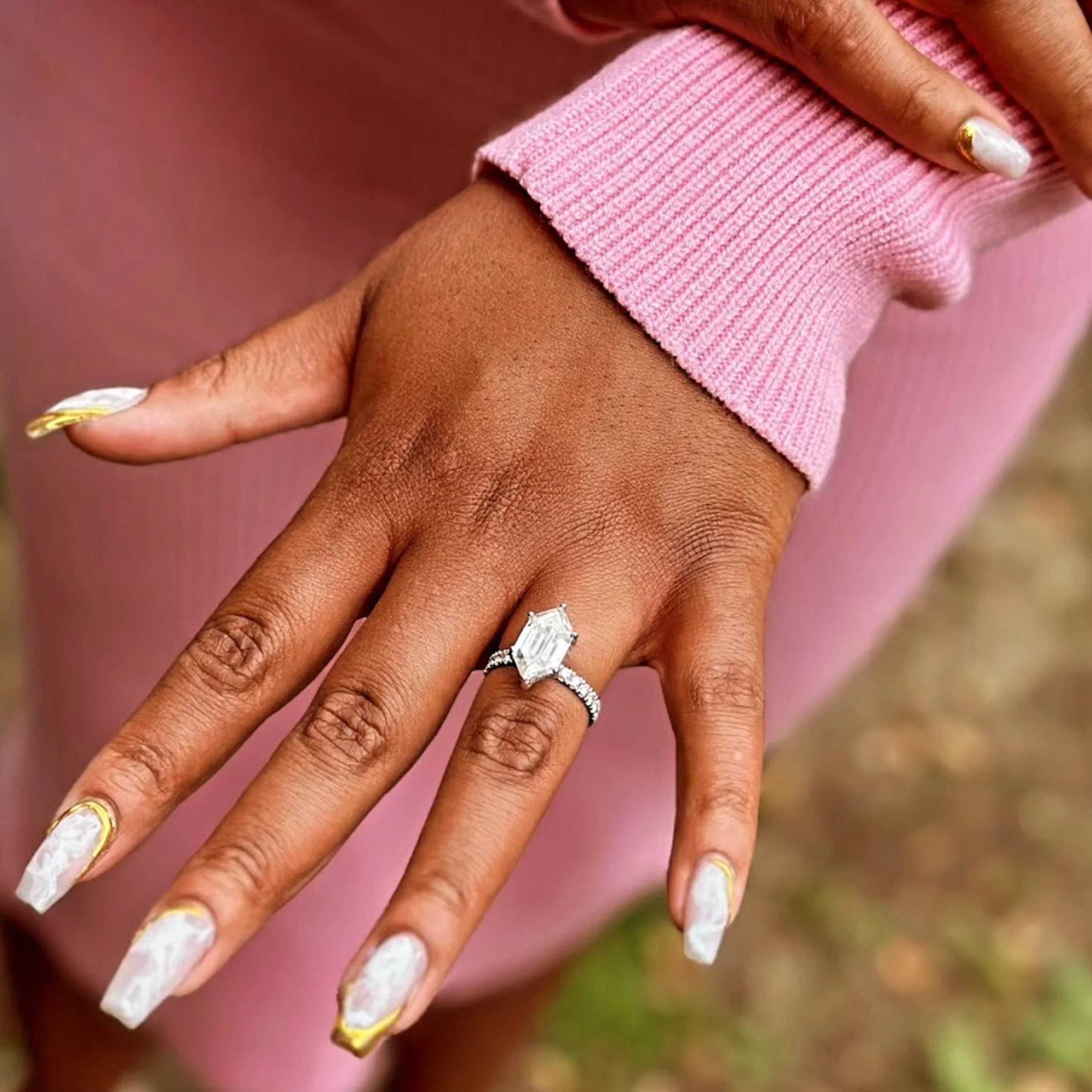
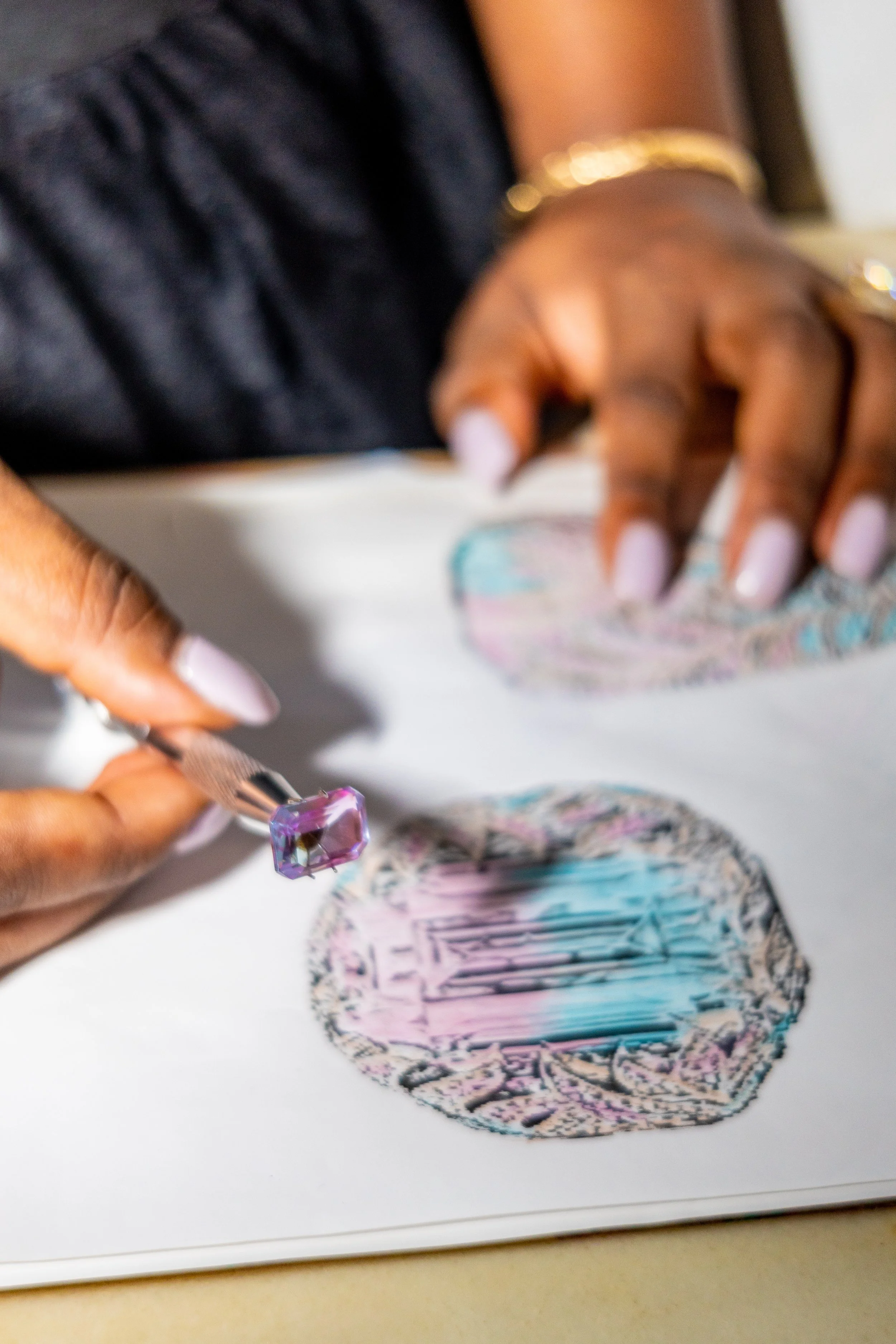
From there, we sketch — typically three or four directions, sometimes rendered in color to help a client visualize the design more concretely. This is a deliberately iterative stage. We're not trying to land on the final design in round one; we're learning, from what a client says no to, exactly what they're actually looking for. One recent client's fiancé handed us reference images of a pear-shaped diamond and said that was "exactly" what she wanted. We designed three pear options — and when we finally spoke with her directly, she was happy, but not thrilled. It took one honest conversation to learn she wanted a center stone shape almost no one else had. She ended up choosing an elongated hexagon cut that never would have surfaced from the original brief alone.
Step Four: CAD — Where the Design Becomes Real
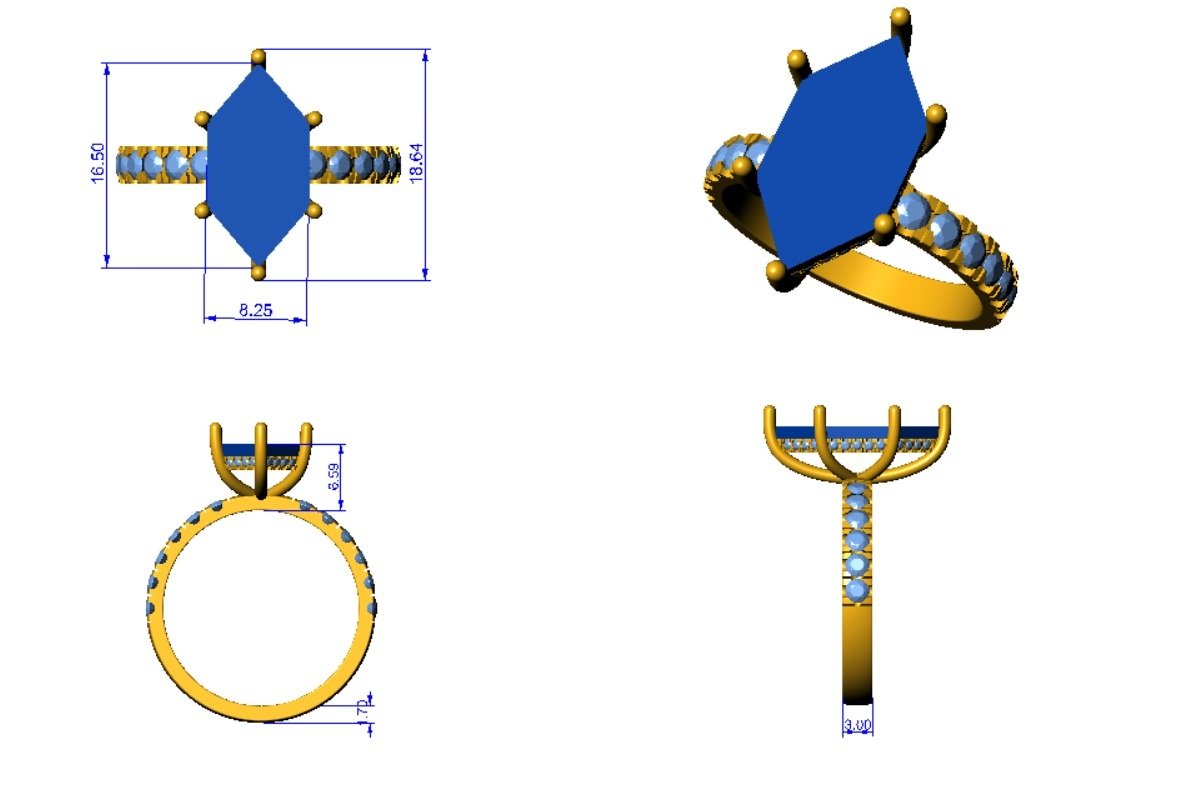
Once a direction is chosen, the piece moves into CAD. This is genuinely the moment a concept stops being an idea and starts being engineered. Sketches can be more elaborate than what's physically or structurally possible, and CAD is where that gets tested — proportions, structural integrity, manufacturability. This stage typically takes anywhere from a day to a week depending on complexity, and it's also where our design standards get applied. At Gerard Rene, for example, we generally avoid bands below 2.5mm in designs intended for everyday wear, because thinner structures can be more vulnerable to bending or deformation.
Step Five: Stone Sourcing
Whether the center stone is a diamond or a colored gemstone, sourcing follows the same underlying discipline, adjusted for what each material rewards. For diamonds, cut quality matters more than chasing the highest color and clarity grade — a slightly lower color can read beautifully in certain gold tones, and a stone that isn't clinically perfect often has more character. For gemstones, the same logic applies, with even more weight given to how the stone's individual personality — its inclusions, its color zoning, the way light moves through it — will read in the final piece. Every stone is vetted for its cut, its visual presence, and its documentation before it's approved for a commission. Depending on the client, this sourcing sometimes happens before design work begins, and sometimes runs alongside it.
Step Six: Renders and Refinement
Once the CAD is finalized, we provide both photo and video renders so the design can be evaluated from every angle before production begins. This is the last checkpoint before the piece becomes physical — the moment to confirm the proportions, the stone placement, and the overall composition feel right.
Step Seven: Production
From approved renders, the ring moves into fabrication. Depending on the design, this may involve hand fabrication, casting, or a combination of both — hand fabrication for crisp, dense, structurally demanding architecture, casting for sculptural or organic forms that would be nearly impossible to achieve any other way. Problems can surface here that never showed up in CAD: a setting that needs reinforcing, a stone that needs to be re-secured, a material behaving differently than expected. We solve these as they arise rather than compromising the final piece to protect a deadline.
Step Eight: Quality Control
Before any ring leaves the atelier, it's reviewed under magnification — prong thickness, prong alignment, band durability, stone security. If it doesn't meet that standard, it isn't finished yet, regardless of the calendar.
What Makes This Bespoke, Not Custom
Customization is choosing from a menu — swapping a setting, resizing a stone, picking from six hundred pre-built templates. Bespoke is different in kind, not just degree. It's design built entirely around a person's story, informed by a real conversation about who they are and why this piece matters, rather than assembled from existing options. That distinction is the entire premise of this atelier.
Ready to begin? Start your commission, browse past one-of-one pieces, or read about what determines the price of a custom engagement ring to understand where the investment actually goes.
What to Do With an Engagement Ring After a Broken Engagement or Divorce
A ring from a relationship that's ended doesn't have to stay frozen in what it used to mean. Here's how it can become something that belongs to your next chapter.
If an engagement ends, the ring can become an unexpectedly complicated object. It may have significant monetary value, family history, or a beautiful gemstone that you still love — even if the meaning attached to the ring has changed.
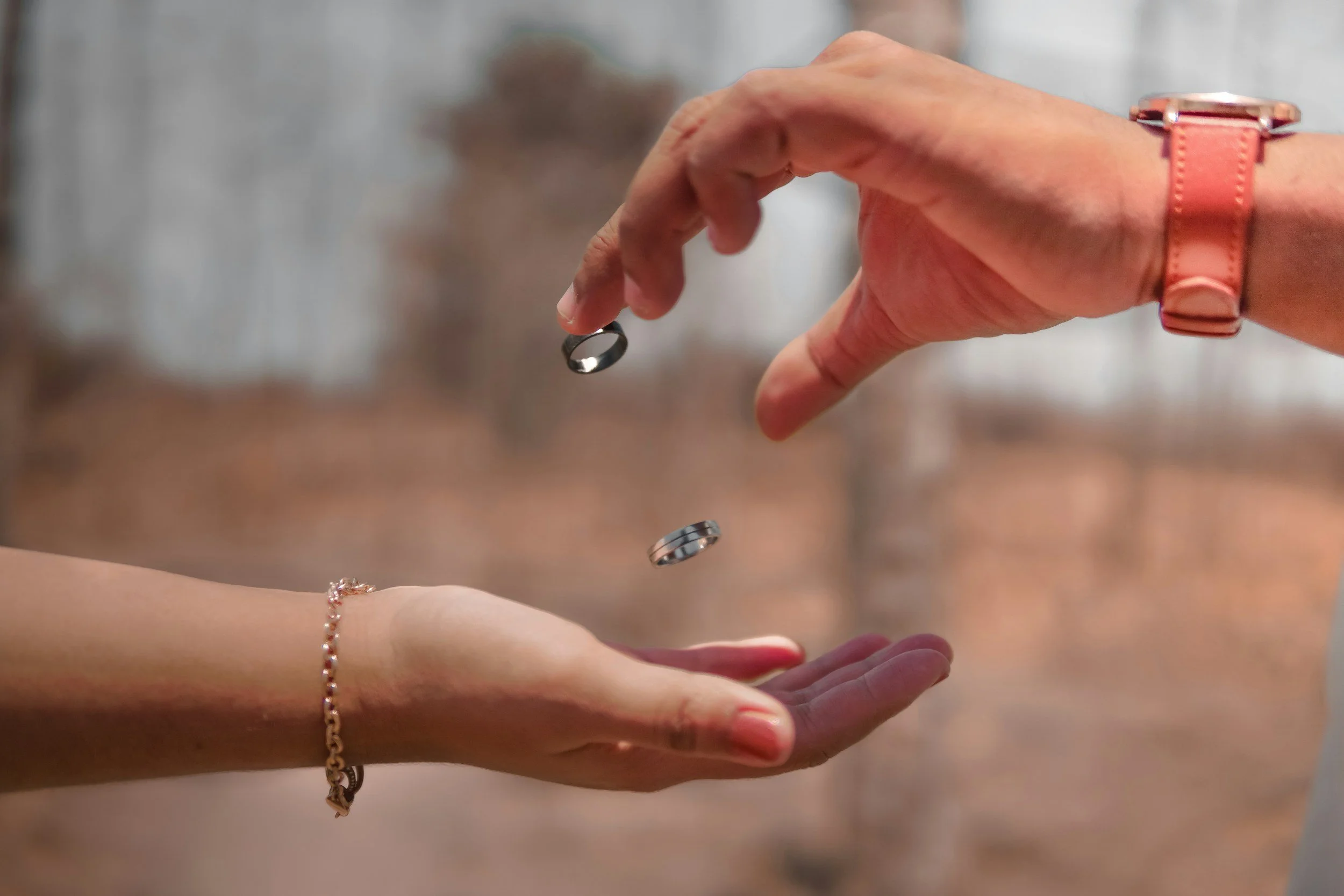
There isn't one right answer. You can sell it, put it away, pass it on, or leave it untouched. But another option is to recommission the jewelry entirely: preserve the materials that still matter to you while creating something that belongs to the life you're living now.
What Jewelry Mediation Can — and Can't — Resolve
If an engagement ring is part of a divorce or a broader property division, jewelry mediation may come into play — helping determine ownership, how the piece's value should factor into a settlement, or who retains it. That process resolves the ring from an ownership standpoint.
What it doesn't resolve is what happens next, creatively. Mediation determines what happens to the jewelry legally. Redesign determines what happens to it artistically. Those are two separate questions, and Gerard Rene isn't in the business of the first one — we're not mediators and this isn't legal advice. But once ownership is settled, the second question is exactly where we come in.
What Happens When You Recommission the Ring?
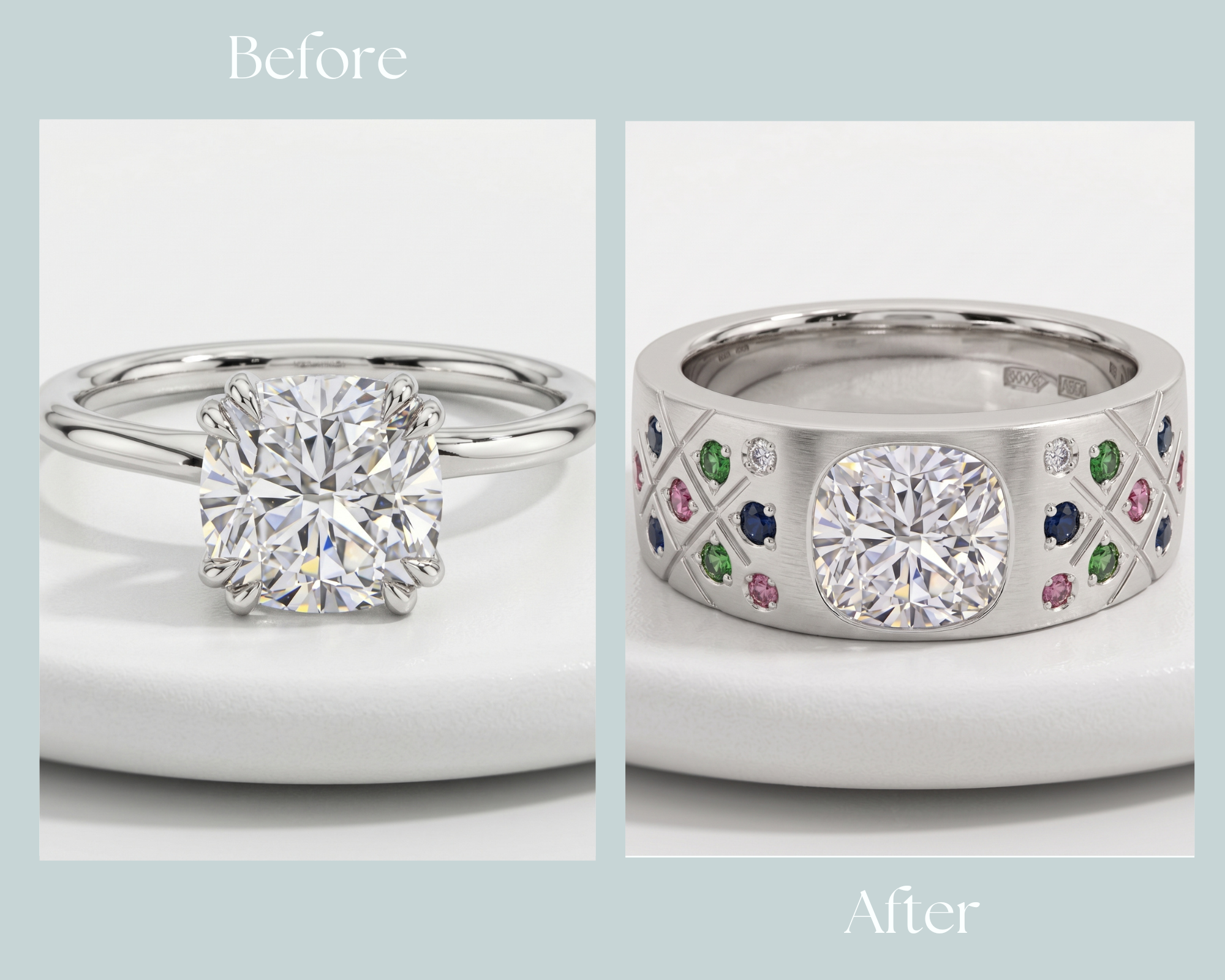
A former engagement ring doesn't have to remain a ring, and it doesn't have to look bridal to remain meaningful. Recommissioning means taking the existing materials — the center stone, accent stones, sometimes the metal itself — and rebuilding them into something designed around who you are now, not who you were when the ring was given.
The ring becomes something completely different. One current Gerard Rene commission began with exactly this question: what could be created from the existing jewelry that would feel entirely removed from its original bridal context? We're currently developing earrings from the original stones — a form that has nothing in common with an engagement ring except the material itself.
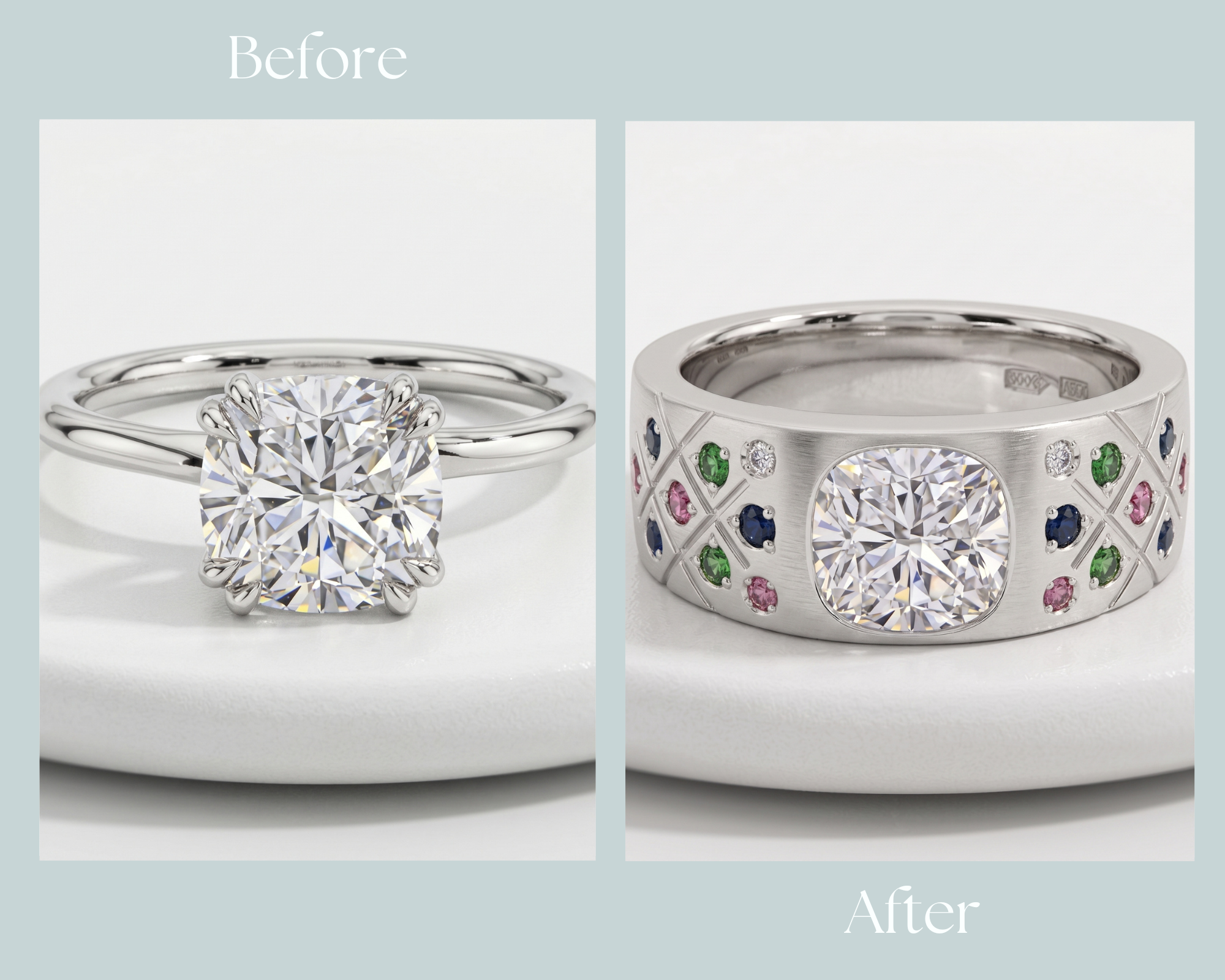
The ring remains a ring, but no longer reads as bridal. In another current commission, the piece will stay a ring, but almost nothing about its new identity will resemble the original. The design is being completely reimagined as a right-hand ring, intended to be worn on the middle finger rather than the ring finger. The goal isn't to disguise the stone's history — it's to give it a new context that has nothing to do with an engagement.
What Can an Engagement Ring Become?
A completely new ring. The original stone can become the centerpiece of a design with an entirely different silhouette, proportion, metal, or architectural language than the original.
A right-hand or statement ring. The stone can be redesigned specifically for non-bridal wear, with proportions and styling deliberately moved away from engagement-ring conventions.
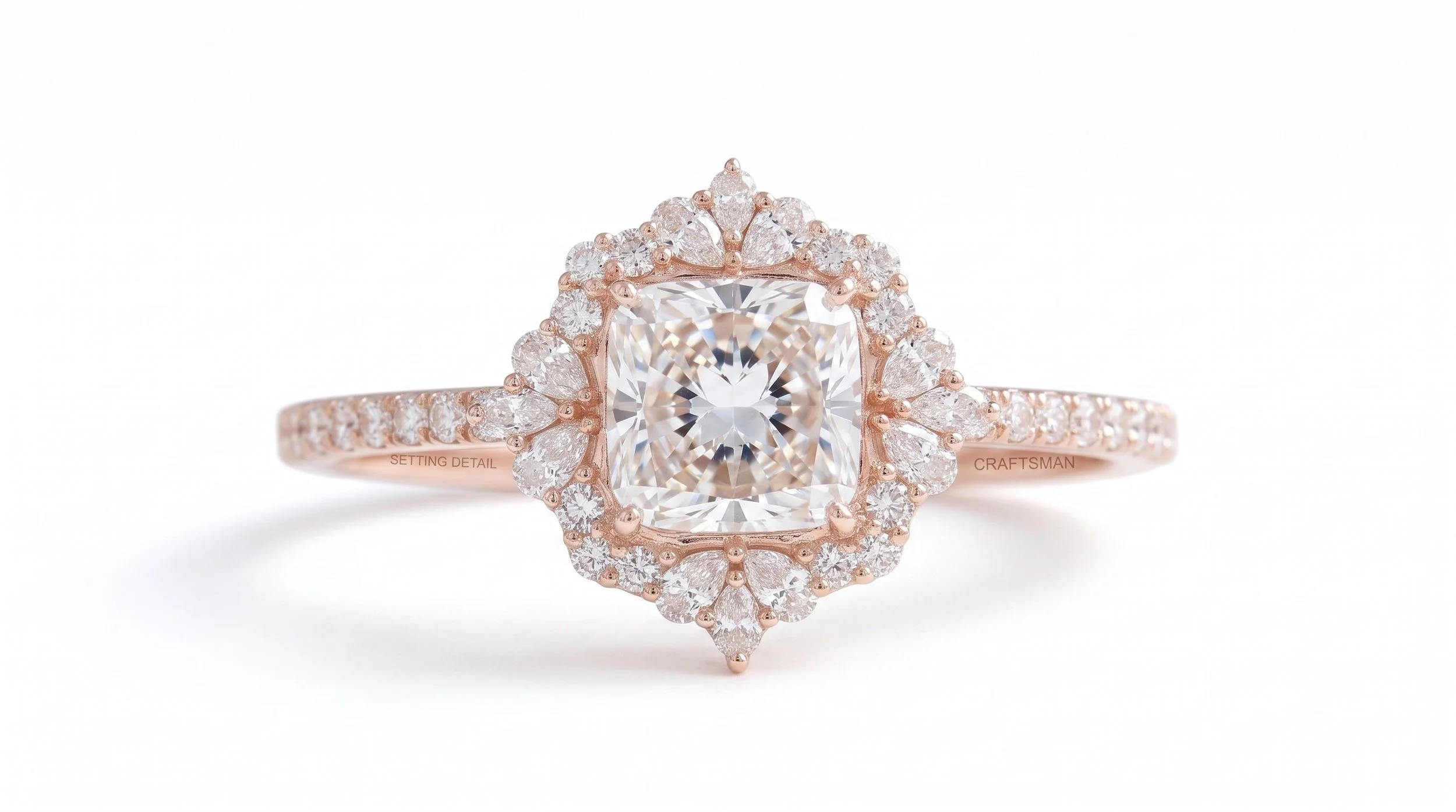
Earrings. One or more stones can become earrings, depending on what's available and the design direction.
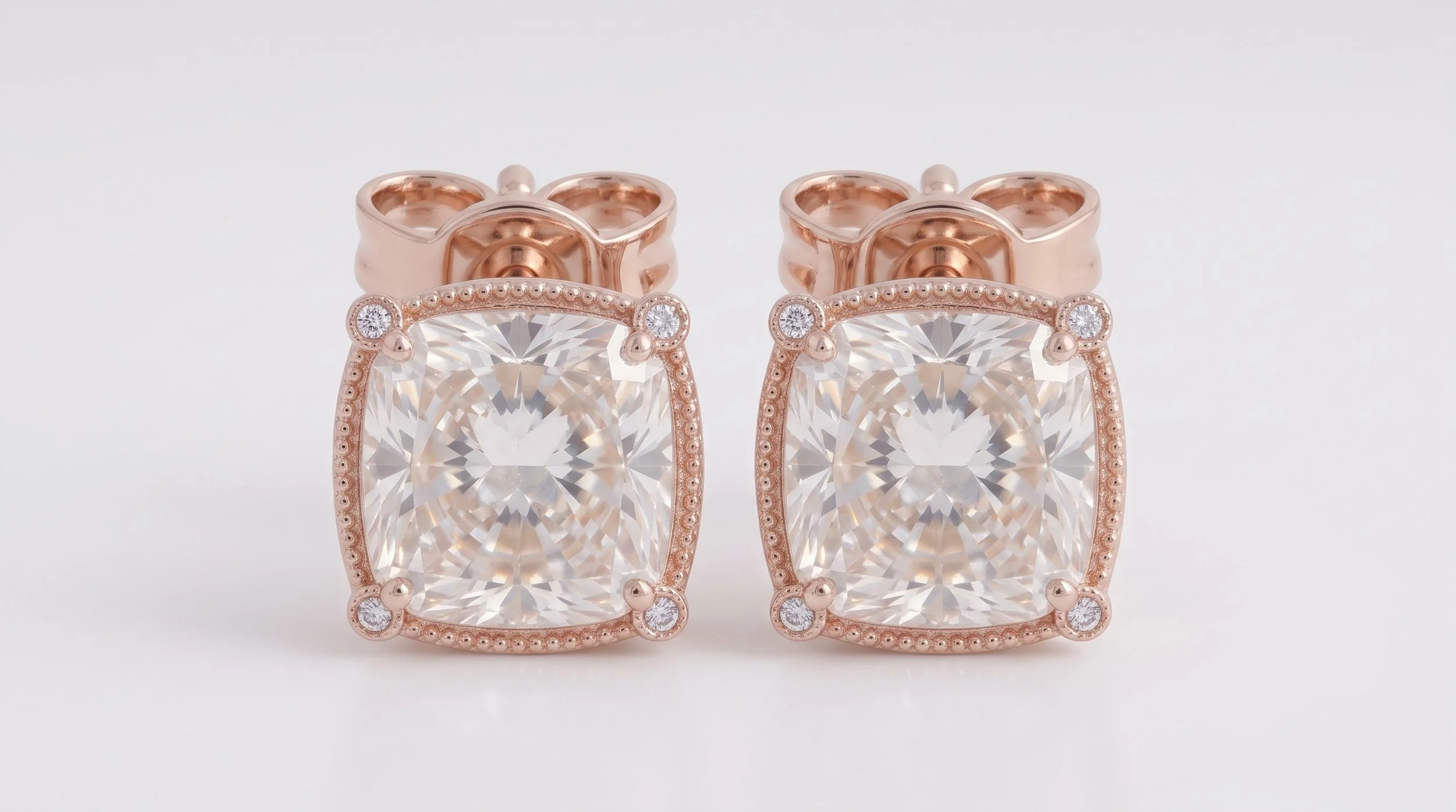
A pendant or other jewelry. This is a valid path too, though usually not the most interesting design opportunity available.
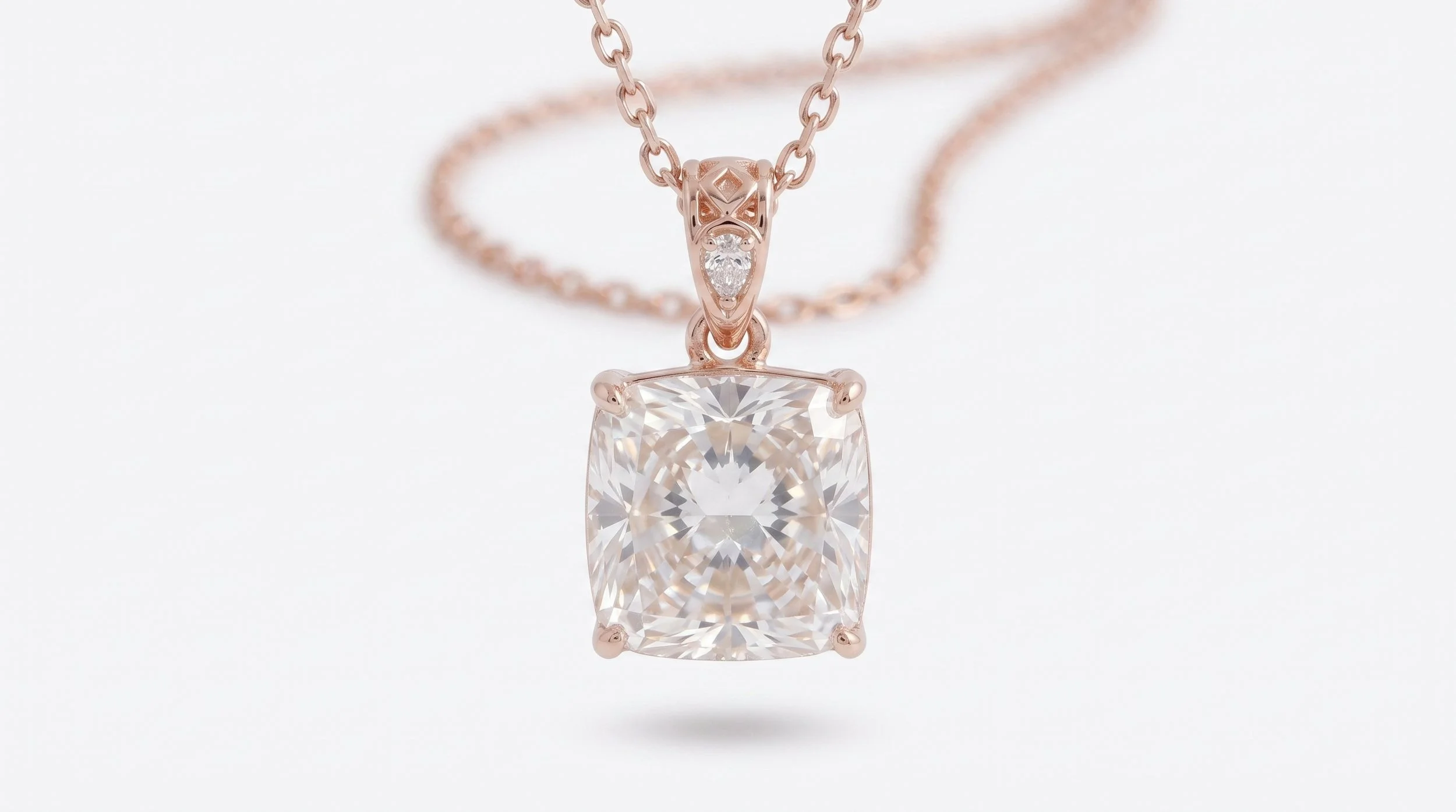
A multi-piece commission. If the original jewelry contains several stones or materials worth preserving, it can become the starting point for more than one new piece rather than a single replacement.
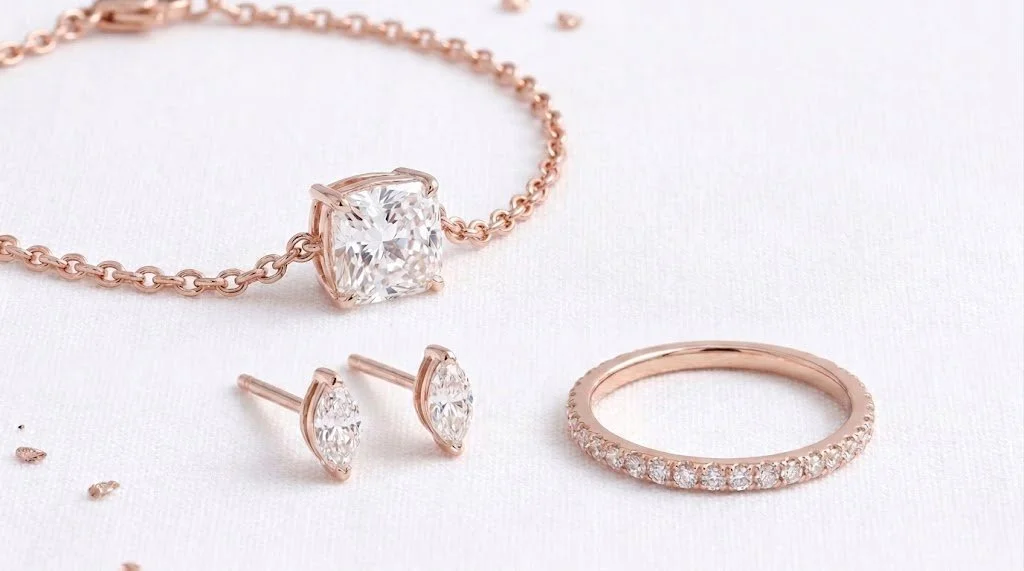
What Should Stay — and What Should Go?
This is where the actual design thinking happens, and it's different for every commission:
Is the original center stone worth preserving on its own merits?
Are the accent stones reusable, or better set aside?
Should the original metal be retained, or fully replaced?
Does any part of the original setting have artistic or historical value worth carrying forward?
Should the new piece look deliberately nothing like the original?
Or should one subtle element survive as a quiet connection to the past?
What does the client actually want the new piece to represent?
There's no default answer to any of these. That's the point of a private consultation rather than a standard package.
Redesign Doesn't Have to Erase the Past
The goal isn't necessarily to erase the history of the piece. Sometimes the history is precisely why the material is worth preserving. The real question is whether the object still belongs to the person you are now.
A redesign can acknowledge what the piece once represented without requiring it to continue representing that thing. The stone doesn't have to be forgotten. It just doesn't have to stay frozen in a form built for a different chapter of your life.
What We See in These Commissions
We've worked with clients who didn't want to discard the materials simply because the relationship ended — they wanted to reclaim them. In some cases, that means transforming a bridal ring into something entirely different. In others, it means retaining the gemstone while changing the silhouette so completely that the original ring is no longer recognizable. And sometimes the right answer is to take the stone somewhere it was never intended to go — into earrings, a pendant, or another form entirely.
The common thread isn't what the jewelry becomes. It's that the client gets to decide what it means now.
What If You Don't Want to Redesign It?
There are perfectly valid reasons to leave a piece untouched, sell it, or pass it to someone else. If you're not ready to make a decision, there's no reason to rush — and no version of this that has to happen on any particular timeline.
If You're Ready to Reimagine It
If you have an engagement ring from a relationship that has ended, and you're wondering whether the materials can become something entirely different, the first step isn't deciding what the finished piece should be. It's a conversation about what you have, what you want to preserve, and what you want the jewelry to mean now.
Begin a private conversation with Gerard Rene about a redesign or recommission.
How Long Does It Take to Commission a Custom Ring?
Six weeks or six months? The honest answer depends on more than most jewelers admit. Here's what actually drives a custom ring's timeline, stage by stage.
If you search "how long does it take to commission a custom ring," you'll find a lot of vague answers: "six to eight weeks," "it depends," "ask your jeweler." None of it tells you what's actually happening during that time, or why one commission takes five weeks and another takes five months.
At Gerard Rene, a private atelier building one-of-one engagement rings and heirlooms in New York City, timeline isn't something we hedge around. We tell clients upfront what to expect, because the honest answer is more useful than a comforting one. Here is what the process actually looks like, stage by stage.
The First Conversation Sets the Clock
Before anything is sketched, we need to understand who the ring is for — not just a budget and a metal preference, but the relationship itself. How long the couple has been together, how they met, what the wearer's day-to-day life looks like, whether she's drawn to a particular stone shape or detail and why. This conversation isn't a formality. It's the foundation the entire design rests on, and rushing it is the single fastest way to add weeks to a project later, because a design built on incomplete information almost always needs to be reworked.
Sketching: Typically the Fastest Stage
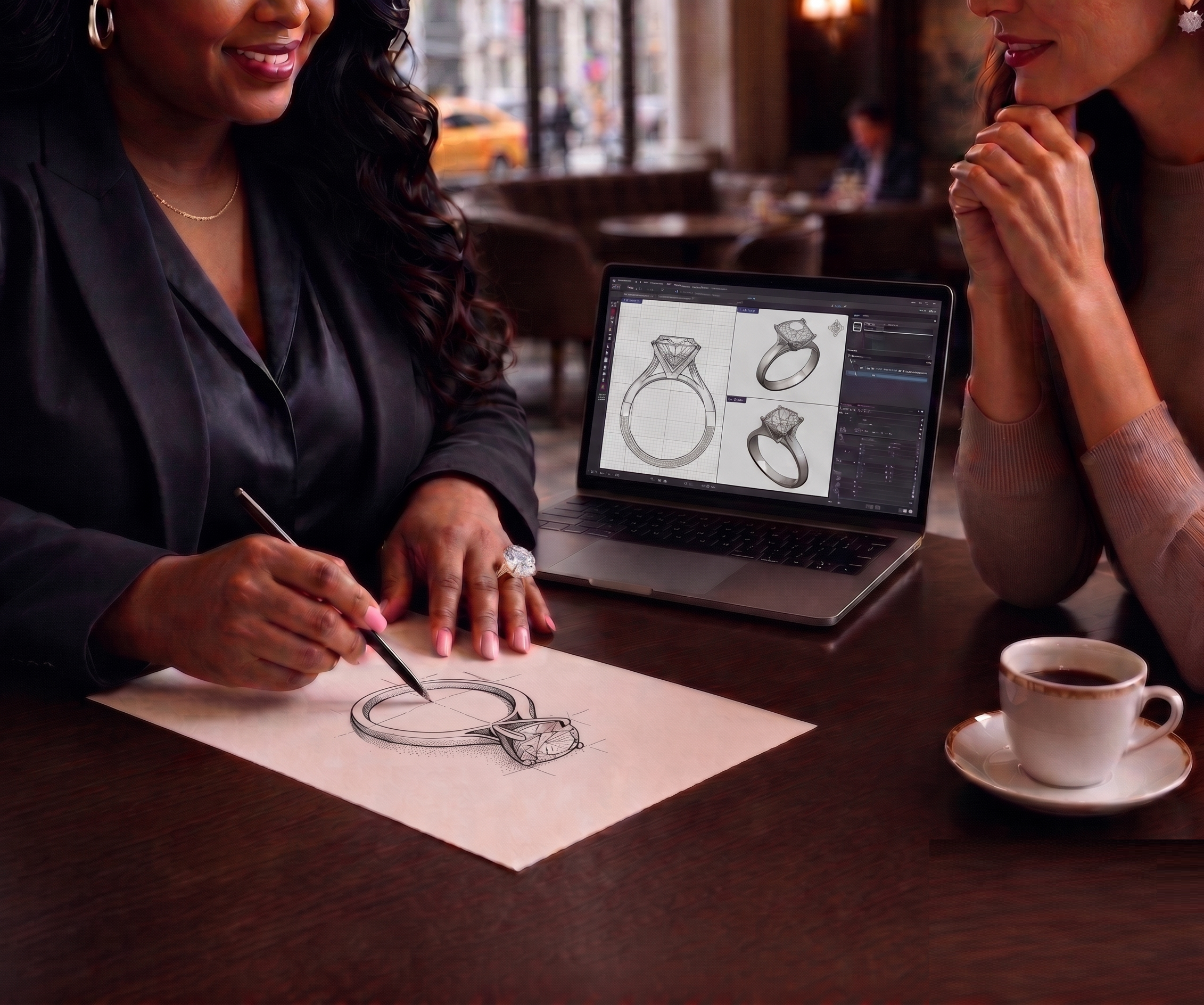
Once we understand the story, we move into concept sketches — usually three or four directions, refined based on what resonates and what doesn't. This stage moves quickly, often within days, because it's iterative by nature: we're not trying to get it perfect on the first pass, we're trying to learn what you respond to so the next round is sharper.
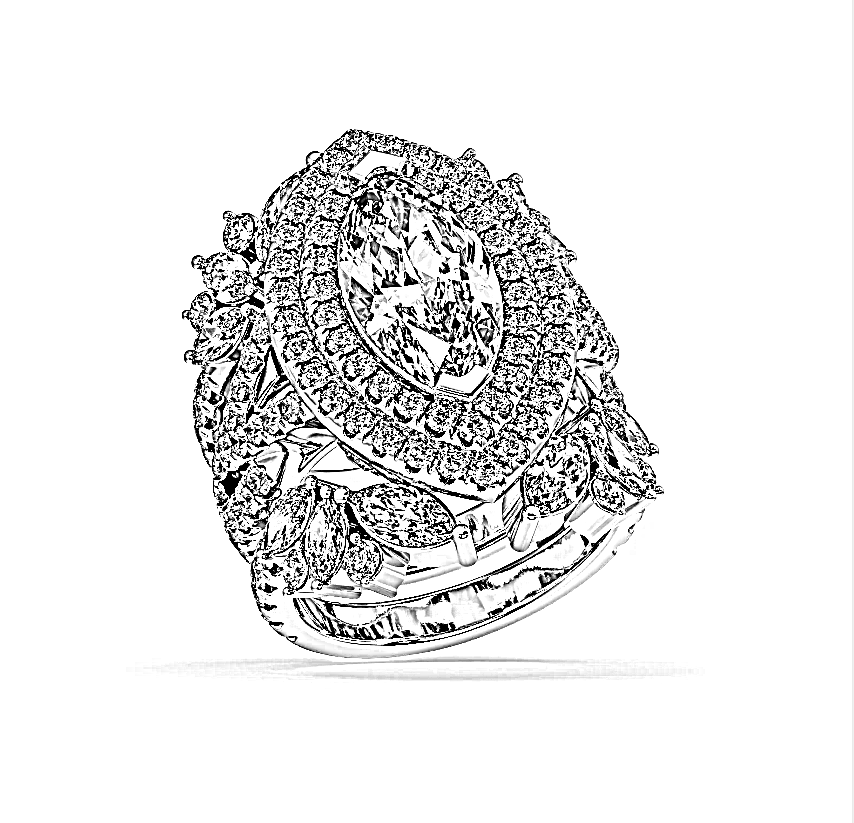
Original sketch of the Alumna wedding set by Gerard Rene atelier
CAD: One Day to One Week
Once a direction is chosen, the piece moves into CAD (computer-aided design), which is where a sketch either proves it can become a real, wearable object or reveals that it needs to be re-engineered. This stage can take anywhere from a single day to a full week, depending on the complexity of the design. An intricate, sculptural piece with hand-engraving, unusual stone placement, or asymmetrical settings simply requires more design iterations than a clean, architectural solitaire.
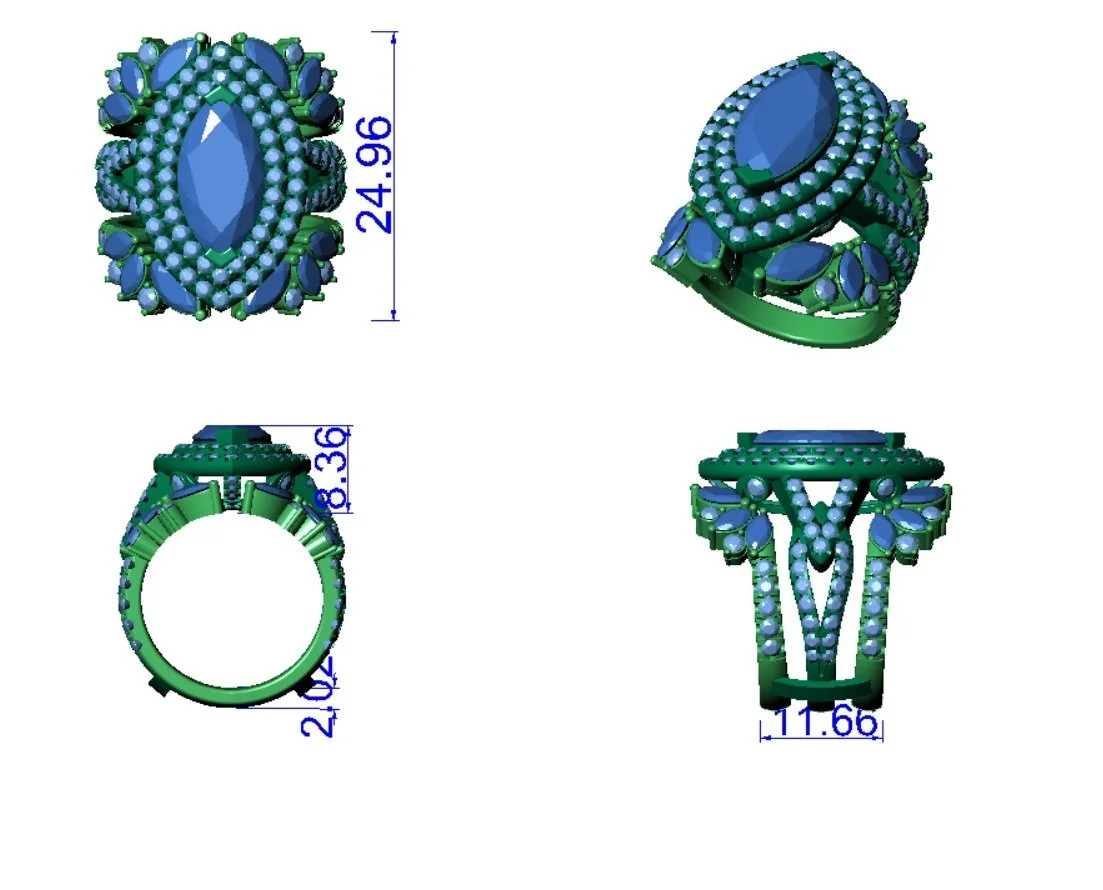
Original CAD of the Alumna wedding set by Gerard Rene atelier
This is also the stage where structural decisions get made that a client will never see but will absolutely feel over the life of the ring. At Gerard Rene, for example, we generally avoid bands below 2.5mm in designs intended for everyday wear, because thinner structures can be more vulnerable to bending or deformation over time. If a design concept conflicts with that kind of structural consideration, we solve it here, before production, rather than after.
Stone Sourcing Can Run in Parallel — or Add Time
If your design centers on a stone we already have vetted and in hand, sourcing adds nothing to the timeline. If it requires locating a specific stone — a particular color of sapphire, a rare cut, a gemstone with a certain character — this can extend the timeline meaningfully, because we don't compromise on documentation or provenance to save a week. Every stone that enters the atelier is vetted for its paper trail, its cut, and its visual presence, and that process takes as long as it takes.
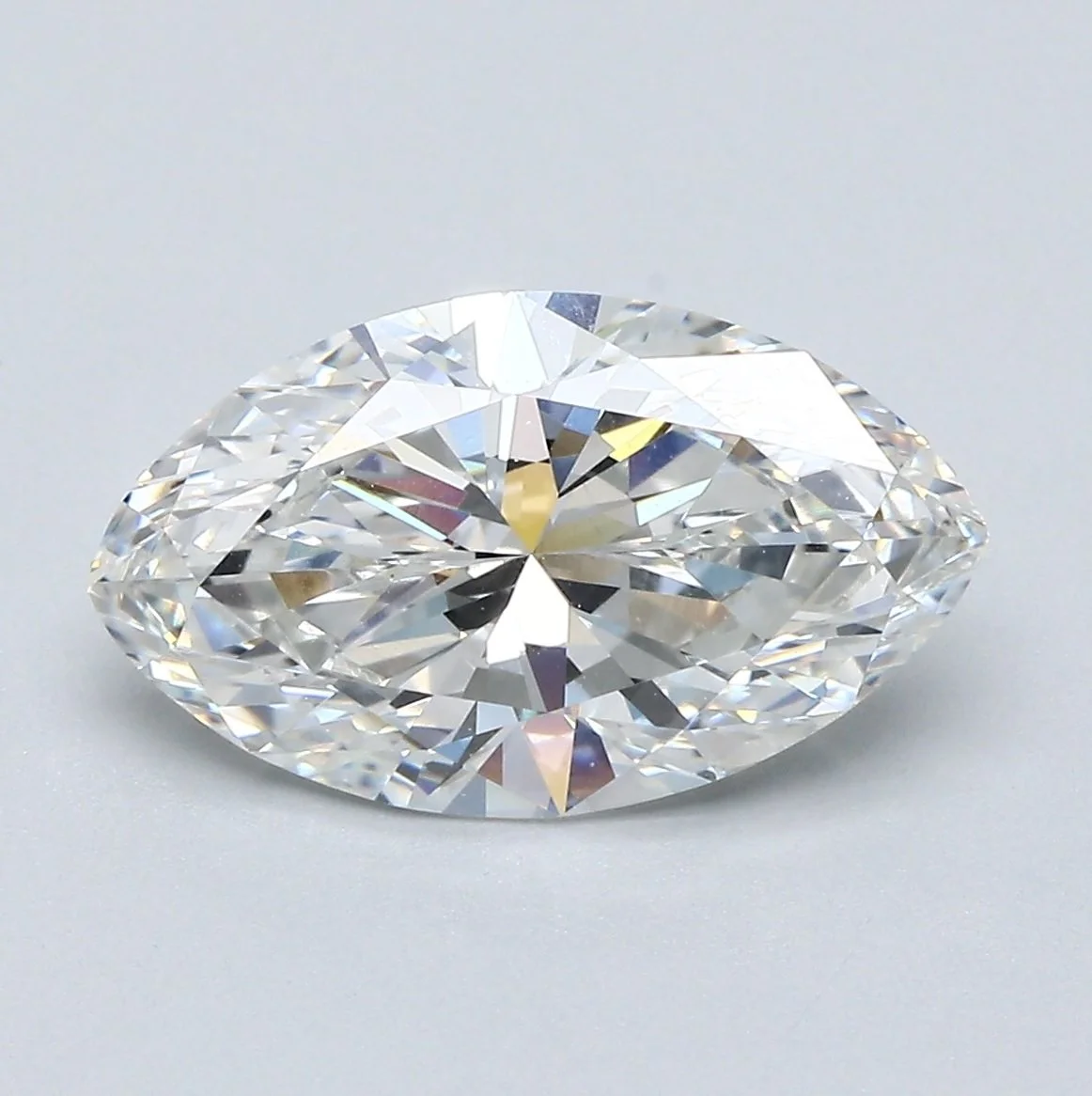
Marquise cut diamond sourced by Gerard Rene atelier
Production and Quality Control
Once the CAD is approved and stones are secured, the piece moves into fabrication. This is where the design becomes physical — and where the most legitimate reasons for a timeline to expand tend to appear. A setting that needs to be adjusted to properly secure a stone. A material behaving differently than expected. A structural detail that needs to be reinforced once it exists in metal rather than on screen. We'd rather solve these issues properly than ship a piece that won't hold up.
Before anything leaves the atelier, it goes through an internal review under magnification — checking prong thickness, band integrity, and stone security. If a piece doesn't meet that standard, it doesn't go out the door yet, regardless of what the calendar says.
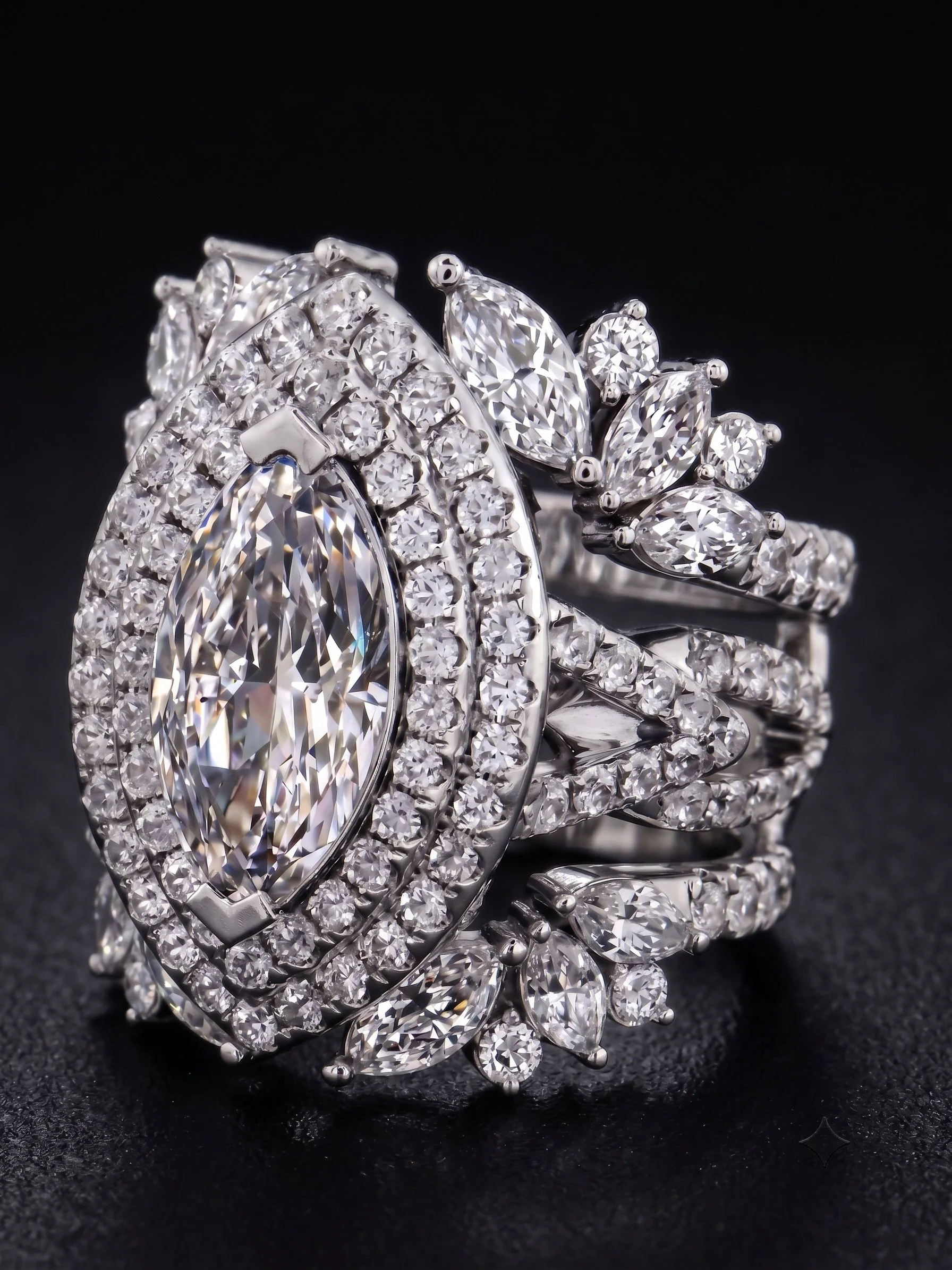
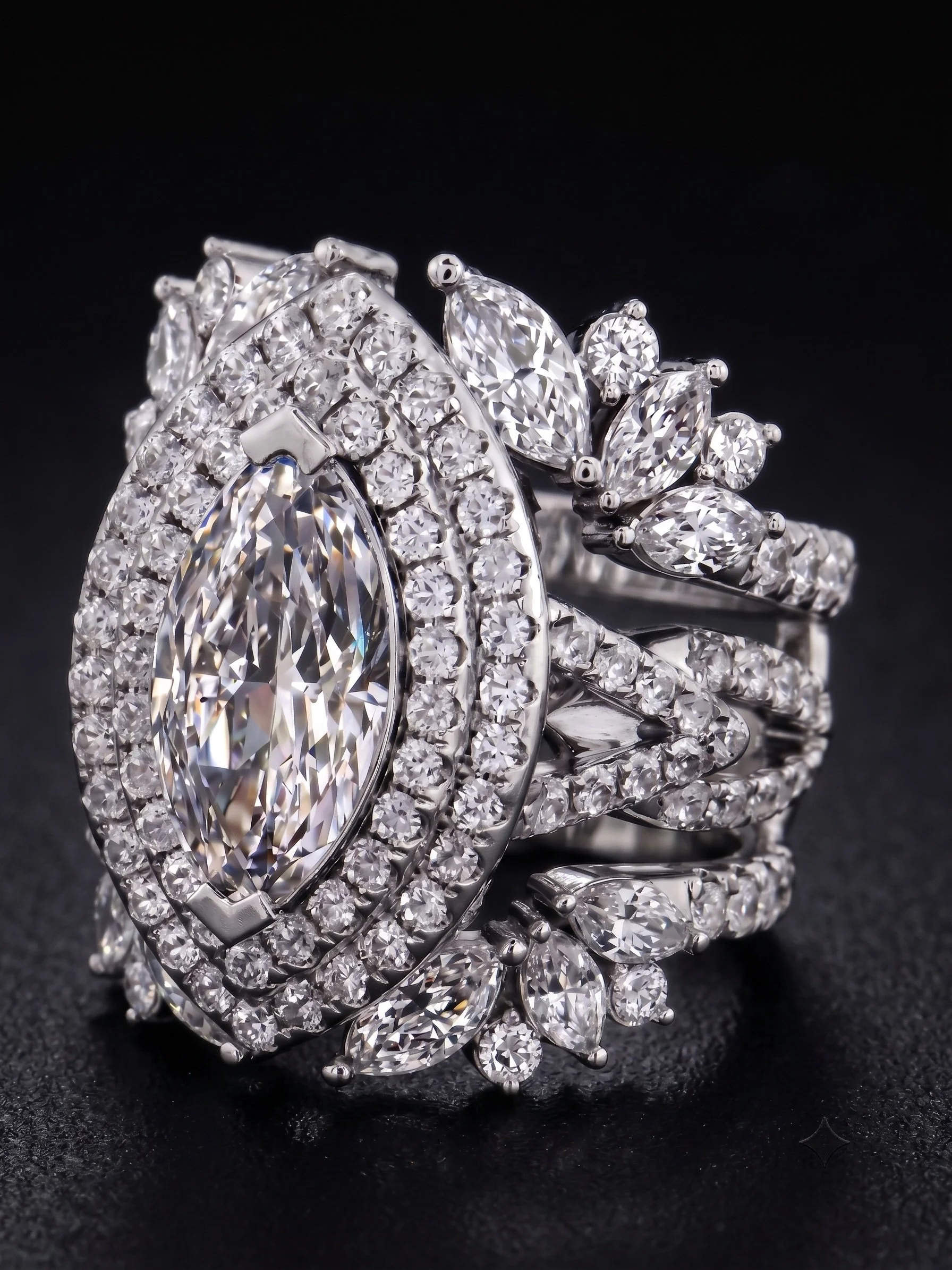
The Alumna wedding set by Gerard Rene atelier
So, Realistically — How Long?
For a design built around stones already sourced, expect the process from first consultation to finished ring to run several weeks. For a piece requiring a specific gemstone search, more elaborate hand-finishing, or a highly complex sculptural design, plan for a longer window — often a few months. The honest range depends entirely on complexity and sourcing, which is exactly why we walk every client through a realistic timeline at the start rather than a marketing number designed to sound fast.
What Actually Extends a Timeline
A design that changes direction significantly partway through
A specific, rare stone that takes time to locate and vet properly
Structural problems discovered mid-build that require re-engineering
A client who isn't yet clear on the "why" behind the piece, which tends to produce more revisions
What Doesn't Have to Slow You Down
Knowing what you want — and, just as importantly, why you want it — is the single biggest accelerant in this entire process. Clients who arrive with a clear sense of the story they want the ring to tell move through concept and CAD faster than those still discovering their own taste in real time. Either way, we meet you where you are. But it's worth knowing that clarity, more than budget or complexity, is often what determines how quickly a commission moves.
If you're planning a proposal and working backward from a date, timeline is exactly the kind of thing worth discussing before you fall in love with a design — not after. Schedule a consultation to talk through your timeline honestly, or explore the full bespoke process from start to finish.
New York's Independent Jewelry Designers Creating One-of-One High Jewelry
Inside New York's independent jewelry design movement, where original artistry and direct client relationships are quietly reshaping high jewelry outside the retail model.
New York's skyline gets most of the attention, but some of the city's most interesting creative work happens quietly, well below it. For decades, the story of New York high jewelry was told almost entirely by historic retail institutions and their flagship windows. Today, a different movement is taking shape alongside them.
A growing number of independent designers and private ateliers are redefining what jewelry in this city can look like, built on original artistry, rare materials, and direct relationships with clients, rather than mass retail structures. New York has quietly become a real center for collectible, one-of-one wearable art.
Gerard Rene is one of the private, independent NYC ateliers working inside that shift, building one-of-one high jewelry and bespoke engagement rings directly with clients rather than through a retail sales process.
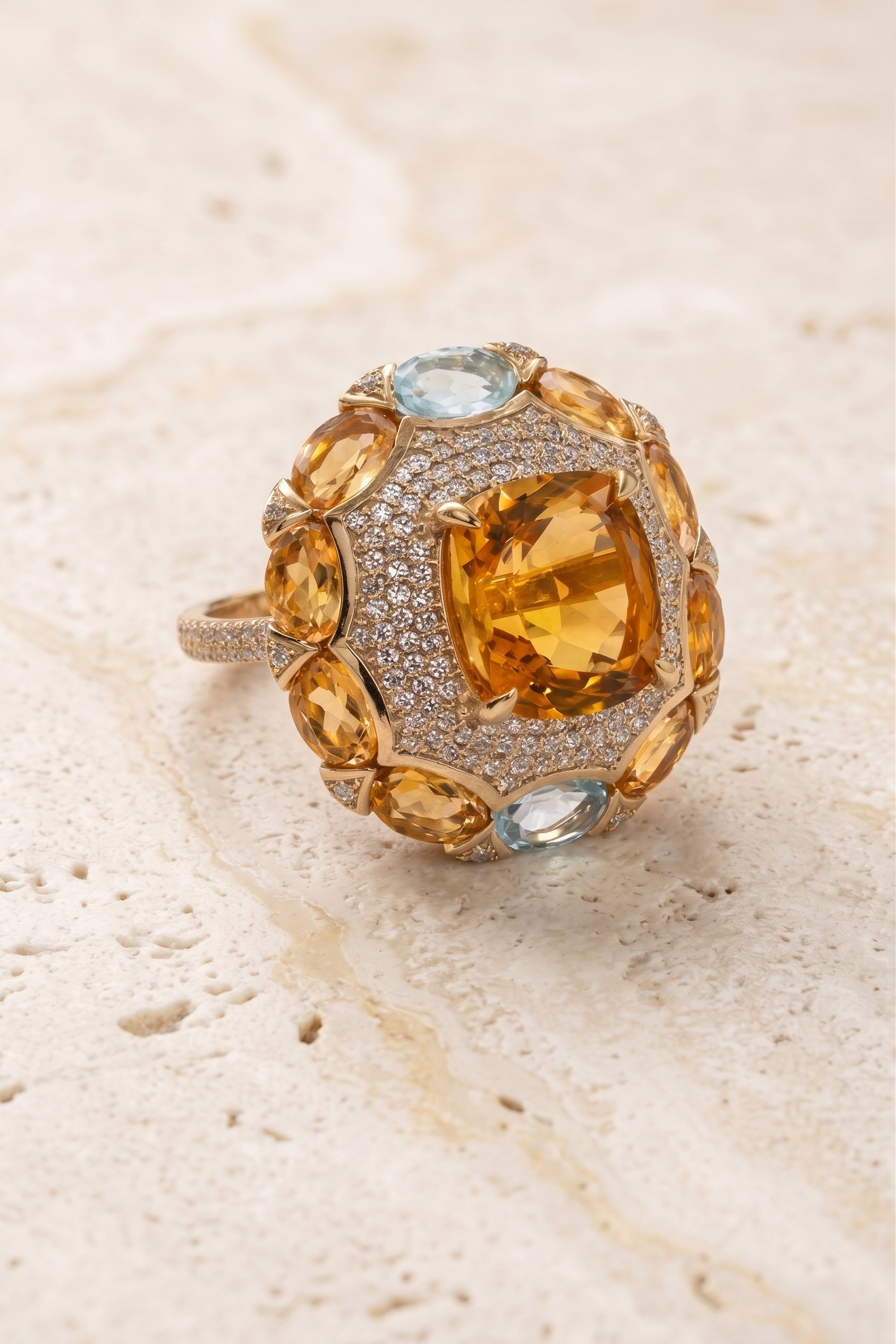
Arise from Gerard Rene’s In Your Dreams Collection, a one-of-one high jewelry ring created by a New York independent jewelry atelier featuring a yellow gold setting, diamond pavé details, vibrant citrines and aquamarines.
What Actually Separates an Independent Designer From a Retail Brand
An independent designer doesn't answer to a corporate board or a wholesale sales target. That single difference changes almost everything about how a piece gets made.
An original design language, driven by one person's point of view rather than a trend forecast
Material-first thinking: instead of designing a setting and forcing a stone to fit it, the raw character of a specific gemstone often dictates the whole design
Naturally limited production: because each piece takes real hours of hand engineering, the focus stays on depth of execution, not volume
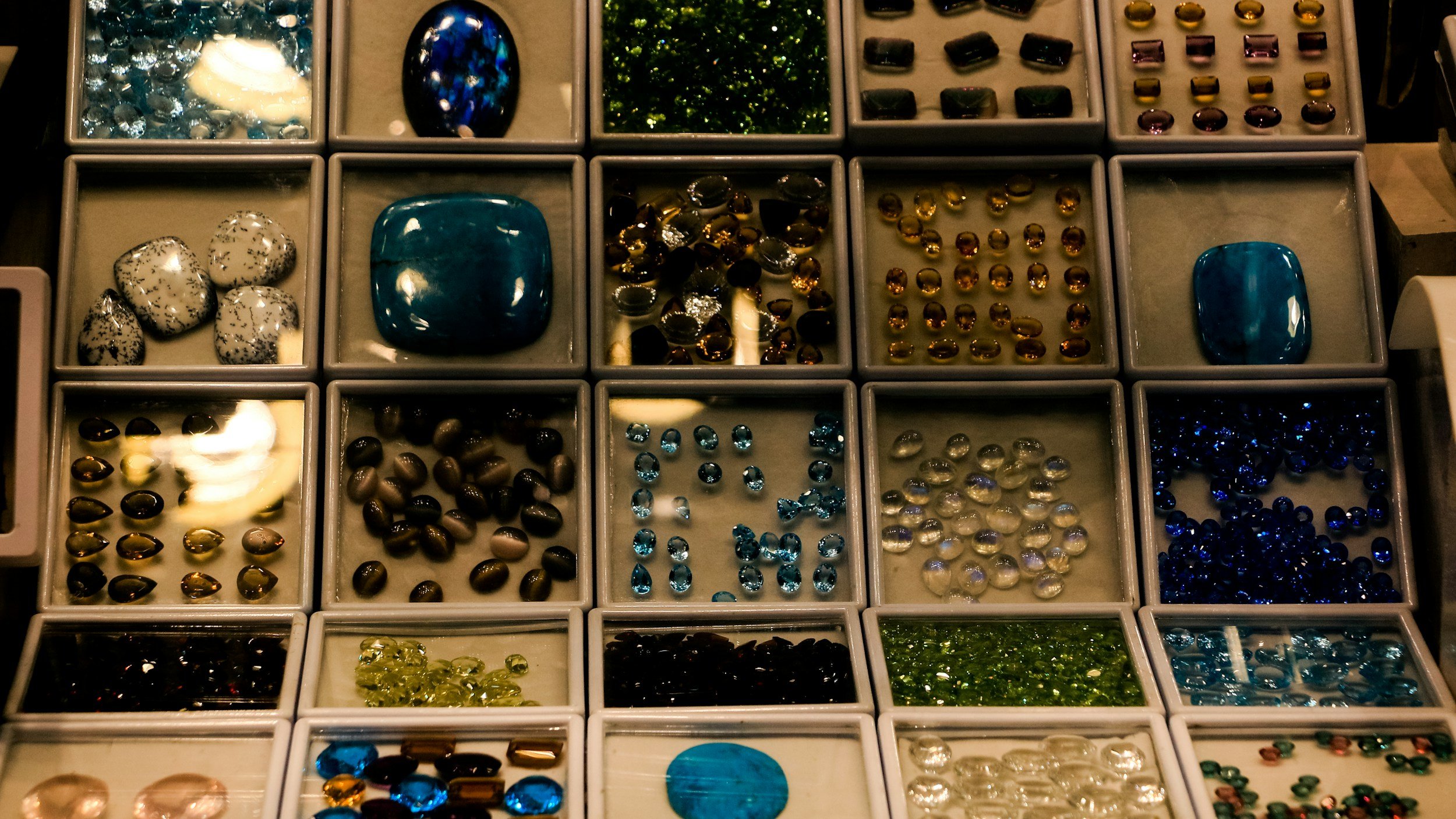
I think about this every time I see a ring that's technically "custom" but has nothing custom about it beyond the size of the stone. If the only thing distinguishing a piece is that it's bigger than what a store had in stock, nothing was actually designed. A more affordable stone in a setting that means something will always be worth more to me than an expensive one in a setting that doesn't.
New York's Living Craft Ecosystem
The independent movement thrives here because New York has a multi-generational network of master lapidaries, diamond cutters, and specialist setters who've spent careers perfecting narrow, highly specific parts of the craft. Independent designers don't work around that heritage, they work directly with it.
When someone commissions a piece from Gerard Rene, they're not just buying an object. They're supporting a small, specialized workshop that keeps a real tradition of craftsmanship alive in a city most people associate with retail flagships, not artisans. You can see that work directly in In Your Dreams.
Gerard Rene's Place in This Movement
Gerard Rene is named for my grandfather, a man from Jérémie, Haiti, whose life was defined by quiet devotion and a dream of opening a boutique of his own that never came to pass in his lifetime. Every piece we create carries some version of that same intention forward: excellence, legacy, and the belief that an object can hold a story worth keeping. You can read more about that history.
Built around bespoke commissions and smaller, story-driven collections, we don't run seasonal collections engineered for retail inventory. Every commission begins with the same question: what does this piece need to say, and for whom?
What a Commission Actually Looks Like
Narrative discovery: an open conversation to understand the emotional weight behind the piece, before any design work starts
Sourcing with integrity: individual gemstones chosen for character and full traceability, not uniformity, part of what we call our process and detailed further in how we source gemstones
Master fabrication: every setting hand-forged in New York, engineered specifically around the stone and the life of the person who'll wear it
A Consultation I Think About Often
One of the most quietly powerful conversations I've ever had was with a client facing a serious, life-limiting illness. He wanted to commission something for the woman who had stood beside him through all of it, and he wanted it to be unmistakably hers. He didn't have unlimited time to get it right, and he wasn't interested in anything ordinary.
I couldn't have designed that piece the same way for anyone else, and that's really the whole point of this work. A ring made under those circumstances isn't decoration. It's a message that needed a form to hold it.
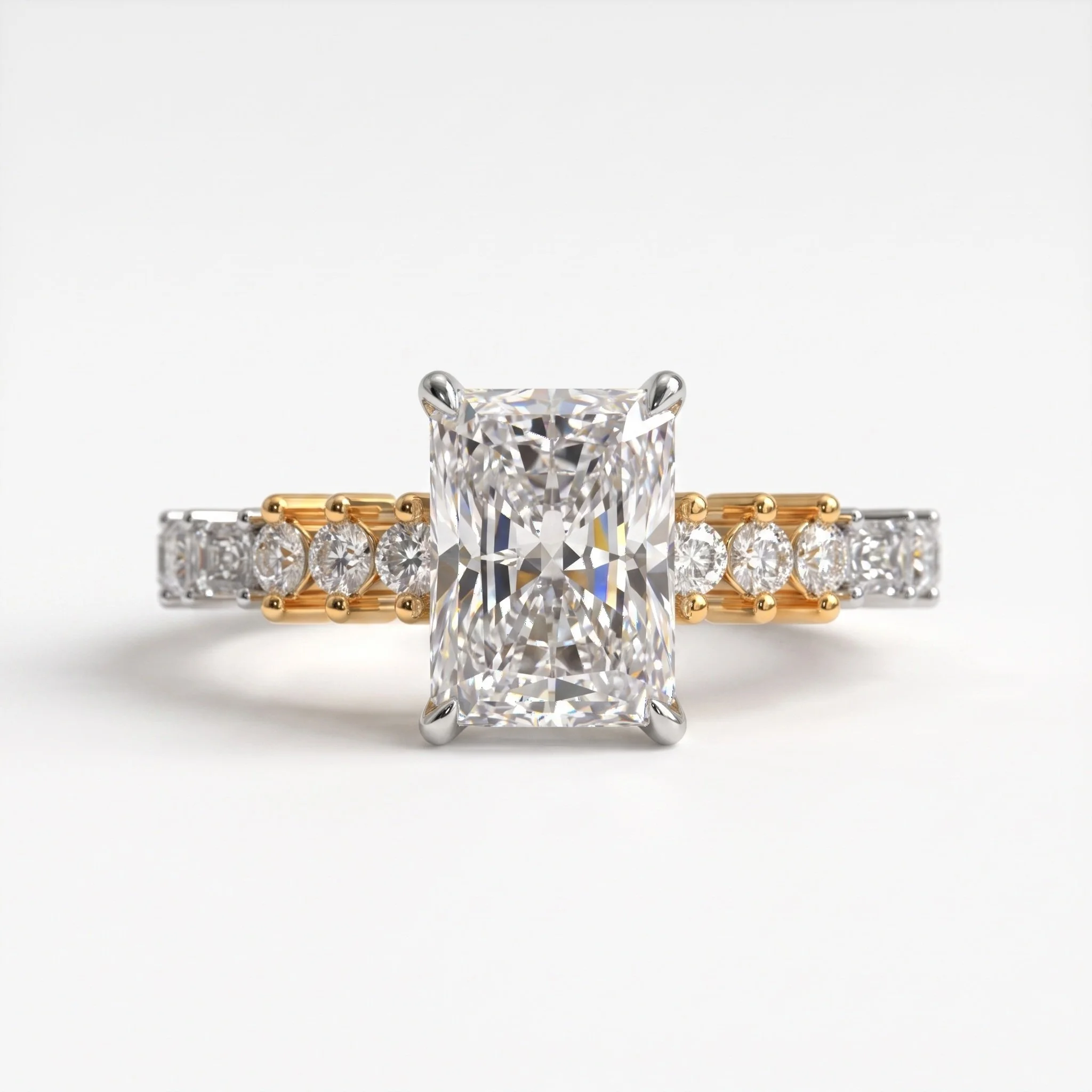
Custom radiant-cut diamond engagement ring by Gerard Rene featuring a 3-carat radiant-cut diamond, baguette and brilliant-cut diamond accents, and a two-tone 18k yellow and white gold setting from the Sonrisa design.
The independent jewelry movement in New York exists because of moments like that one, proof that this kind of meaning can't be mass-produced. It only happens in the quiet space where a designer, an artisan, and a client build something together that outlasts all three of them.
Independent NYC Jewelry Ateliers vs. Traditional Luxury Houses: What Collectors Should Know
Why modern collectors are looking past Place Vendôme and Fifth Avenue flagships in favor of independent NYC ateliers, and what changes when you collaborate directly with the person shaping your piece.
The historic houses of the Place Vendôme and Fifth Avenue shaped what luxury jewelry meant for over a century. Their contribution to the decorative arts is real. Houses like Cartier and Van Cleef & Arpels created some of the most recognizable designs in the world, and for generations, wearing their name was the definitive marker of arrival.
But something is shifting.
A growing number of collectors are looking past the global flagships for something the biggest houses, by virtue of their scale, can no longer easily offer: a direct, individualized relationship with the person actually designing their piece. That shift has fueled a real renaissance among independent, private jewelry ateliers right here in New York City.
Why the Private Atelier Model Works Differently
Traditional luxury houses excel at global recognition. Buying from a famous collection means buying a recognizable signature, a design instantly identifiable anywhere in the world. But that kind of scale requires high-volume production, standardized sourcing, and a retail experience run by brand ambassadors rather than the person who actually designed the piece.
A private NYC atelier removes that layer entirely. At Gerard Rene, the collector works directly with the designer, either shaping an entirely new piece together or choosing an existing made-to-order piece that already speaks to their story or experience. Either way, it isn't a purchase off a mass-retail catalog. It's a personal object with a narrative attached to it, whether that narrative was written from scratch or found in a piece already waiting for the right person.
Gerard Rene is a private, by-appointment-only jewelry atelier in New York specializing in one-of-one bespoke high jewelry and custom engagement rings, designed directly with the founder rather than through a retail sales process.
What Actually Draws Collectors to Independent Ateliers
Three things tend to come up again and again in these conversations: individuality, provenance, and craftsmanship.
True individuality. In a world where mass luxury is universally accessible, real distinction lives in what can't be repeated. A one-of-one commission means no one else on earth owns your exact piece, and no one ever will.
Transparent provenance. Collectors increasingly want to know where their materials actually came from. A private atelier can answer that plainly, because there's no corporate supply chain standing between the question and the answer.
Direct craftsmanship. Instead of moving through an assembly line, atelier pieces are hand-forged by artisans who spend dozens of focused hours shaping the metalwork around one specific gemstone, not a standardized mold.
New York's Quiet Tradition of Independent Craftsmanship
New York has always been a center of jewelry commerce, but its real depth lives above the street-level retail storefronts. Within a few city blocks, an independent atelier has access to some of the world's most skilled diamond cutters, lapidaries, and master setters, the same hyper-local expertise the historic houses draw from, without the corporate layer in between.

Working from a private NYC space lets Gerard Rene tap directly into that network for every commission, the same caliber of craftsmanship, applied to a single piece instead of a production run.
What This Looks Like in Practice
I didn't always fully value what went into that process myself. Early on, a friend, later a client, pointed out that the difference between what I charged and what my actual process was worth (the sketching, the sourcing, the fabrication, the revisions) was significant. That conversation changed how I priced my own work, and more importantly, how I explained it to clients. The craftsmanship behind a piece isn't invisible. It just usually goes unspoken.
At Gerard Rene, consultations are slow and collaborative by design. We sit down and talk through the idea of a piece before any metal is touched. Whether you're building something entirely new around a rare stone, evolving an inherited piece into something wearable today, or commissioning a unique one-of-one Gerard Rene design that already speaks to your story, the goal is the same: your identity woven into the object, not adapted around a pre-existing template.
What Makes a Piece Genuinely Collector-Worthy
Material integrity: because we're not sourcing hundreds of matching stones for a product line, we can work with individual "oddity" stones, unusual inclusions, rare cuts, uncommon color zoning, that a corporate brand would reject for lack of uniformity
A consistent artistic language: every sketch, model, and forge line happens under one designer's direct supervision
Documentation: every commission comes with a record of its design origin and fabrication journey, which matters when a piece is meant to be passed down
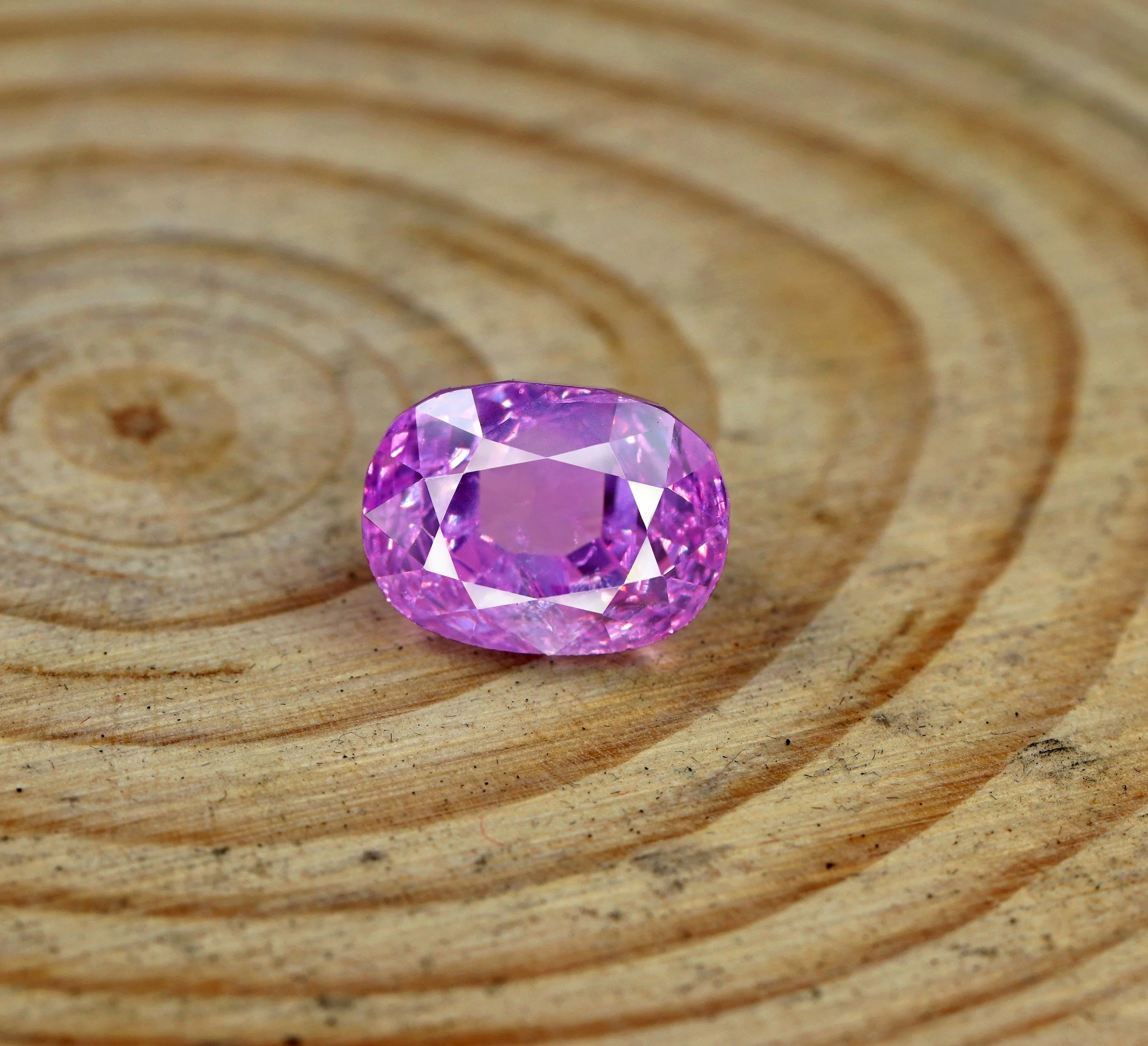
The historic houses will always hold a place in jewelry history. But the future of personal luxury increasingly belongs to the private spaces where the designer, the client, and the story are never separated by a sales floor. It's the same philosophy behind what you're actually paying for when you commission a custom ring here.
Initiate a Private Commission →
Explore our process or learn more about the atelier.
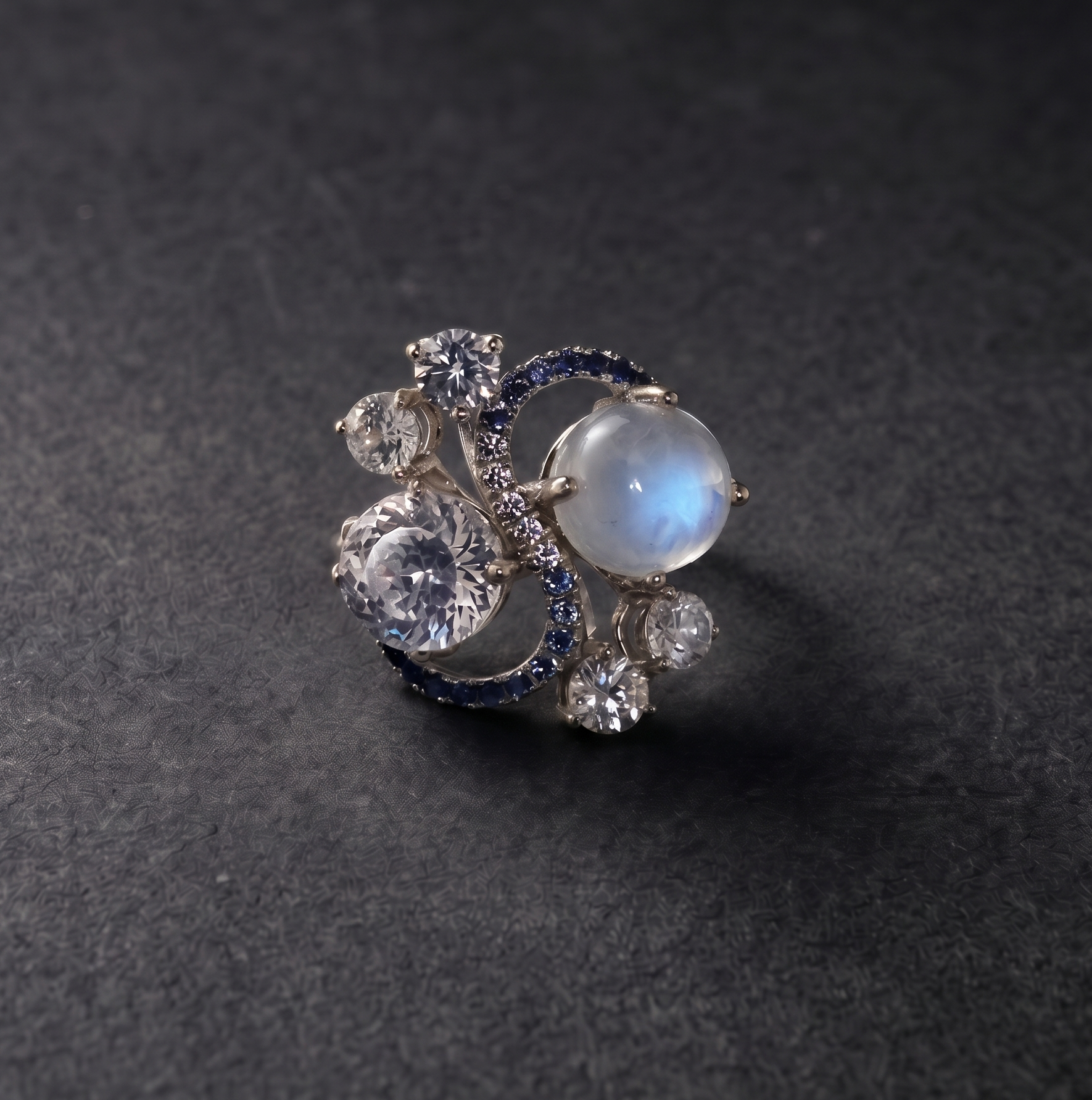
Why Gerard Rene Creates Future Heirlooms Instead of Retail Collections
Why Gerard Rene builds future heirlooms instead of retail collections — jewelry made for one person, engineered to still mean something a century from now.
The traditional luxury jewelry industry runs on a predictable rhythm: the seasonal launch, the global retail collection, the same recognizable design repeated across glass vitrines in every major capital. For generations, that rhythm defined what exclusivity looked like.
A growing number of collectors are no longer interested in luxury they can find in an airport terminal or a flagship shelf. They're looking for something made for exactly one person, built with the intention that it will still mean something a century from now.
That shift is close to the entire reason Gerard Rene exists. We don't run mass retail collections engineered for volume. Even our smaller, made-to-order collections are built to eventually find the one person they were always meant for, not manufactured to fill a shelf.
Luxury Isn't Defined by Inventory
For most luxury houses, inventory is the business. Collections are engineered to scale, which means design decisions get made around what can be mass-produced consistently, not around what any one person actually needs.
Gerard Rene is a private, by-appointment NYC atelier built around bespoke commissions and smaller, story-driven collections, both designed as future heirlooms rather than retail inventory built for volume. Every bespoke commission starts from a single client's story, not a catalog page. Our collection pieces, like those in In Your Dreams, begin with a story of their own and are made in extremely limited numbers, each one waiting to find the person it actually belongs to. You can also explore the completed work in In Your Dreams, or learn more about the atelier.
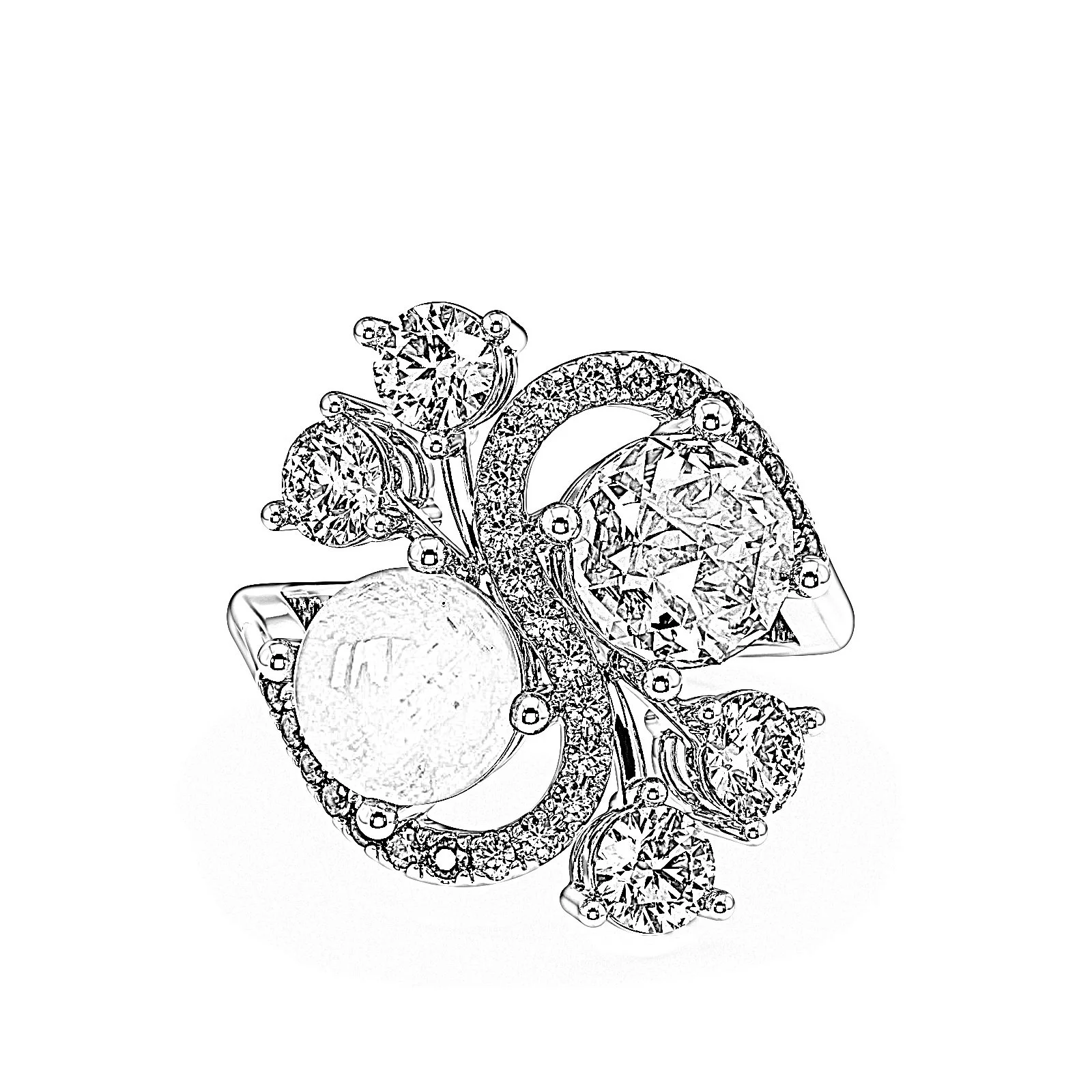
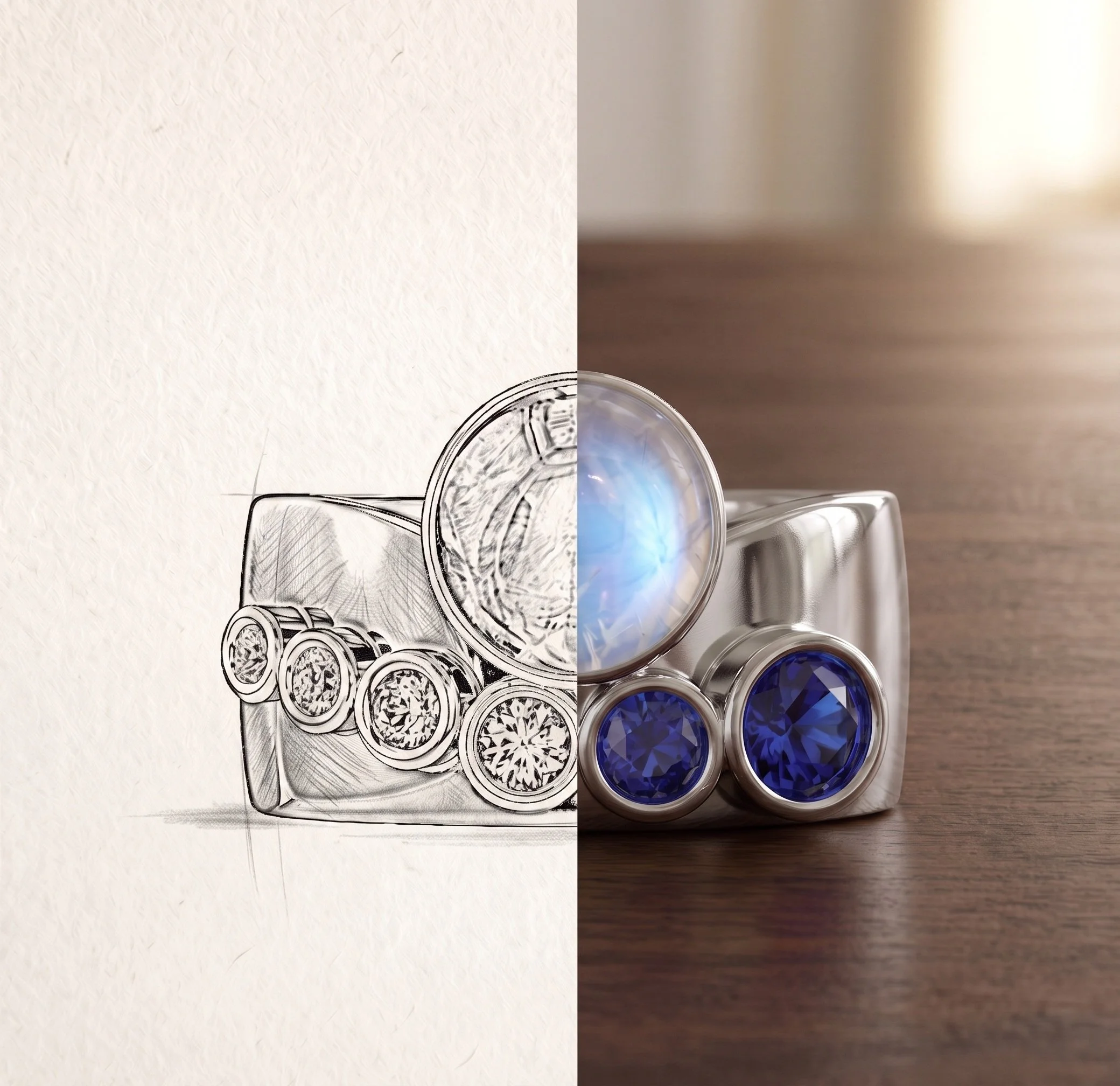
Original Gerard Rene design sketch for Dreamwatcher, a one-of-one bespoke high jewelry ring from the In Your Dreams collection.
What Actually Separates Retail Jewelry From Gerard Rene's One-of-One Design
Retail collections are built around market trends and repeatability, cast in repeatable runs, and replicated across flagships, which means their value comes from brand recognition and standardized weight. A Gerard Rene commission starts somewhere else entirely: built around one person's story and a specific stone, hand-forged for a single wearer, and never duplicated. Its value comes from rarity, provenance, and personal history, not a name on a box.
This is how we approach one-of-one design specifically. Other ateliers using the same language may work differently.
Exclusivity in mass luxury is usually manufactured, a limited run, a waitlist, a controlled release schedule. Real rarity works differently. When a piece is engineered around the exact dimensions of one gemstone and the specific person wearing it, duplicating it isn't a marketing restriction. It's not physically possible. And that's what Gerard Rene actually is.
A Future Heirloom Starts With a Story, Not a Stone
Gold, platinum, and diamonds are geologically permanent, but material alone doesn't make something an heirloom. An heirloom needs a reason for existing.
One of my favorite examples is a ring I designed for a client who wanted her piece to reflect her connection to nature and to her cat, Mabelle. The center stone became an asymmetrical marquise-cut emerald, cut to echo the shape of a cat's eye, set inside hand-sculpted leaf scrollwork with small diamonds worked into the band. Nothing about that design exists because it looks good on a mood board. It exists because it answers something specific about the person wearing it. That's the difference between jewelry that photographs well and jewelry that still means something in fifty years.
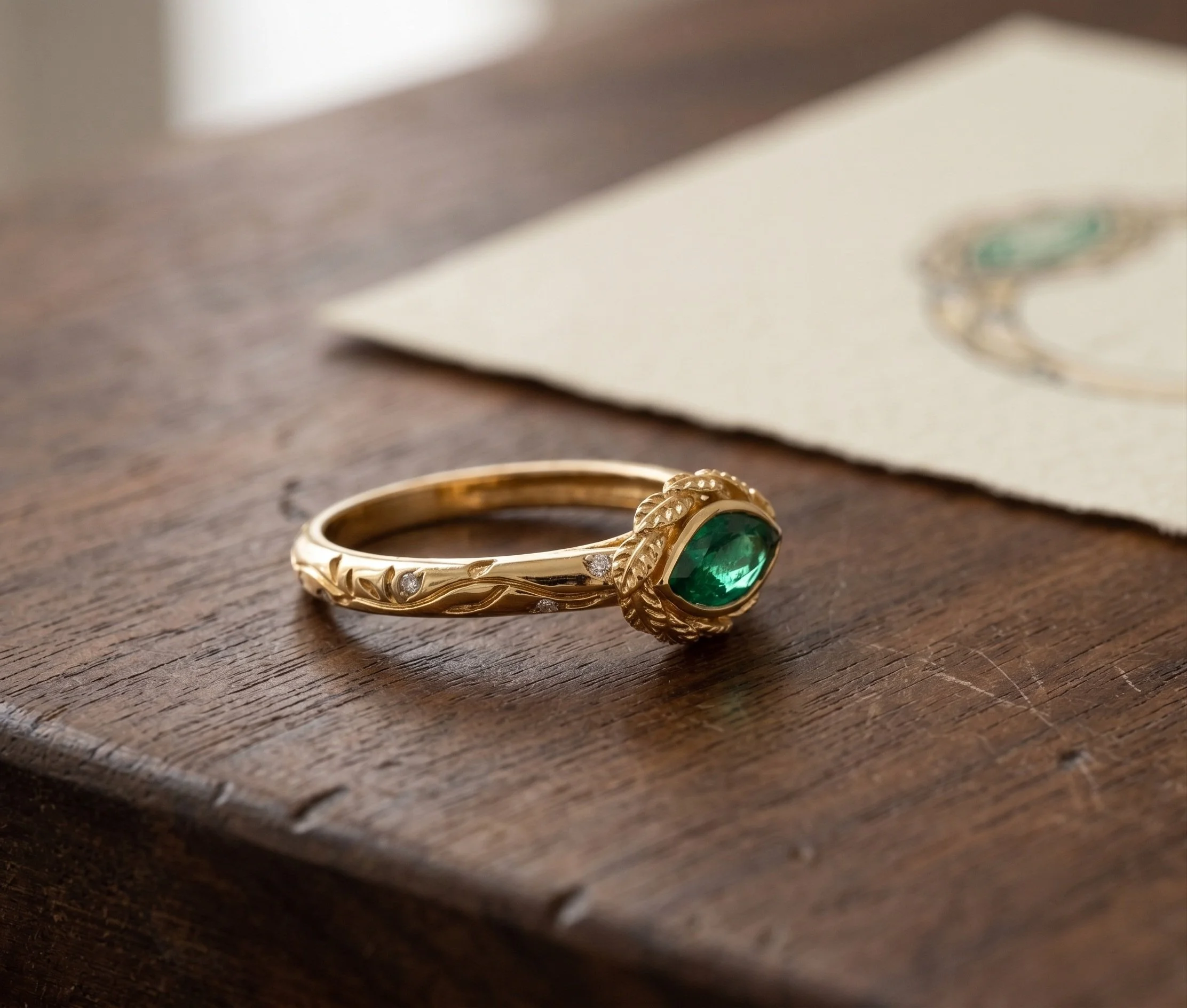
Sandrine, a custom Gerard Rene ring inspired by a client's connection to nature and her cat, Mabelle.
Designed Around a Person, a Memory, or a Vision, Not a Product Line
Traditional collections treat the wearer as a standard: a size, a demographic, a market segment. Our process runs the opposite direction. A bespoke commission is a direct dialogue between the client and the atelier, working through not just what a piece should look like, but how it moves, how it catches light, how it fits into someone's actual life. Not every piece starts with a person sitting across from me, though. Sometimes it starts with a memory, a vision, or a single idea I can't let go of, and the piece gets made before I know exactly who it belongs to.
For those existing one-of-one pieces, the dialogue works differently, almost like the ring is waiting for the person whose story it already carries. Some pieces choose their wearer before we've ever met.
Because there's no seasonal mood board dictating the work, the only real constraints are structural integrity and the character of the materials themselves. Learn more about how that process actually unfolds through our process.
Why We Never Replicate a Commission
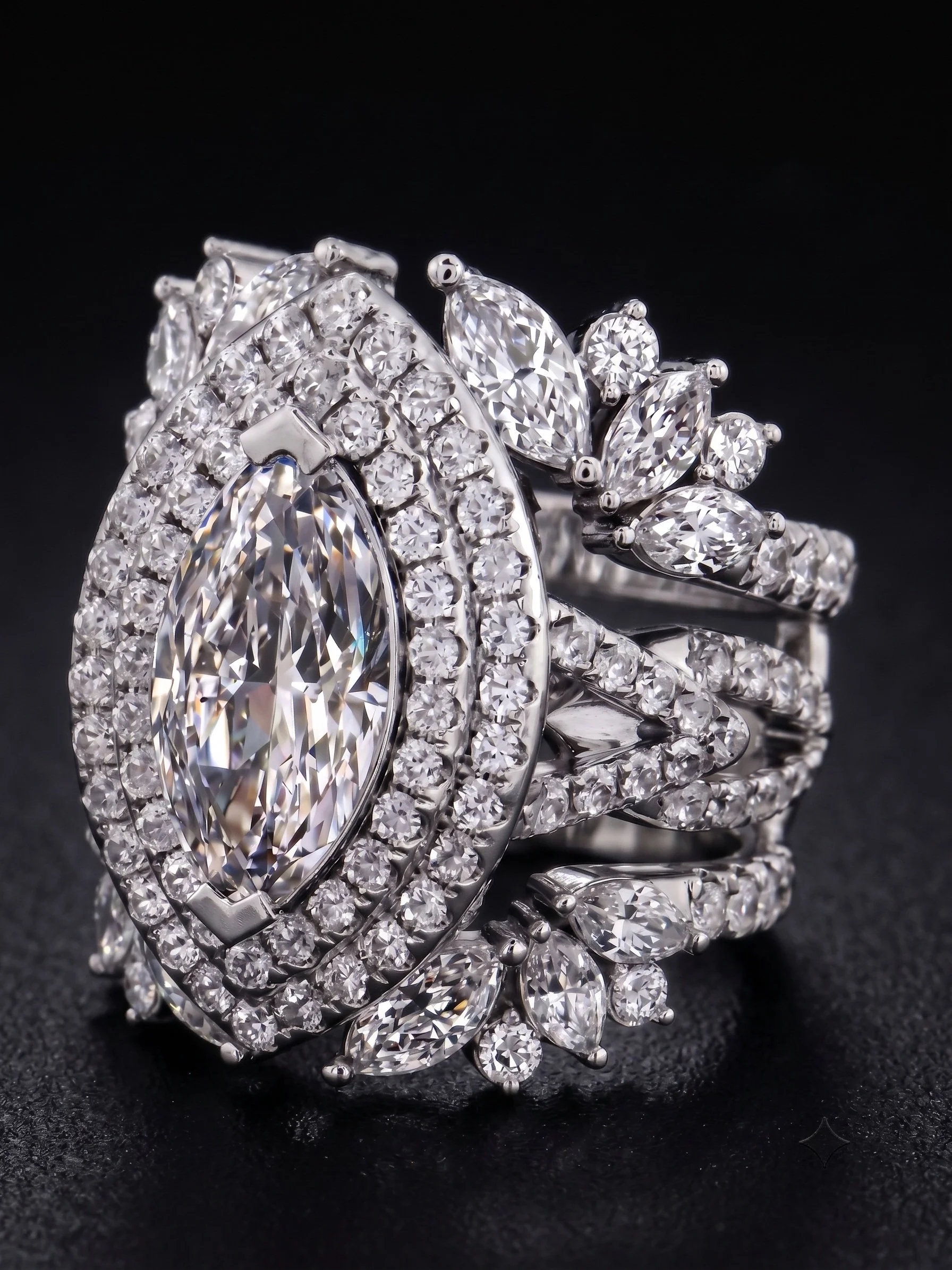
Alumna, a one-of-one diamond wedding set designed by Gerard Rene, featuring a custom engagement ring and matching bands created as a unique heirloom commission.
A hard rule at Gerard Rene: we never recreate a past commission for a new client. When someone trusts us with their story, that design belongs to them alone. If another collector admires a piece from our archive, we won't copy it. We'll use it as a starting point for something entirely new.
That rule isn't a marketing restriction. It's what makes the word "heirloom" mean something instead of just sounding luxurious.
The Value of Rarity
Rarity in mass luxury is usually manufactured: a numbered edition, a waitlist, a controlled release calendar. It's scarcity as a marketing lever, applied after the design is already finished.
Rarity in one-of-one design works in the opposite direction. It isn't added on top of the piece, it's built into the piece from the first decision. That's not a promise we make in copy. It's simply what happens when a piece is built around one irreplaceable set of specifics instead of a repeatable template.
What Collectors and Families Are Really Preserving
Retail jewelry is bought for the present, a current trend, a matching season, a recognizable status marker. One-of-one jewelry is built for the horizon. Styles will keep changing. The desire to anchor meaning, love, and identity into something permanent doesn't. It's the same idea running through how we approach heirloom redesign and why significance matters more than exclusivity.
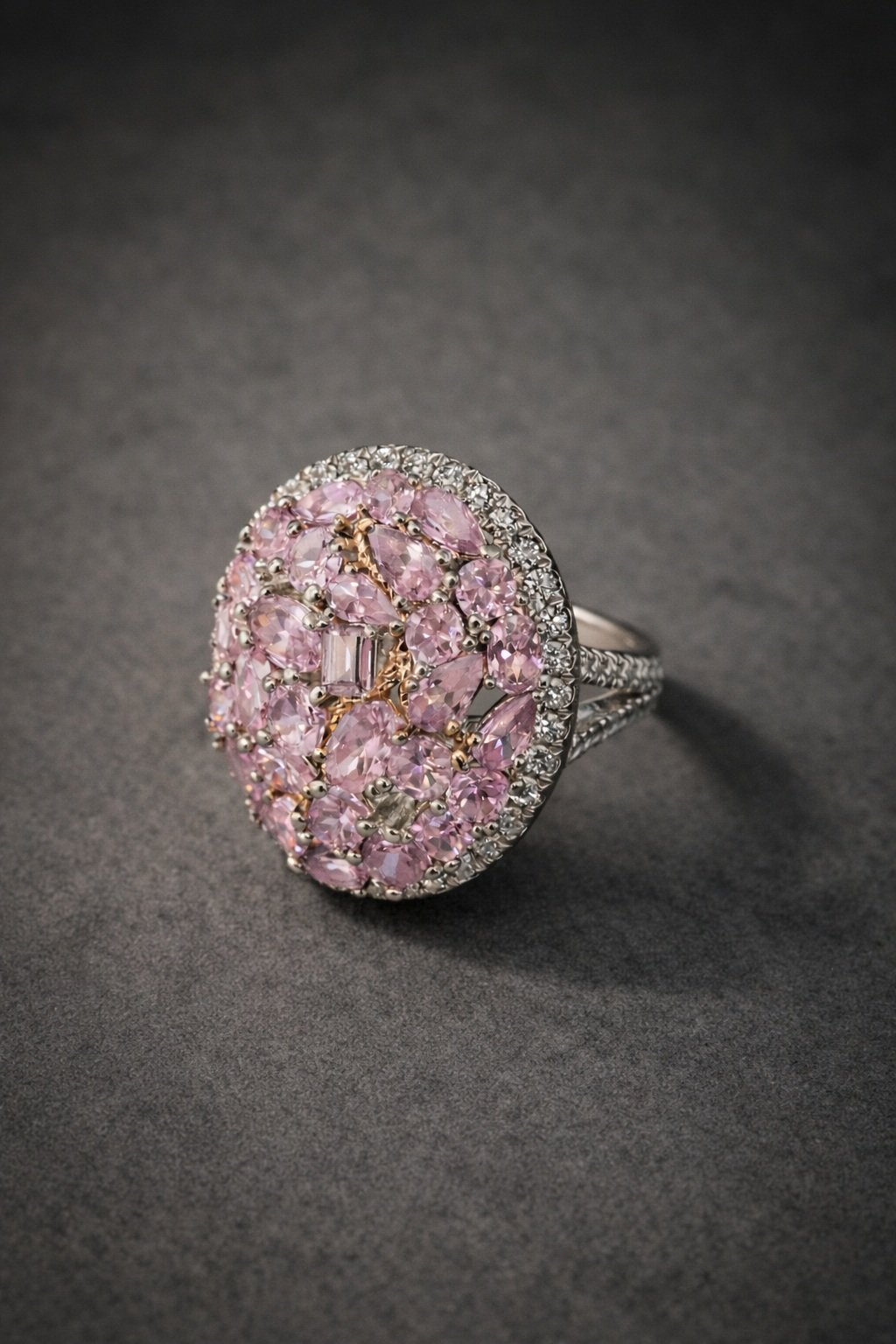
Dreamcatcher, a one-of-one pink diamond high jewelry ring from Gerard Rene’s In Your Dreams collection.
Frequently Asked Questions
What is a future heirloom? A future heirloom is a piece of jewelry designed and built today with the artistic, material, and narrative intention to hold meaning for generations, not just for the moment it was made.
What is one-of-one jewelry? One-of-one means a piece is completely unique. Only one exists, it will never be mass-produced, and the atelier never replicates the design for another client.
Is bespoke jewelry more valuable than retail jewelry? Retail jewelry carries markups tied to brand recognition and global distribution. Bespoke jewelry directs that same investment into material quality, craftsmanship, and irreplaceable personal rarity, a different kind of value, not simply a bigger or smaller one.
How does Gerard Rene design custom engagement rings? Every commission begins with a conversation about the person and the story behind the piece, not a catalog. From there, design, sourcing, and fabrication all move around that story rather than a pre-set template. Learn more about our process.
If you're ready to explore what a one-of-one commission could look like for your own story, we'd welcome that conversation.
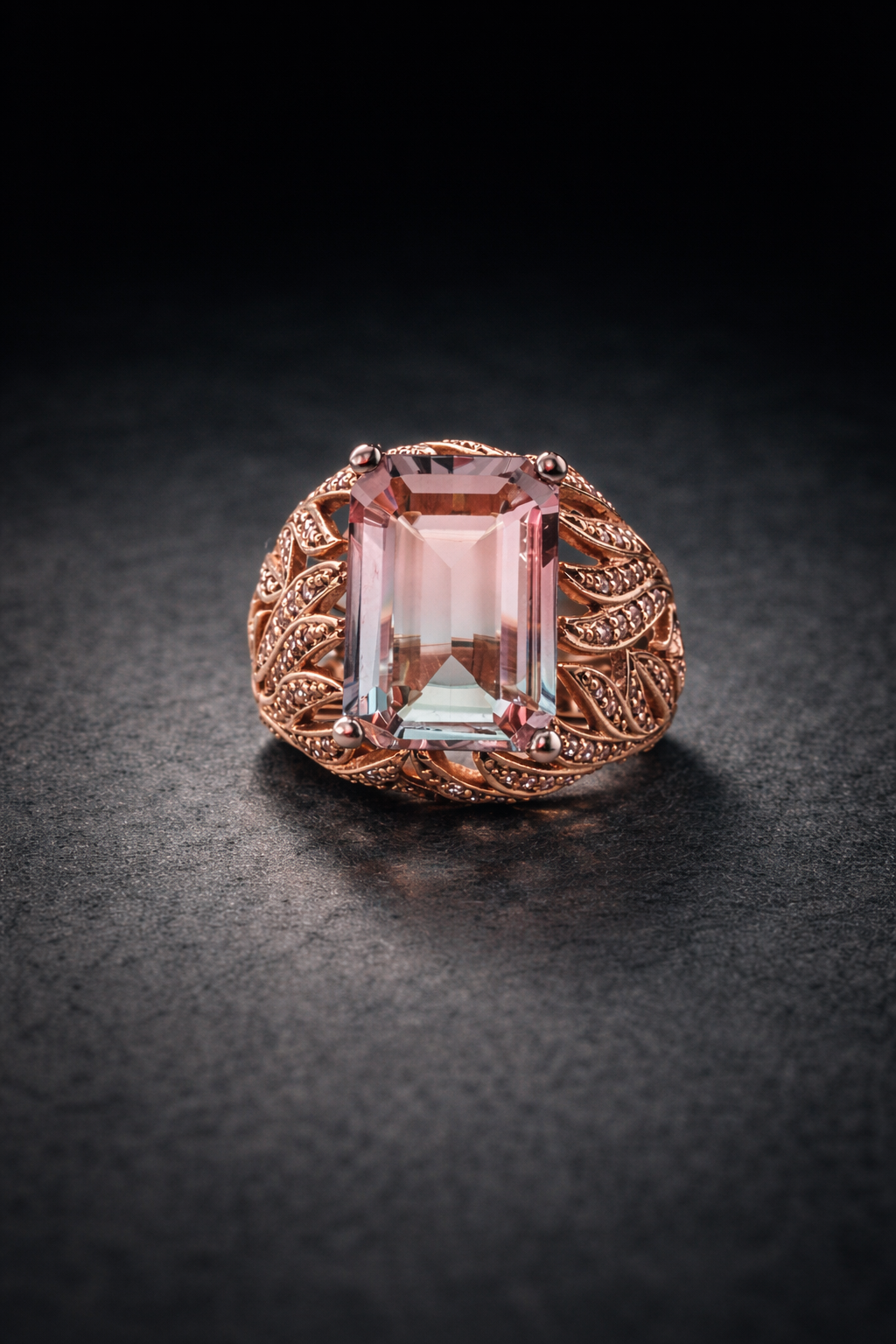
Luxury Has a Branding Problem: Why Significance Matters More Than Exclusivity
Luxury has become obsessed with looking expensive. A case for significance over manufactured scarcity, and what fifty years of meaning actually requires.
Luxury has become obsessed with looking expensive.
Spend enough time in the jewelry industry and you'll notice the same playbook everywhere: limited editions, waitlists, celebrity endorsements, logos, exclusivity campaigns, carefully manufactured scarcity. The assumption is simple: if fewer people can have it, people will want it more.
I understand why that works, but I don't think it's what makes something truly valuable.
The Moment My Definition of Luxury Changed
My definition of luxury didn't shift decades ago. It shifted in 2025, at The Winter Show at the Park Avenue Armory.
I went expecting to admire exceptional craftsmanship. I didn't expect to rethink my entire philosophy of value.
That year's exhibition felt different. It felt less like an antiques fair and more like walking through centuries of human imagination. An extraordinary Art Deco coffee and tea service. A Tiffany Studios Oriental Poppy table lamp whose light seemed almost alive. Furniture, paintings, sculpture, and silver carrying price tags into the hundreds of thousands of dollars.
Tiffany Studios leaded glass lamp displayed at The Winter Show 2025, illustrating craftsmanship and artistic vision beyond material value.
None of it captivated me because it was expensive. It captivated me because every piece had something to say. The Tiffany lamp was remarkable because someone imagined light differently. The Art Deco silver was beautiful because an artist believed geometry could communicate elegance.
Standing there, I realized I wasn't looking at expensive objects. I was looking at conviction made physical. Every brushstroke, carving, and imperfection existed because someone believed their vision was worth preserving.
The luxury was never the price tag. It was the honesty behind the object. That realization shapes everything I believe about who Gerard Rene is as an atelier.
Jewelry Should Preserve More Than Wealth
People often ask whether jewelry is a good investment. Sometimes it is. Sometimes it isn't. I think that's the wrong place to start.
The better question: what is this piece preserving that would otherwise be forgotten? A marriage. The birth of a child. A family's homeland. A season of grief. A personal transformation. The memory of someone who changed your life.
When jewelry carries those things, it stops being decoration. It becomes history, which is where I think real luxury jewelry begins.
Scarcity Isn't the Point. Meaning Is.
Scarcity has become one of luxury's favorite marketing tools: limited releases, artificial waitlists, manufactured shortages, all implying the same thing. If fewer people can buy it, it must be more valuable.
I don't reject scarcity entirely. Some things genuinely are rare: a remarkable gemstone, master craftsmanship, time, an original idea.
Gerard Rene creates one-of-one bespoke jewelry and high jewelry pieces, but not because scarcity itself is the product. Every bespoke commission is built around one person's history, relationships, memories, beliefs, and future. Every high jewelry piece is conceived as an individual work of art rather than a design intended for replication, which is why every piece in In Your Dreams exists exactly once.
If I reproduced those pieces over and over simply because they sold well, I wouldn't just diminish their exclusivity. I would erase the very reason they were created.
Our exclusivity isn't manufactured through artificial restriction. It's the natural consequence of refusing to duplicate a story that was never meant to belong to anyone else.
Trends Have Expiration Dates. Meaning Doesn't.
The jewelry industry runs on constant reinvention: elongated diamonds one year, hidden halos the next, paper-thin bands after that. Eventually every trend disappears, replaced by the next set of rules. That business model depends on your taste expiring.
Mine doesn't. I want someone wearing a Gerard Rene piece fifty years from now to feel exactly what they felt the day they received it, not because it came back in style, but because its story never stopped mattering.
Price Should Follow Substance
I don't think luxury has a pricing problem. I think it has a justification problem.
Some objects genuinely deserve extraordinary prices: museum-quality paintings, master sculpture, historic furniture, rare gemstones. Jewelry belongs in that conversation when the work justifies it. When extraordinary pricing reflects extraordinary craftsmanship, rare materials, and real artistic vision, I have no objection to it. What I object to is luxury pricing that relies on branding alone to justify itself, with nothing underneath it.
Every person who contributes to a piece (the miner, the cutter, the polisher, the setter, the engraver) deserves to be paid fairly for it. Luxury shouldn't exist because someone further down the supply chain was underpaid. It should elevate everyone whose hands made the work possible.
How My Thinking About Lab-Grown Diamonds Changed
Early in my career, I generally supported clients choosing lab-grown diamonds over natural stones if it let them own a larger diamond within budget.
Looking back, that advice was incomplete because I was asking the wrong question. Today I start somewhere different: what are you actually trying to accomplish? Owning a beautiful ring is one conversation. Maximizing visual size for a given budget is another. Building a bespoke heirloom that carries both emotional and material significance for future generations is a different conversation entirely.
Our commission process begins in that third conversation. Before we discuss gemstones, we talk about what you're trying to preserve. Once that's clear, the material usually becomes obvious. Clients deserve honesty, not a sales pitch, and that honesty is the foundation of our process from the very first conversation.
What Gerard Rene Actually Creates
People often assume I make jewelry. I don't think that's quite right. I embed stories into metal and stone: sometimes celebrating a marriage, sometimes honoring someone who's passed, sometimes marking the birth of a child or a person's own transformation. Every consultation starts with the same question: why? Not because sentimentality sells, but because that answer shapes every decision after it: the gemstones, the engineering, the symbolism, the engraving.
Fifty Years From Now
Whether someone commissions a bespoke ring or acquires a one-of-one Gerard Rene high jewelry piece, I hope their first reaction isn't "this is expensive." I hope it's "this belongs in my story."
Then I think fifty years ahead. A granddaughter or grandson opening a jewelry box, wanting to know who wore it, why it was made, what it survived, what it meant.
At that point the jewelry has stopped being a luxury good. It's become part of a family's mythology. Not simply an object that appreciates in value, but one that appreciates in meaning.
If you're building a piece meant to outlive trends, and maybe outlive you, I'd be glad to help tell that story. Join the Collector List to stay close to the atelier, or begin a private commission conversation below.
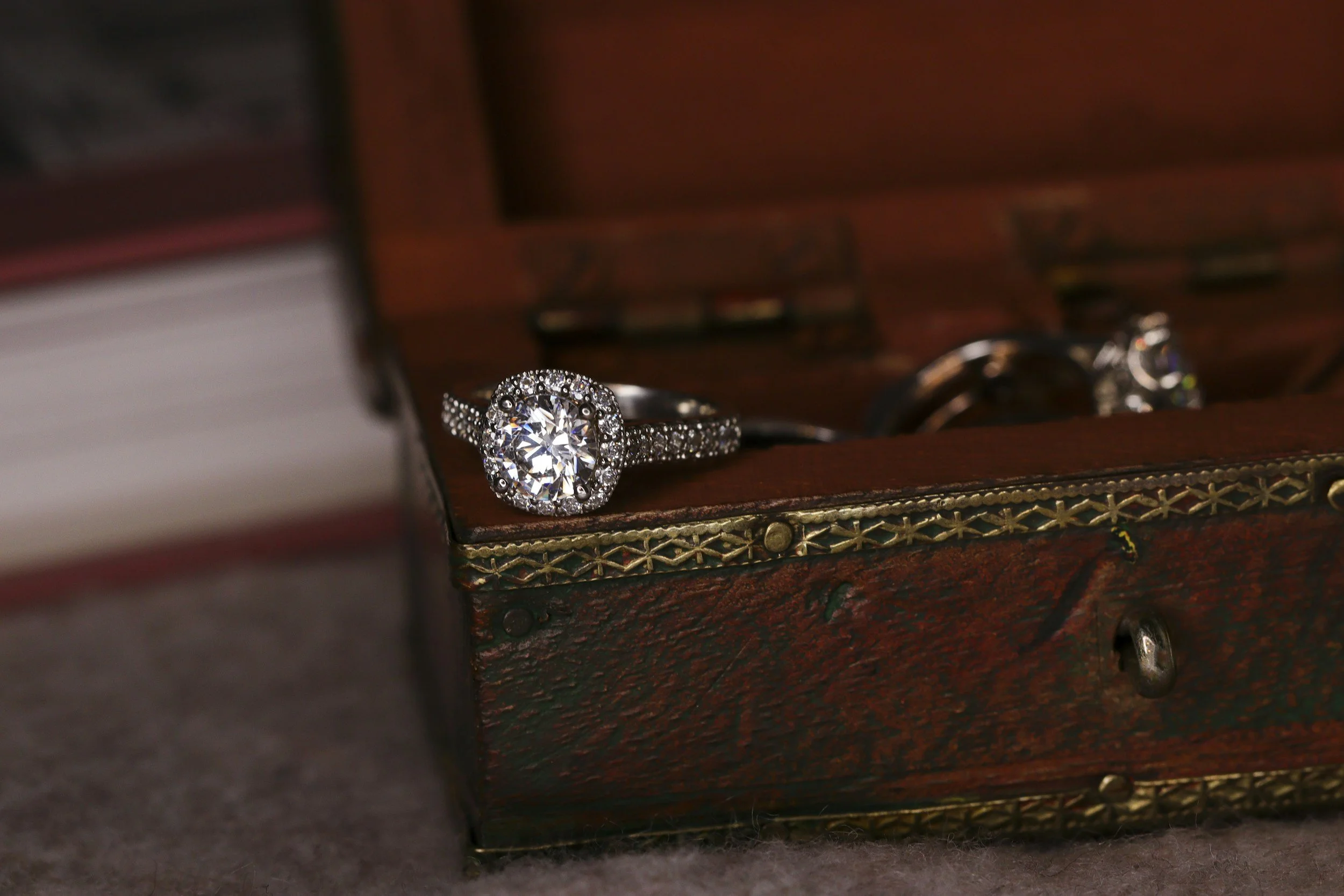
Heirloom Jewelry Redesign NYC: The Story Behind a Family Ring's Second Life
Some of the most valuable jewelry isn't the most expensive. It's the piece someone's been too afraid to touch for decades. The story behind one family's redesign.
Why the Most Meaningful Jewelry Was Never Meant to Stay in a Box
Some of the most valuable pieces of jewelry I have ever held weren't the most expensive. They weren't flawless. They weren't famous. Many of them weren't even being worn.
They arrived wrapped in tissue paper, tucked inside velvet boxes that hadn't been opened in years. Sometimes decades.
Almost every time, the client begins with the same sentence.
"I've been afraid to do anything with it."
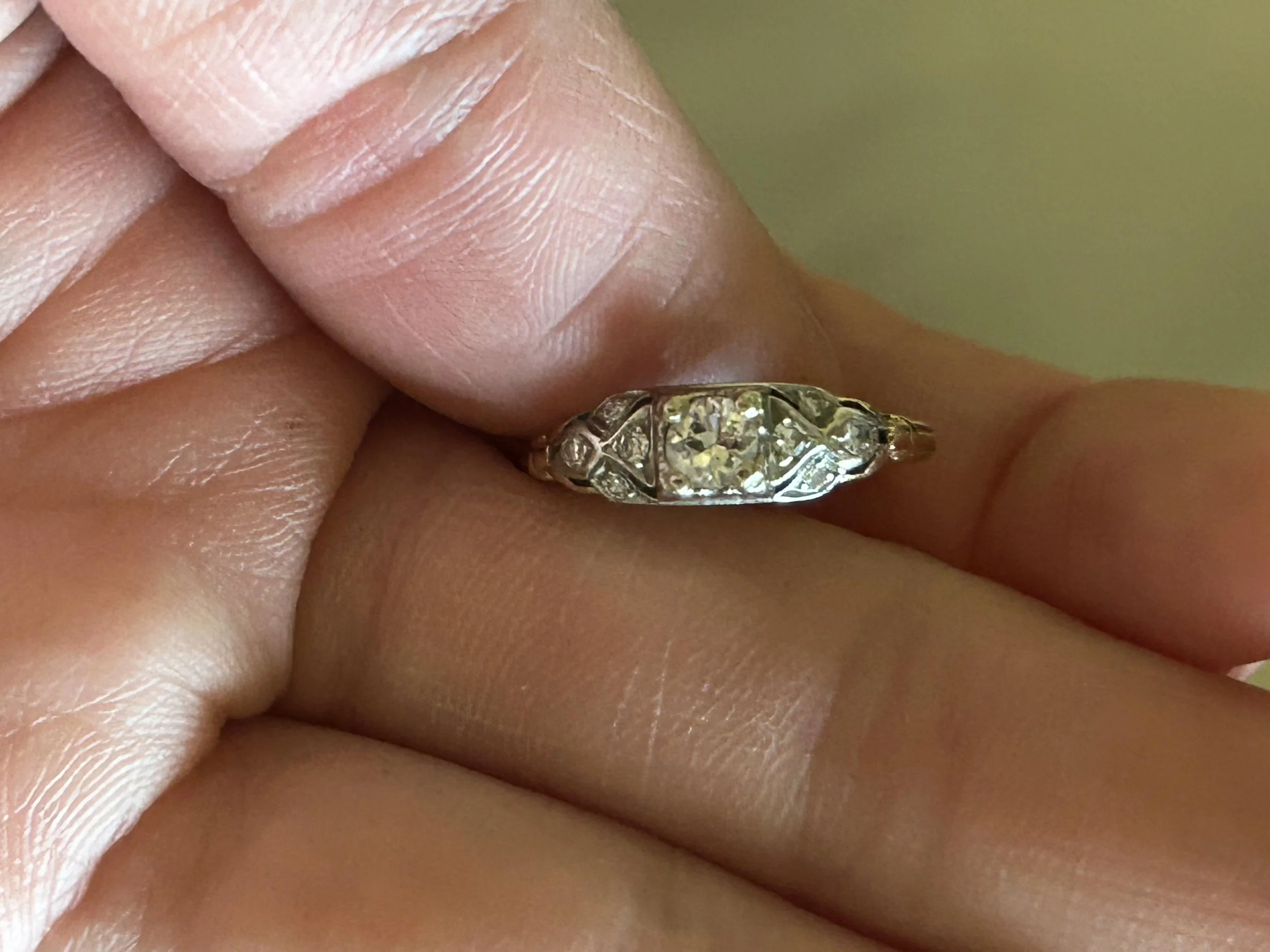
Photo of client heirloom. Every heirloom begins as more than a piece of jewelry — it carries the memories, milestones, and stories of the people who wore it.
Not because they don't love it. Because they love it so much. They're afraid that changing the ring somehow means changing the memory.
I understand that fear. But I don't believe memory lives inside a setting. I believe it lives inside the meaning we choose to carry forward.
Jewelry Was Never Meant to Be Archived
Families often treat heirlooms like museum pieces. Too precious to wear. Too sentimental to alter. Too fragile to risk. Eventually the jewelry becomes something everyone owns but no one experiences, sitting quietly in a safety deposit box while life continues without it.
I don't think that's what heirlooms were made for. A wedding ring wasn't created to become an artifact. It was created to witness a marriage. It watched hands grow older. It held babies. It survived arguments and anniversaries. It traveled. It celebrated promotions. It comforted grief. Every tiny scratch became part of its history.
Why should its story end simply because the original owner is no longer here? The greatest honor we can give an heirloom isn't preserving it perfectly. It's allowing it to keep participating in life.
Before I Design, I Listen
When someone places a heirloom in front of me, I don't immediately begin sketching. I ask what makes this piece impossible to replace. What they remember when they hold it. If we changed everything about the ring except one detail, what would that detail have to be.
Sometimes the answer surprises even the client. People often believe they're attached to the design. After a longer conversation, they realize they're attached to something quieter: the engraving inside the band, the way their grandmother always turned the ring while thinking, a tiny chip only they know exists, an emerald their grandfather spent months searching for.
Not because these details are expensive. Because they're true. This is exactly why every consultation follows our process of listening first and sketching second.
[Learn more about private jewelry consultations in NYC with Gerard Rene, where bespoke commissions, heirloom redesigns, and one-of-one creations begin with a conversation.]
History Doesn't Have to Look Historical
One of the biggest myths surrounding heirloom jewelry is that preserving history requires preserving appearance. It doesn't. History is remarkably adaptable. A Victorian engraving can live beautifully inside a contemporary ring. An Art Deco silhouette can inspire a completely modern composition. A family diamond can become part of a minimalist design without losing its lineage.
Sometimes we preserve the stone. Sometimes the metal. Sometimes a motif. Sometimes nothing physical survives except the story itself, and that can be enough. The goal was never imitation. It's continuity.
A Consultation I'll Never Forget
A client once came to me carrying her late aunt's engagement ring from the 1930s. She adored it. She also admitted something that made her feel guilty: she didn't want to wear it. Not because she didn't appreciate its beauty. Because it simply wasn't her.
Every time she opened the box, she felt torn. Leave it untouched and never enjoy it, or redesign it and risk erasing the woman who once wore it.
Instead of discussing settings, we talked about her aunt. What she admired about her. The memories that surfaced every time she saw the ring. The role that piece had played in their family's story.
Eventually, something became clear. She wasn't trying to preserve the ring. She was trying to preserve her relationship with her aunt. Those are not the same thing.
So we chose a different path. Her aunt's engagement ring remained exactly as it was. Instead of redesigning it, we created a companion ring designed to sit beneath it, borrowing subtle architectural details from the original while incorporating her partner's birthstone in a way that felt unmistakably modern. Nothing meaningful was lost. Everything meaningful was carried forward.
You can see the finished Lars ring that resulted from that conversation.
The Most Beautiful Redesigns Begin With Grief
People often imagine heirloom consultations are joyful. Many are. Many are also heartbreaking.
I've had clients tell me about parents they never had the chance to properly say goodbye to. Children they lost. Marriages that ended. Illnesses that permanently changed the way they understood time. Sometimes a redesign becomes the first tangible expression of healing. Other times it's an act of gratitude. A celebration. A quiet promise to remember.
Jewelry has an extraordinary ability to hold emotion without asking us to explain it. That's why redesign isn't merely a creative exercise. It's an emotional one. Sometimes people don't need a new ring. They need permission to carry an old story differently.
A Ring Doesn't Have to Stay a Ring
One of the most freeing realizations clients have is understanding that preserving an heirloom doesn't require preserving its original function. A ring can become a pendant worn close to the heart. A brooch can become earrings shared between siblings. Inherited gold can become wedding bands for an entirely new generation. A diamond that spent decades hidden in a drawer can become the center of a completely different story.
Transformation doesn't diminish significance. It extends it. The materials remain the same. Only the chapter changes.
Every Generation Adds Something
I sometimes think about heirlooms the way historians think about old buildings. The oldest cathedrals in Europe weren't constructed in a single decade. Generation after generation added windows, restored stonework, strengthened foundations, and repaired what time had worn away. No one would argue those buildings became less authentic because they continued evolving. Quite the opposite. Their evolution became part of their authenticity.
Family jewelry works the same way. One generation commissions the ring. Another resizes it. Another engraves initials inside the band. Another redesigns it to reflect a changing life. Another eventually passes it forward. None of those decisions erase history. They become history.
Jewelry Should Continue Living
One day, someone you will never meet may inherit the jewelry you wear today. They may know your name. They may only know fragments of your story. Either way, they'll hold something your hands once held.
That thought changes the way I approach every heirloom redesign. I'm not trying to freeze a moment in time. I'm trying to create continuity. The best heirlooms aren't the ones that remain untouched. They're the ones that remain loved.
The question is never "how do we protect this object." The better question is "how do we make sure this story keeps being lived." Because jewelry was never meant to spend generations hidden inside a velvet box. It was meant to gather scratches. To witness milestones. To absorb laughter. To survive loss. To be worn. To be remembered. And eventually, to be entrusted to someone new.
That, to me, is what makes an heirloom priceless.
If you're holding a piece with a story like this, waiting for its next chapter, I'd be honored to help write it.

Beyond the Four Cs
The Four Cs tell you what a gemstone is. They don't tell you if it's the right one. Inside the verification-first approach to sourcing behind every commission.
Why I Source Gemstones Like an Investigator, Not a Salesperson
The Four Cs are a useful place to begin. They're not where I stop.
For decades, the jewelry industry has taught consumers to evaluate gemstones the way they might compare appliances: cut, color, clarity, carat weight. Add a grading report, compare two stones side by side, and choose whichever scores higher. There's nothing wrong with that approach, it's just incomplete. A grading report tells you what a gemstone is. It doesn't tell you whether it's the right gemstone for the piece in front of you, and those are two very different questions.
When I source a stone for a custom commission, I'm not hunting for the highest number on a certificate. I'm looking for the stone that belongs in that specific piece. Sometimes that's the same stone. Often it isn't.
Beauty Isn't Always Perfect
One of the biggest misconceptions in fine jewelry is that perfection is always the goal. It isn't. I've turned down technically flawless stones because they felt lifeless, and fallen for gemstones with tiny natural characteristics most buyers would never even notice.
Not every inclusion is a flaw. Sometimes it's a fingerprint. Natural gemstones spent millions of years forming under extraordinary heat and pressure, and no two emerge with the same internal landscape. Those subtle differences change how light moves through a stone, which changes its personality and how it feels to wear.
That said, not every imperfection deserves to be celebrated, and there's a real difference between character and compromise. A surface-reaching fracture isn't charming, it's a structural weakness. An inclusion positioned where daily wear could threaten the stone's integrity isn't romantic, it's a problem. Knowing the difference is the actual job.
I Don't Buy Paperwork. I Verify It.
Alongside running Gerard Rene, I still work in anti-money laundering compliance, financial crimes, sanctions, and regulatory risk, a field I've built my career in for more than a decade and continue to practice in today. I hold a law degree from New York Law School, though I'm not a practicing attorney; the compliance work and the atelier run in parallel, not one before the other.
That world has permanently shaped how I evaluate information. In compliance, trust isn't built on confidence, it's built on verification. Documentation isn't optional. Claims aren't accepted simply because someone makes them. Everything has to withstand scrutiny.
That mindset followed me directly into gemstone sourcing. When a supplier tells me a stone is ethically sourced, my first question isn't "that's wonderful," it's "can you substantiate that?" A laboratory report isn't a marketing document to me, it's independent verification. If a supplier can't clearly explain provenance, treatment history, or documentation, I get cautious, not because I assume dishonesty, but because uncertainty itself carries risk. My clients trust me with acquisitions that may stay in their families for generations. That trust deserves diligence.
Know Your Vendor
People often ask how I choose suppliers, and the answer usually surprises them: price is rarely my first consideration.
I want to know who a vendor has worked with, who trusts them, and how long those relationships have existed. If I ask for documentation, do they provide it immediately, or become defensive? Do they respond consistently, or only when they're trying to close a sale? I also pay attention to how they evaluate me. The best suppliers don't work with everyone; they run their own diligence, verify identities, and protect their own businesses. That's a good sign. Strong standards tend to exist on both sides of a relationship.
I call this my Know Your Vendor standard, a compliance principle borrowed from my other career and applied directly to how I source materials for one-of-one commissions. It's one of the quieter parts of our process, but it's the part that protects every commission long after it leaves the workbench.
Provenance Matters, But Not in the Way Most People Think
Clients sometimes assume provenance automatically makes a gemstone more meaningful. Not necessarily. The beauty of the stone comes first; a remarkable gemstone doesn't need an extraordinary origin story to deserve admiration. But when reliable provenance is available, it becomes another layer of meaning. Knowing exactly where a gemstone came from, who handled it, and how it moved through the supply chain doesn't replace beauty, it enriches it, the same way knowing the history of a painting doesn't change how it looks, only how deeply you appreciate it.
The Questions Collectors Rarely Ask
Many collectors know to ask whether a gemstone has been treated. Few ask what kind of treatment was used, and that distinction matters. Take emeralds: minor clarity enhancement is common and widely accepted, but not all enhancement methods behave the same way. Traditional cedarwood oil has been used for generations and is stable and well understood. Certain modern polymers and resins behave very differently. They can discolor, cloud, or become difficult to remove without damaging the stone. The word "treated" doesn't tell you enough; the method and its long-term implications do.
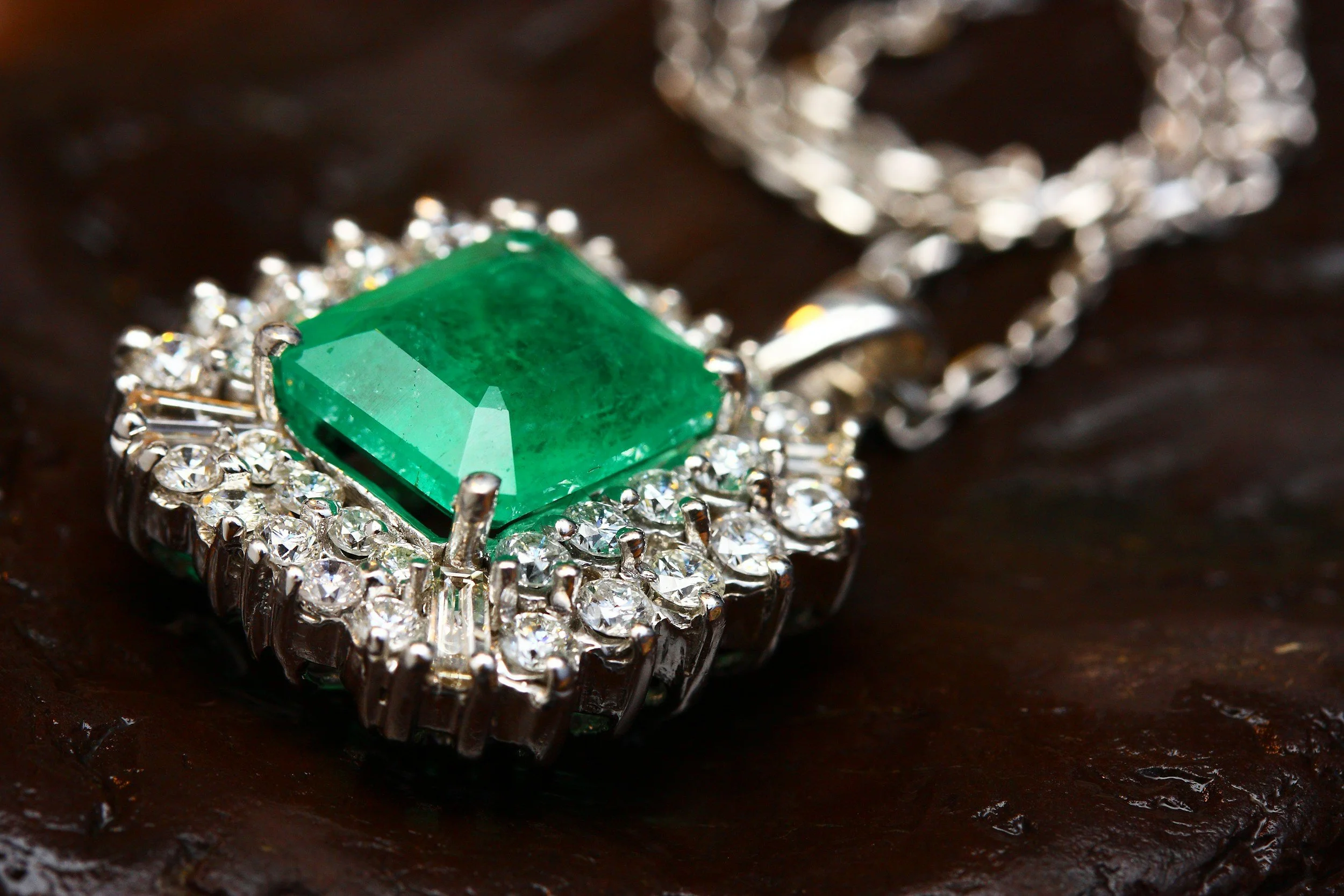
The same goes for inclusions. Not all of them affect durability equally. A feather buried safely within a gemstone may never cause a problem. A fracture reaching the surface is another story entirely, and understanding that difference can mean the gap between enjoying a piece for decades and facing avoidable repairs.
Sometimes the Right Stone Costs Less
People often assume a more expensive gemstone is automatically the better choice. That's rarely how I approach sourcing. If a client wants something quiet and understated, the largest available center stone may overwhelm the design. If someone lives an active lifestyle, a beautiful but fragile stone may not be the wisest recommendation. I've recommended smaller diamonds, different cuts, and lower-priced alternatives, not because they're cheaper, but because they're more truthful to the piece and the person wearing it. The goal isn't maximizing budget. It's maximizing meaning.
Beyond the Certificate
The Four Cs remain valuable. They're part of the conversation, just not the whole conversation. A gemstone is more than a set of measurable characteristics. It's a material that existed for millions of years before either of us ever saw it, and it deserves both technical discipline and human sensitivity.
My years in regulatory compliance taught me to verify what can be verified. Jewelry taught me that not everything that matters can be measured. The best commissions happen where those two worlds meet, where evidence satisfies the mind, beauty satisfies the eye, and meaning satisfies the heart. That's the point a gemstone stops being inventory and becomes irreplaceable.
If sourcing a gemstone for your own custom commission is something you're considering, I'd welcome that conversation.
What You Are Actually Paying For When You Commission a Custom Engagement Ring in NYC
What a custom engagement ring commission in NYC actually pays for with Gerard Rene, beyond the diamond: judgment, engineering, and a piece built to outlive the moment it was made for.
When You Commission a Ring from Gerard Rene, You're Not Buying Jewelry. You're Investing in Permanence.
A client arrives expecting to talk about diamonds. They have a Pinterest board full of inspiration photos, a rough budget in mind, and a handful of questions about carat weight or color grades. They assume we'll spend the next hour comparing gemstones.
There's a moment during almost every consultation when that expectation changes. Instead of talking stones, I ask a different question: why this ring? Not why this shape, or why this budget. Why this moment?
The answer is rarely about jewelry. It's usually about the person they're becoming.
A custom engagement ring has the potential to outlive everyone who first gave it meaning. Long after the flowers have wilted and the wedding venue has hosted a hundred other celebrations, the ring remains. Eventually, it may belong to a child or grandchild who never met the couple who first exchanged it.
That changes how I think about design. When you commission a ring from Gerard Rene, you're not simply buying a piece of jewelry. You're commissioning something that may become part of your family's visual language for generations, and that deserves more than shopping from a spreadsheet.
Beyond the Four Cs
The jewelry industry has done an exceptional job teaching consumers how to compare diamonds: cut, color, clarity, carat weight. Those characteristics matter, and they're useful for understanding a gemstone's physical qualities.
What they don't explain is why one ring stays with someone forever while another is eventually forgotten. A grading report can tell you how a diamond performs under laboratory conditions. It can't tell you whether the proportions feel harmonious on your hand, whether the design reflects your personality, or whether you'll still love looking at it thirty years from now.
Most importantly, it can't tell you whether the piece says anything meaningful about the life it represents.
Answering that question is the real starting point of custom design with Gerard Rene.
What I Actually Look At
When another jeweler shows me a finished piece, my eyes don't go straight to the center stone. I step back and look at the composition first: does the whole piece feel balanced, do the colors speak to one another, do the proportions create tension or harmony? I look at how the prongs interact with the geometry of the stone, whether they're simply holding the diamond in place or contributing to the architecture of the design.
Then I move closer. The engraving hidden inside the band. The finishing. The gallery beneath the stone. The transitions between one design element and another. Sometimes I find myself appreciating an ancient technique that's survived for centuries; other times I'm excited by a modern structural solution I haven't encountered before.
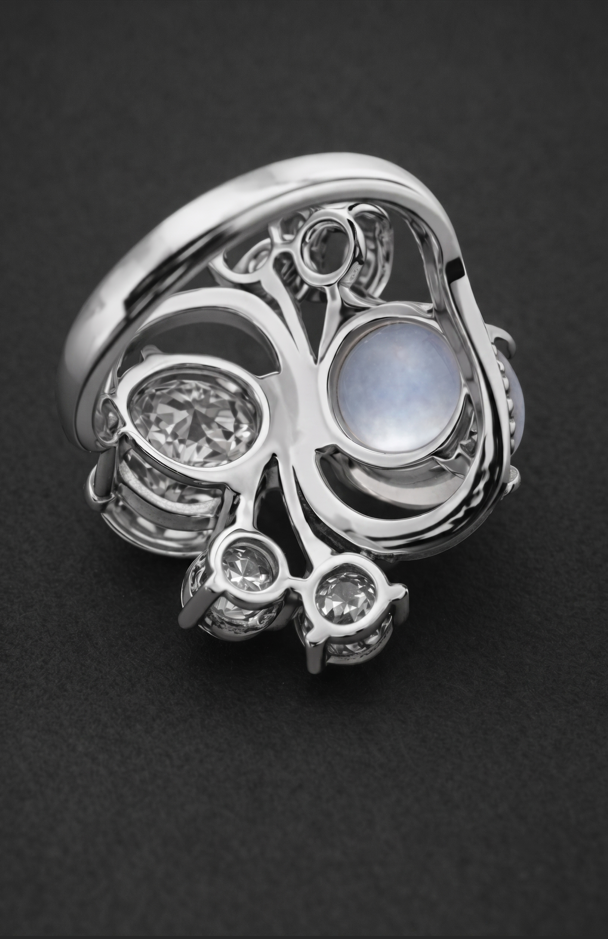
Underside detail of the Dreamwatcher one-of-one high jewelry ring, highlighting its sculptural gallery and handcrafted design.
When a gemstone is large enough, I often look for subtle inclusions, not because flaws are inherently undesirable, but because natural stones have personalities. Light moves differently through every crystal, and two diamonds with identical grading reports can feel completely different once they're in the hand. Jewelry is experienced with the eye, but it's remembered emotionally, and those two things aren't always measured the same way.
Engineering Is an Act of Love
Romance without structure doesn't last. Neither does jewelry.
Once a design moves from sketch to CAD and eventually to the workbench, my attention shifts almost entirely toward engineering: will this ring survive everyday life, will the stones stay secure, does the CAD preserve the original design intent or did something meaningful get lost in translation? Can someone wear this daily for decades without constantly worrying about repairs?
There are compromises I won't make. I don't design bands thinner than 2 millimeters. Thin bands have become fashionable because they make center stones appear larger, but they also wear down faster, bend more easily, and create structural problems over time. A ring shouldn't sacrifice longevity for a trend. Likewise, I avoid gemstones that aren't eye-clean unless that characteristic is intentionally part of the story we're telling. Every design decision should serve both beauty and permanence. If I know something is likely to fail, I won't build it just because it's popular. This same engineering discipline shapes our process from the first sketch to the final polish.
Sometimes the Best Advice Costs Me Money
People often assume custom jewelers are always trying to increase the final invoice. In reality, some of my favorite consultations end with clients spending less than they originally intended.
One gentleman came to me convinced he needed a three-carat diamond for his fiancée. Before we discussed stones, I asked about her: what was she like, how did she dress, what kind of jewelry did she already wear? He described someone petite, understated, and deeply minimalist. A three-carat round diamond would have dominated her hand; it would have reflected his expectations more than her personality.
I recommended something different instead: a one-carat oval, which naturally creates more visual coverage across the finger than a round of the same weight. She'd still have presence and elegance without sacrificing proportion. The recommendation reduced the cost significantly, and it also produced the better ring. My job isn't to sell the largest diamond available. It's to build the piece that's actually true to the person wearing it.
When Does Something Become Truly Custom?
This is probably where I disagree with much of the industry. Many people call a ring "custom" simply because it combines elements from a few inspiration photos. I'd call that customization, not custom.
A ring becomes truly custom when it answers a question only one person could ask. Maybe the center stone reminds someone of their grandmother. Maybe a flower represents where a proposal happened. Maybe an engraving quietly honors a child who changed everything, or the design carries a country, a faith, or a family history forward. Meaning is what turns decoration into authorship. Without that "why," you're just rearranging existing ideas.
A Ring That Could Only Exist for One Story
One of my favorite commissions came from a client from the Dominican Republic. He didn't ask me to build an extravagant ring. He asked me to tell a story: faith, forgiveness, healing, and his Taíno heritage, all within a single piece.
That request changed the design process from the start. I began researching Taíno history instead of browsing jewelry references, and discovered that Anacaona's name means "golden flower," which led me to the Rosa de Bayahíbe, the national flower of the Dominican Republic, found nowhere else on Earth. That flower became one side of the band. To honor the cacique Caonabo, I incorporated El Corral de los Indios on the opposite side. The central motif became an owl, an animal frequently depicted in Taíno cave art and tied to the spirit world and guardianship, with natural Larimar, the Dominican Republic's national gemstone, set as its eyes.
Every decision answered the same question: why. Nothing existed simply because it looked beautiful. Everything belonged. The finished piece became a conversation between history, identity, spirituality, and craftsmanship that no catalog could have produced. It's the kind of one-of-one, narrative-driven work you'll find throughout In Your Dreams.
What You're Really Paying For When You Commission Gerard Rene
When someone commissions a custom engagement ring from Gerard Rene, they're paying for far more than precious metal and gemstones. They're paying for judgment, for restraint, for engineering that protects future generations from preventable problems, and for someone willing to recommend the smaller diamond because it's the better choice. Mostly, they're paying for a process that begins with a person instead of a product.
People often assume I make jewelry. What I actually do is embed stories, memories, and identity into metal and stone. The jewelry is simply the medium.
I don't believe the value of a custom ring can ever be measured by its materials alone. The most enduring pieces are remembered not because they held the largest diamond, but because decades later, someone can still explain exactly why they were made.
Every Gerard Rene commission begins with one question: why. Everything else follows from there.
If you're ready to start that conversation, or simply want to understand what's possible, we'd welcome hearing your story.
Sometimes the Ring Doesn't Change. You Do.
Why an anniversary redesign isn't about a bigger stone, it's about a ring finally catching up to who you've become. The story behind a 10-carat NYC commission.
The Art of the Anniversary Redesign
There's a misconception that redesigning an engagement ring means rejecting the past. I don't see it that way. I think the opposite is often true.
The clients who come to me for a redesign usually aren't trying to erase a chapter of their lives. They're trying to understand how that chapter fits into the person they've become.
An engagement ring captures a moment in time, but the people who wear them don't stay frozen there. Careers evolve, families grow, priorities shift, and identity changes right along with them. If we allow ourselves to grow as people, why should we expect the objects we wear every day to tell only the story of who we used to be? A redesign isn't about abandoning history. It's about letting history keep speaking.
Jewelry Should Age With You
One question I ask most often during a redesign consultation is surprisingly simple: who were you when you first wore this ring?
Almost every client pauses. Then the stories begin. Some tell me they were twenty-three, just starting out and doing the best they could with what they had. Others describe a season shaped by uncertainty, where the original ring reflected financial limitations more than personal taste. I upgraded a ring last year for a client who got engaged to her husband back in college. They're both nurse practitioners now, and the redesign wasn't about the original ring being insufficient. It was about the two people who chose it becoming entirely different, more established versions of themselves, together. You can see the finished Clemence ring in full.
Others come to celebrate milestone anniversaries, not because the first ring wasn't enough, but because the marriage had become something richer than either of them could have imagined on their wedding day.
The catalyst is always different. The deeper reason rarely is: people want the objects closest to them to feel honest.
The Difference Between Redesign and Reinvention
There are times I tell clients not to redesign a piece, which usually surprises them. If the only reason for changing a ring is that social media convinced them it's outdated, that's not enough on its own. Trends have expiration dates. Meaning doesn't.
A redesign should never strip the soul out of the original piece just to make it look current. That doesn't mean an antique setting has to stay untouched. It means understanding what made the original meaningful before deciding what deserves to survive. Sometimes it's the center stone. Sometimes it's a hand engraving hidden inside the band, or simply the memory attached to the piece. My job isn't to preserve everything about a ring. It's to preserve what actually matters.
I Always Ask "Why?"
When someone places an heirloom on my desk, I rarely start by discussing metal or gemstones. Instead I ask what they love about the piece, what they remember when they look at it, and what they're actually afraid of losing. Those answers become the blueprint.
Clients often arrive convinced they need to preserve every physical detail. By the end of the conversation, they usually realize what they wanted to preserve all along was the feeling, not the setting. Once we identify the emotional center of a piece, the design becomes remarkably clear. This is exactly why every redesign begins with a real conversation as part of our process, not a straight-to-sketch approach.
A Consultation I'll Never Forget
One client came to me having outgrown a ring that no longer reflected the decade she and her husband had built together. She wanted her tenth anniversary marked in the piece itself: ten total carats, one for each year of marriage. We built the design around a 7.5-carat pear-shaped center stone, added roughly 2.5 carats across the band and matching ring jacket. The set could be worn together or separately depending on the day.
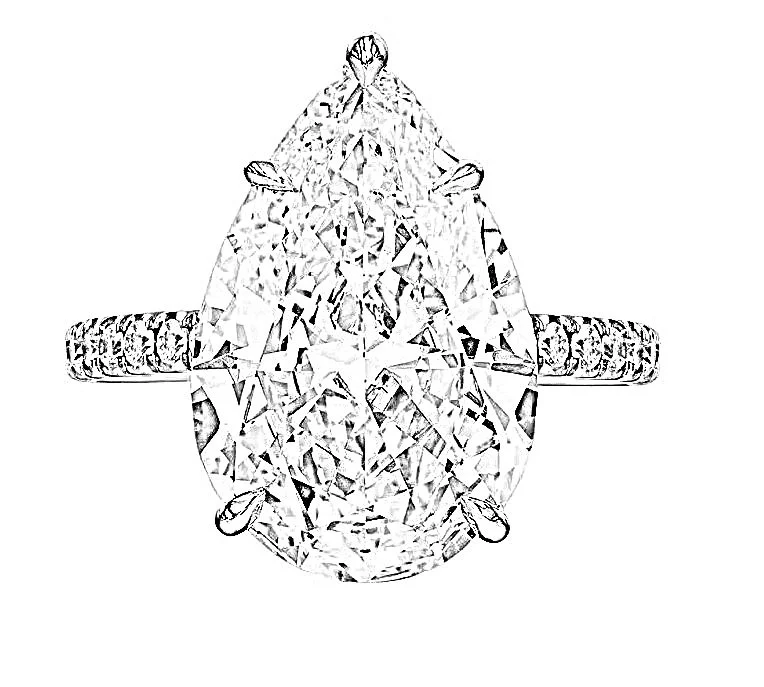
Before a finished piece exists, every commission begins as an idea. This early sketch explored the proportions, structure, and design language behind Karla’s 7-carat pear upgrade ring.
You can see the finished Karla ring set in full.
She described the process as consistent and attentive from the very first conversation: I asked about her vision before anything else, then revised renderings until each one matched exactly what she'd imagined. That ring set has since become one of the most requested looks on my site, not just for the carat count, but for what it actually represents: a decade, quantified in stone, worn every day since.
History Doesn't Have to Look Old
One of my favorite parts of a redesign is discovering how timeless certain ideas really are. Victorian engraving, Art Deco geometry, Edwardian elegance, organic botanical motifs: these aren't relics, they're design languages, and a language doesn't become obsolete just because time passes. It simply finds new ways to be spoken.
An heirloom can feel modern without losing its history. Sometimes that means changing yellow gold to platinum, or introducing rose gold to soften an otherwise formal design. Sometimes it means transforming a ring into a pendant worn close to the heart, or creating wedding bands from inherited gold so multiple family members can carry a shared legacy forward. The goal was never preservation for its own sake. It's continued life. Jewelry wasn't meant to spend decades inside a velvet box. It was meant to witness life.
The Ring Becomes Honest Again
One of the most rewarding parts of my work is watching someone put on a redesigned piece for the first time. There's usually a brief silence, then a smile, not because the ring is newer or larger, but because it finally feels like theirs.
The past hasn't disappeared. It's simply found a new voice. That's what a thoughtful redesign should accomplish: not replacement, not reinvention, but recognition. Recognition that the person you were deserves to be honored, and the person you've become deserves to be seen. The most meaningful pieces aren't the ones that stay physically unchanged. They're the ones that keep telling the truth, generation after generation.
Sometimes the ring doesn't change. You do. And sometimes the most respectful thing you can do is let your jewelry grow alongside you.
If you're sitting on a piece you love but no longer wear, that conversation is worth having.